
Introduction
The bedroom is the one room in your home that exists entirely for you — and no design philosophy honors that truth more completely than Japandi. The most transformative Japandi bedroom ideas strip away every unnecessary element and replace visual noise with deliberate calm, honest materials, and a quality of stillness that makes rest feel genuinely restorative. Whether you are starting from scratch or refining what you already have, these 20 Japandi bedroom ideas will show you exactly why the whole world is trying to sleep inside this aesthetic.
1. Low Platform Bed in Solid Walnut With Linen Bedding
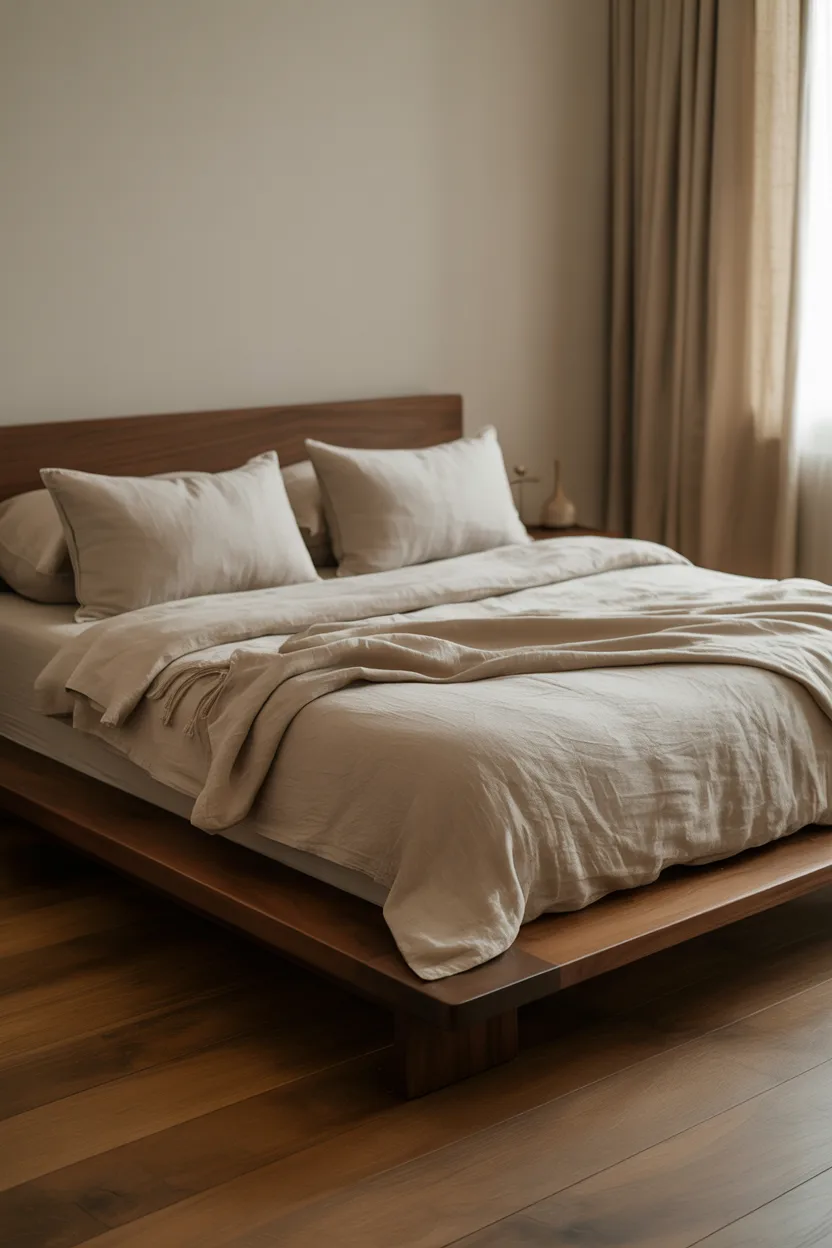
The low platform bed is the defining furniture piece of all Japandi bedroom ideas — its closeness to the floor creates a grounded, humble quality that is deeply rooted in Japanese domestic tradition, where sleeping at floor level connects the body to the earth and quiets the nervous system in ways that elevated bed frames cannot replicate. Solid walnut is the ideal material: its dark warmth adds visual weight without heaviness, and its grain becomes more beautiful with every year of use.
Undyed linen bedding in oatmeal tones is the Scandinavian counterpart to the Japanese bed form — honest fabric in its most natural state, chosen for breathability and longevity rather than decorative impact. The deliberately loose, unlabored way the bedding is arranged is itself a Japandi styling principle: not too precise, not too casual, but human and lived-in. Among all Japandi bedroom ideas, the platform bed in walnut with linen bedding is the foundation from which every other decision flows naturally.
2. Wabi-Sabi Plaster Walls in Warm Greige
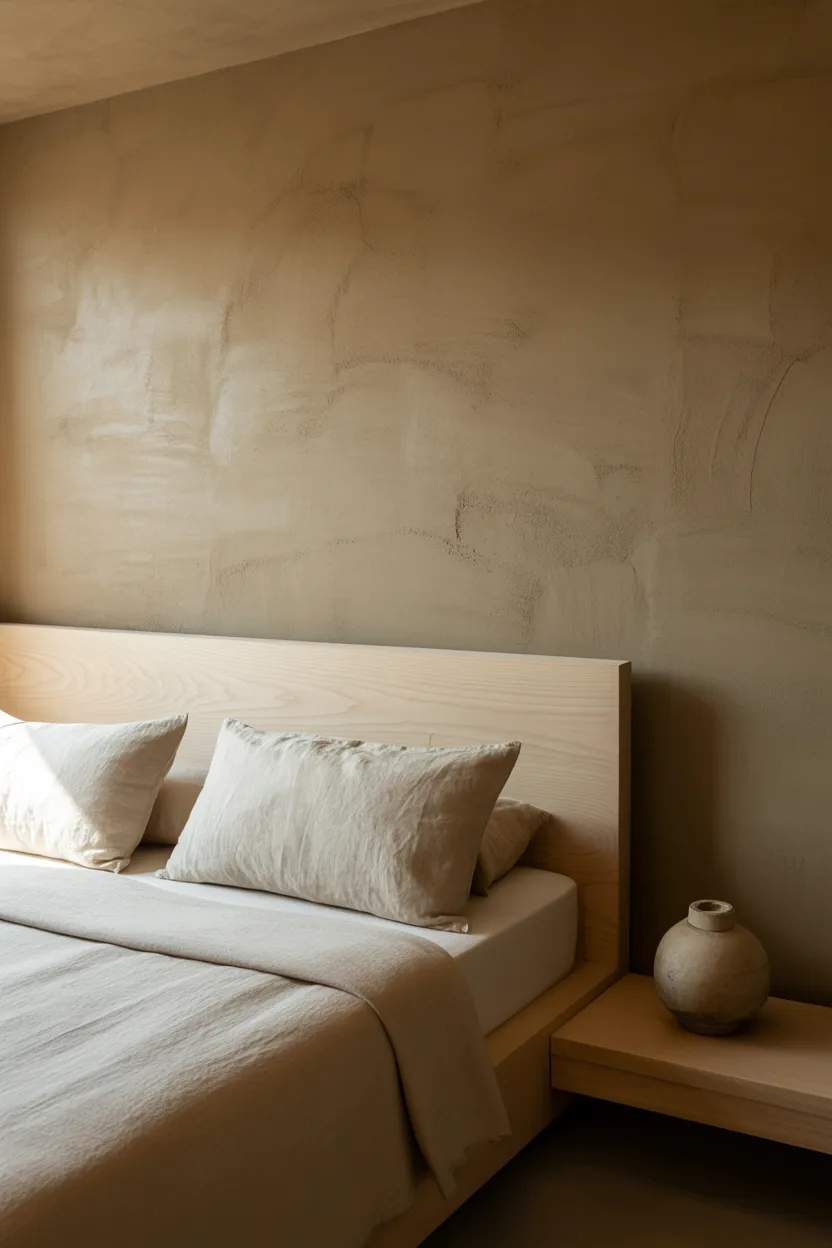
Wabi-sabi plaster walls are among the most authentic expressions of Japandi bedroom ideas because they embody the Japanese philosophy of finding beauty in imperfection and incompleteness. A hand-applied plaster finish celebrates every mark left by the plasterer’s tool — the slight ridges, the tonal shifts, the irregular surface that catches morning light differently than afternoon light. The wall becomes a living surface that changes throughout the day without any human intervention.
The warm greige tone — that nuanced blend of warm gray and beige — is the ideal Japandi bedroom neutral because it reads as pale in bright light and deeply warm in the low amber of evening lamps. Against this textured backdrop, pale ash furniture and cream linen appear luminous rather than flat. Among Japandi bedroom ideas, wabi-sabi plaster walls create the most irreplaceable atmosphere — one that no paint color, however carefully chosen, can fully replicate.
3. Japandi Bedroom With Shoji Screen Wardrobe Doors
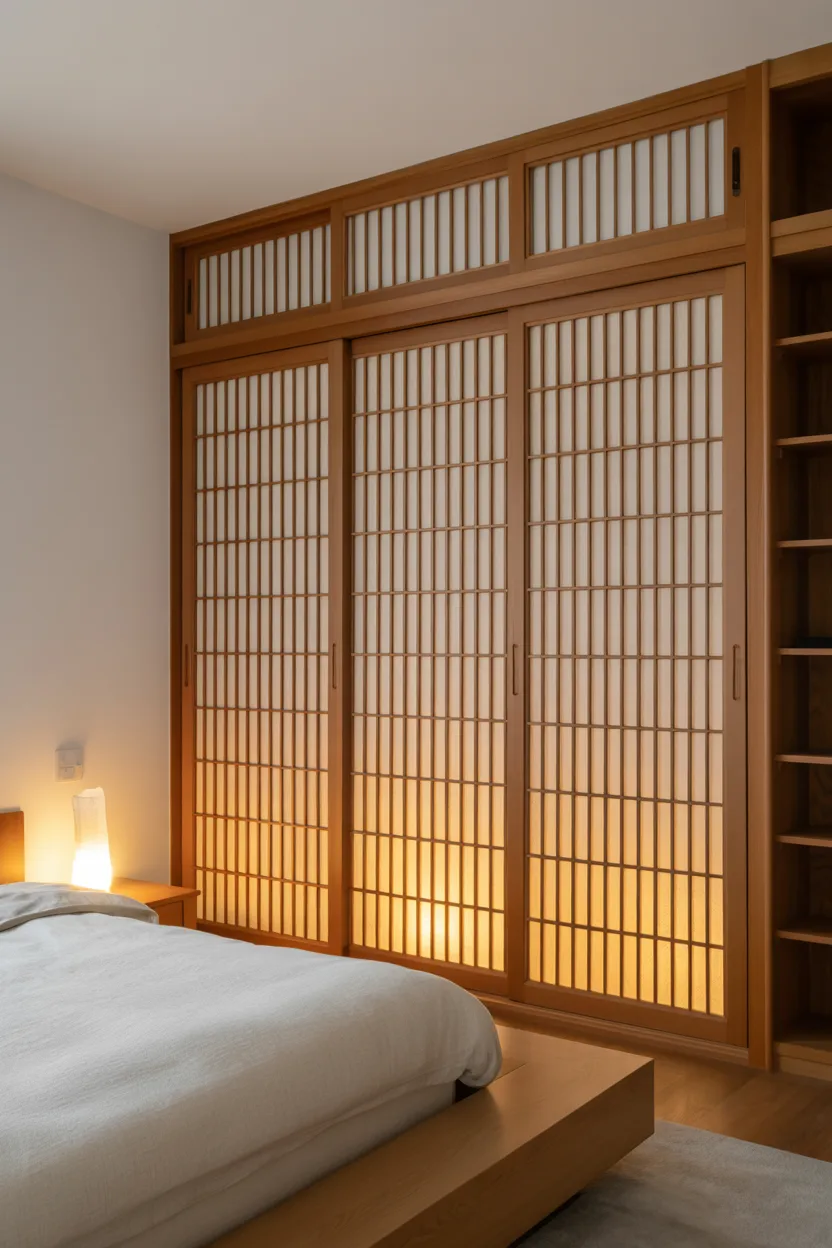
Shoji screen wardrobe doors are one of the most architecturally elegant Japandi bedroom ideas because they solve the visual problem of large wardrobe doors — which so often dominate and visually crowd a bedroom — with a material that is simultaneously practical and beautiful. Sliding shoji screens in a slim white oak frame with rice paper panels replace the reflective glare of mirrored sliding doors with a soft, translucent surface that diffuses light rather than bouncing it back.
When the wardrobe interior has a small LED light installed, the rice paper panels glow from within like a tall standing lantern — a beautiful, warm presence in the bedroom that functions as ambient lighting rather than requiring a separate lamp. The slim oak frame adds natural wood warmth to the bedroom without the visual mass of conventional wardrobe furniture. These Japandi bedroom ideas make the most utilitarian piece of bedroom furniture the most beautiful one.
4. Neutral Japandi Bedroom in Cream, Oatmeal, and Pale Oak
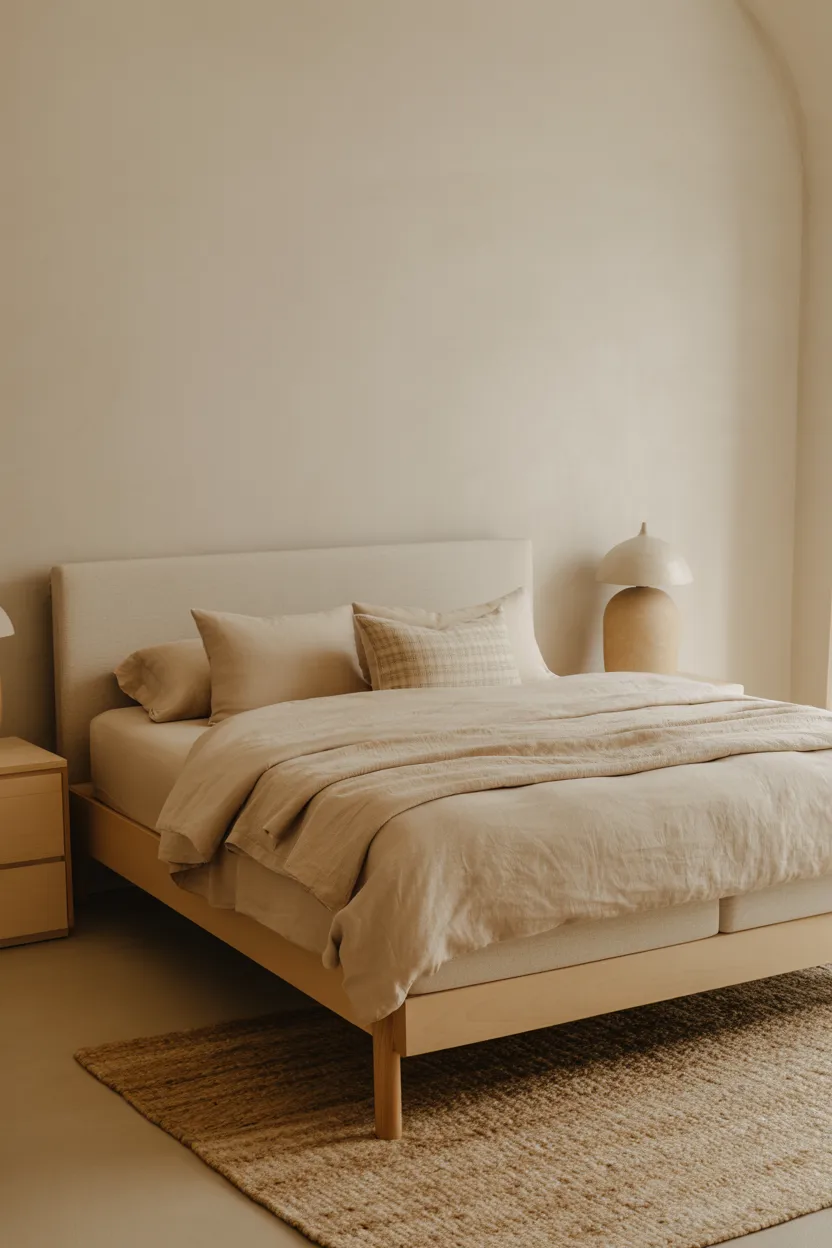
The all-warm-neutral Japandi bedroom palette is the color philosophy that makes the most immediately successful Japandi bedroom ideas — every tone from the warmest pale oak to the quietest oatmeal linen belongs to the same family of natural, unhurried colors that the eye finds genuinely restful. There are no cool undertones to introduce tension, no stark whites to feel clinical — only the gentle tonal gradation of materials in their most honest, un-dyed state.
Achieving this palette requires discipline in rejecting anything with a cool or blue undertone: warm white walls rather than cool white, oatmeal wool rather than silver gray, pale ash rather than bleached white wood. This consistent tonal warmth creates a bedroom that feels as though it grew from the earth rather than being assembled — a room where every surface contributes to the same calm frequency. Among Japandi bedroom ideas, the all-warm-neutral palette is the most universally livable and the most quietly beautiful over long periods.
5. Japandi Bedroom With Handmade Ceramic Bedside Lamp
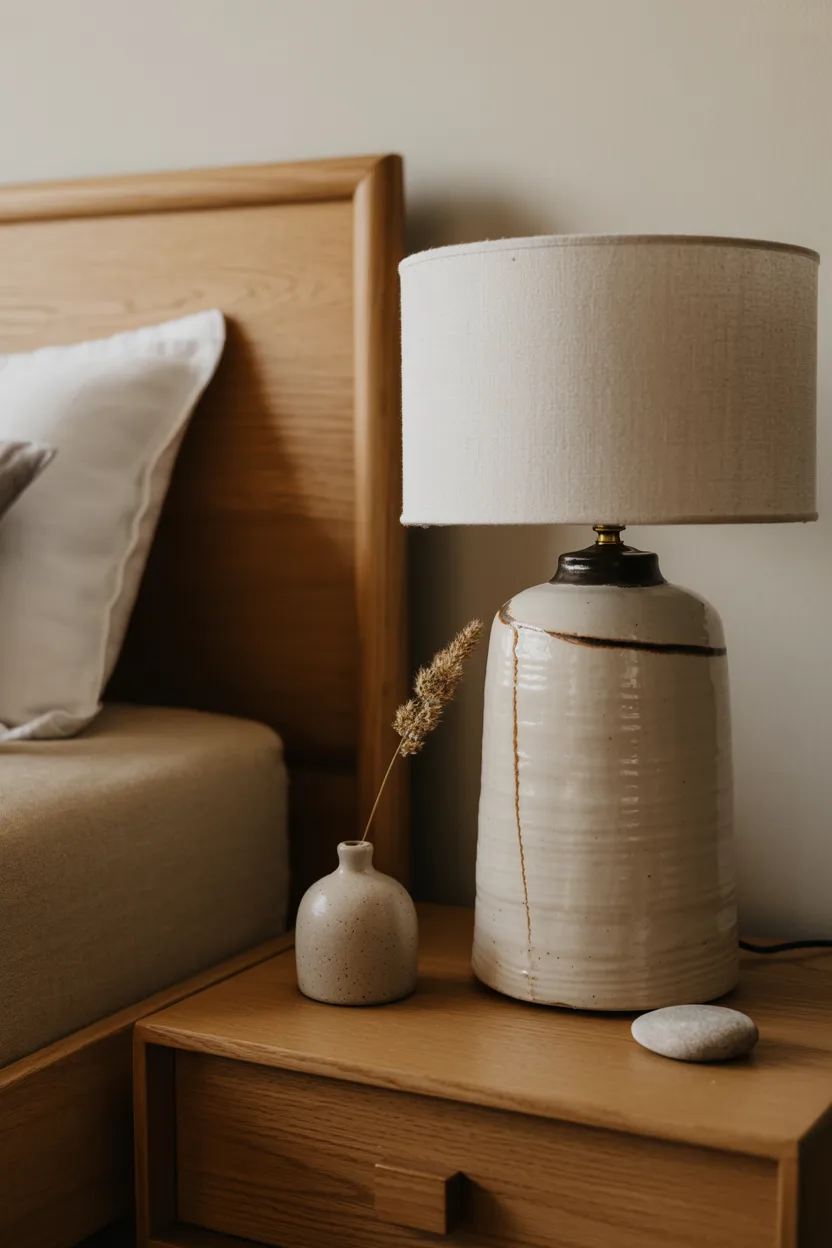
A handmade ceramic lamp is the bedside object that most precisely communicates the philosophy behind Japandi bedroom ideas — the Japanese reverence for objects made by a skilled human hand, showing the evidence of that making in every slight irregularity of form and variation in glaze. A wheel-thrown lamp base in warm matte white with visible throwing marks is more beautiful and more meaningful than any factory-produced lamp, and the linen drum shade it wears is its Scandinavian partner — functional, natural, honest.
The bedside vignette it anchors — one dried grass stem, one smooth river stone — follows the Japanese principle of extreme selective curation: three objects total, each chosen for its individual beauty and its contribution to the group composition. The smooth stone provides weight and earthiness, the dried stem provides height and organic movement, the lamp provides light and warmth. Together these three objects make a bedside arrangement of extraordinary quiet sophistication. These Japandi bedroom ideas find their soul in the beauty of things made by hand.
Visit more https://www.pinterest.com/Dreamgardenshome/
6. Japandi Bedroom With Floor-Level Futon and Tatami Mat
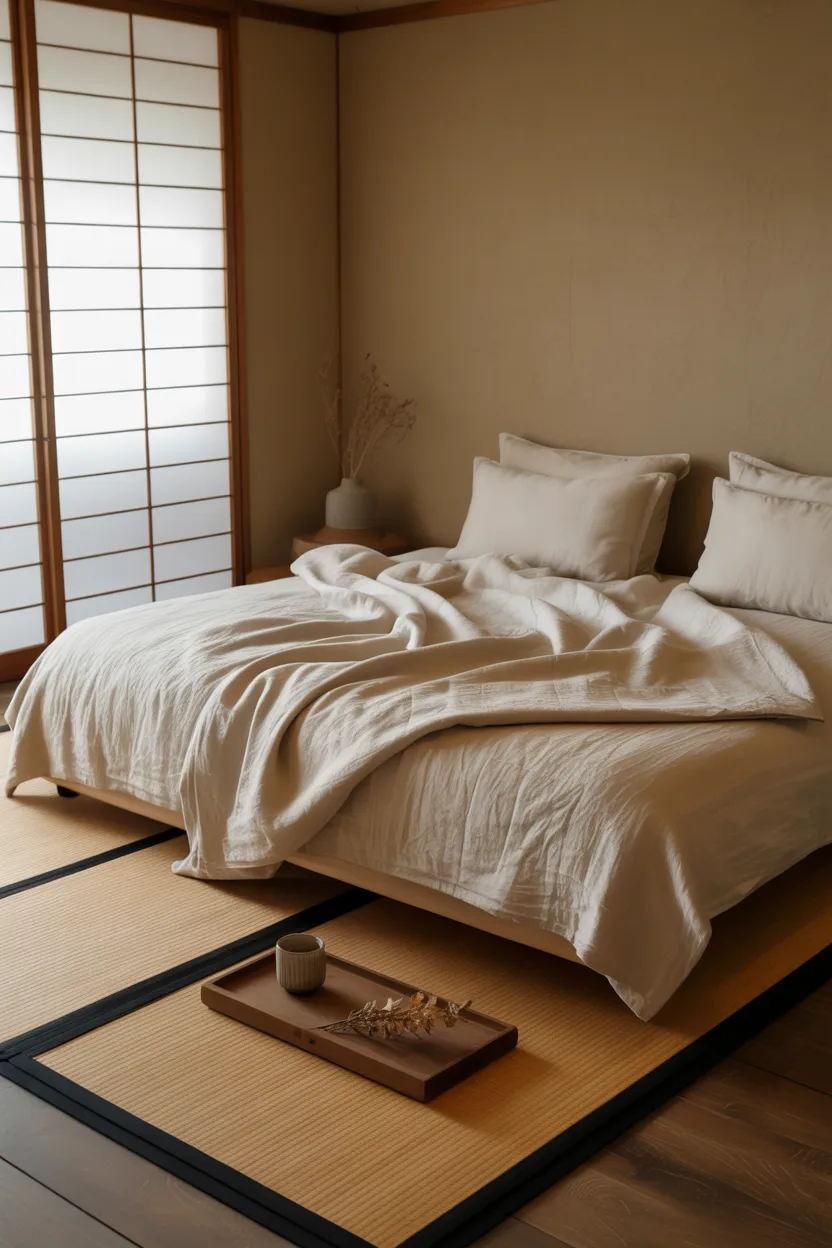
Floor-level futon sleeping is the most authentically Japanese of all Japandi bedroom ideas — and the most profoundly different from Western sleeping conventions. Laying a shikibuton futon directly on tatami mats eliminates the bed frame entirely, bringing the sleeping body into the closest possible contact with the floor and creating a sense of grounded calm that no elevated mattress can replicate. The tatami mat itself adds a natural woven texture underfoot and an earthy fragrance to the room.
The low wooden tray beside the futon serves as a bedside table at floor level — holding only what is genuinely needed for sleep: a cup of water or tea, a small dried botanical for fragrance, perhaps a slim book. Nothing superfluous, nothing stored for convenience. In the morning, the futon can be rolled and stored, returning the room to an open, breathable space. These Japandi bedroom ideas treat the act of sleeping as a ritual worthy of careful, considered design.
7. Dark Japandi Bedroom With Charcoal Walls and Warm Timber
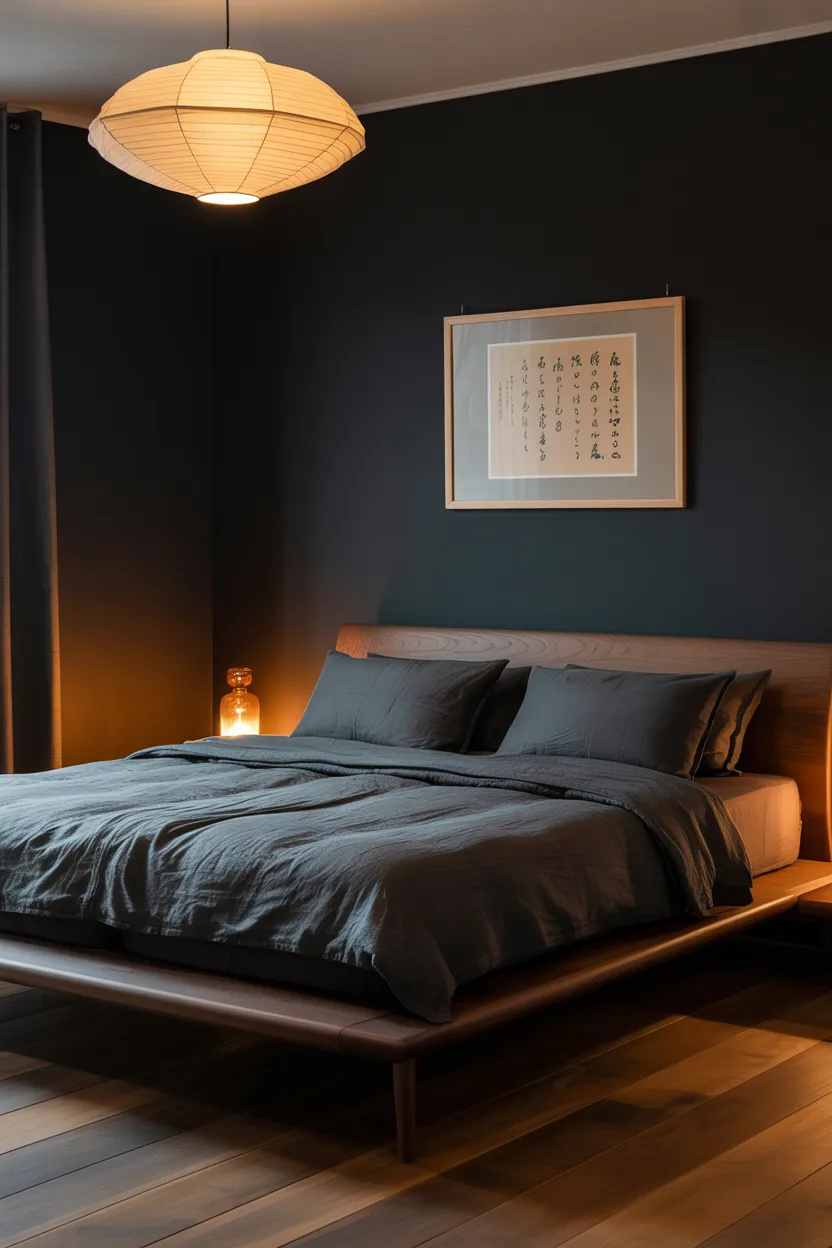
Dark Japandi is one of the most compelling and most misunderstood variations of Japandi bedroom ideas — the assumption that Japandi must be pale and light-filled is a misreading of its principles. Japandi is defined by material honesty, restraint, and intentionality — all of which can be expressed equally powerfully on a dark ground. Deep charcoal walls create a bedroom that feels cave-like in the best sense: enclosed, safe, and deeply conducive to the surrender of sleep.
Against charcoal walls, warm honey oak flooring and walnut furniture glow with an extraordinary richness they might not achieve against paler backgrounds. The paper pendant lamp becomes a moon in the dark room — its warm, diffuse light creating a soft sphere of illumination above the bed that is as beautiful to look at as it is gentle to sleep under. Japanese calligraphy on the dark wall adds cultural depth and artistic restraint simultaneously. Among Japandi bedroom ideas, the dark palette variation is the most dramatic and the most deeply restorative.
8. Japandi Bedroom With Exposed Wooden Ceiling Beams
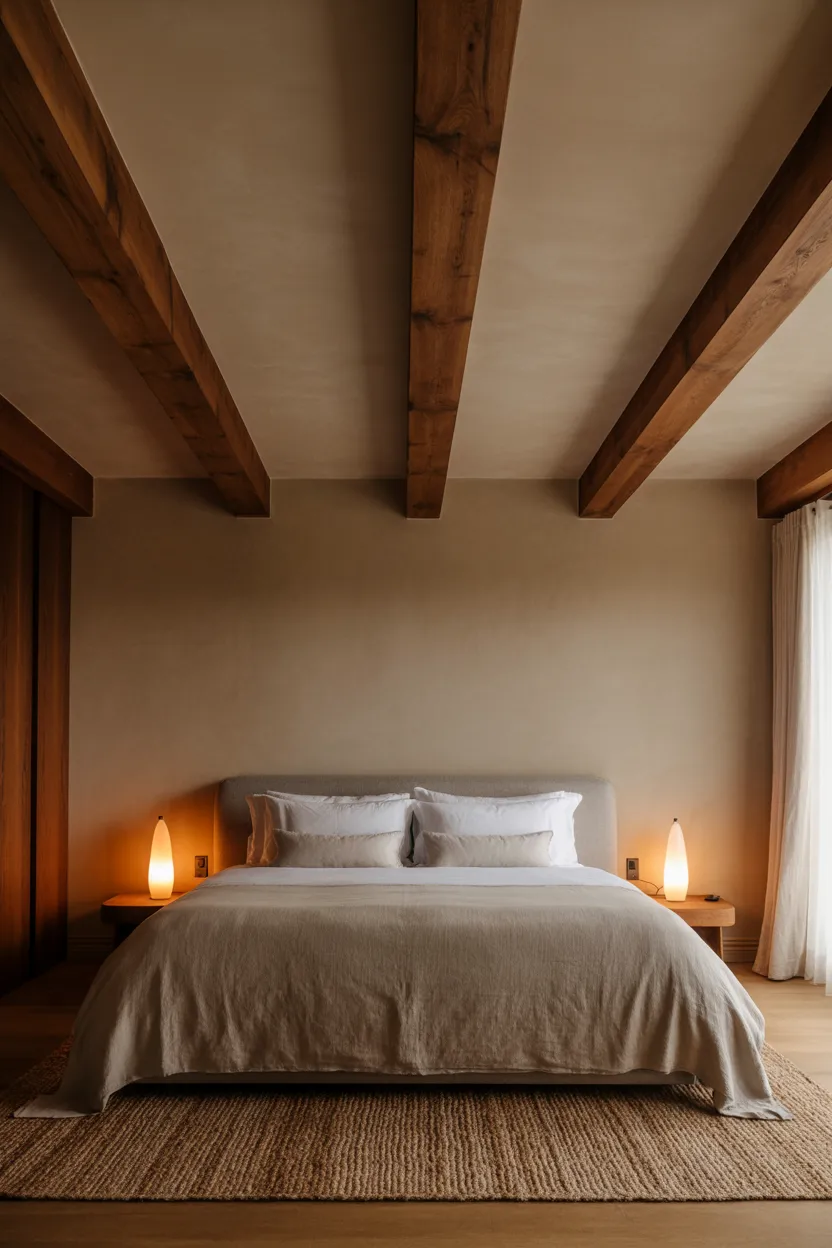
Exposed wooden ceiling beams carry the Japandi bedroom into a register of architectural permanence that cosmetic design choices simply cannot reach. The dark oak beams against a pale plaster ceiling satisfy both design traditions simultaneously — the Japanese admiration for visible structural honesty, where nothing is hidden behind false ceilings, and the Scandinavian appreciation for natural wood in its most elemental, unadorned form. The beams make the bedroom feel genuinely old even in a new building.
For Japandi bedroom ideas that incorporate ceiling beams, the furniture below should have enough visual weight to stand in proportion to the structural elements above — a substantial low linen bed, a solid wool rug, ceramic lamps with physical presence. Lightweight or insubstantial furniture looks lost beneath heavy beams. When the balance between architectural ceiling elements and grounded floor furniture is achieved, the bedroom becomes one of the most naturally beautiful rooms imaginable.
9. Japandi Bedroom With Bamboo Blind Window Treatment
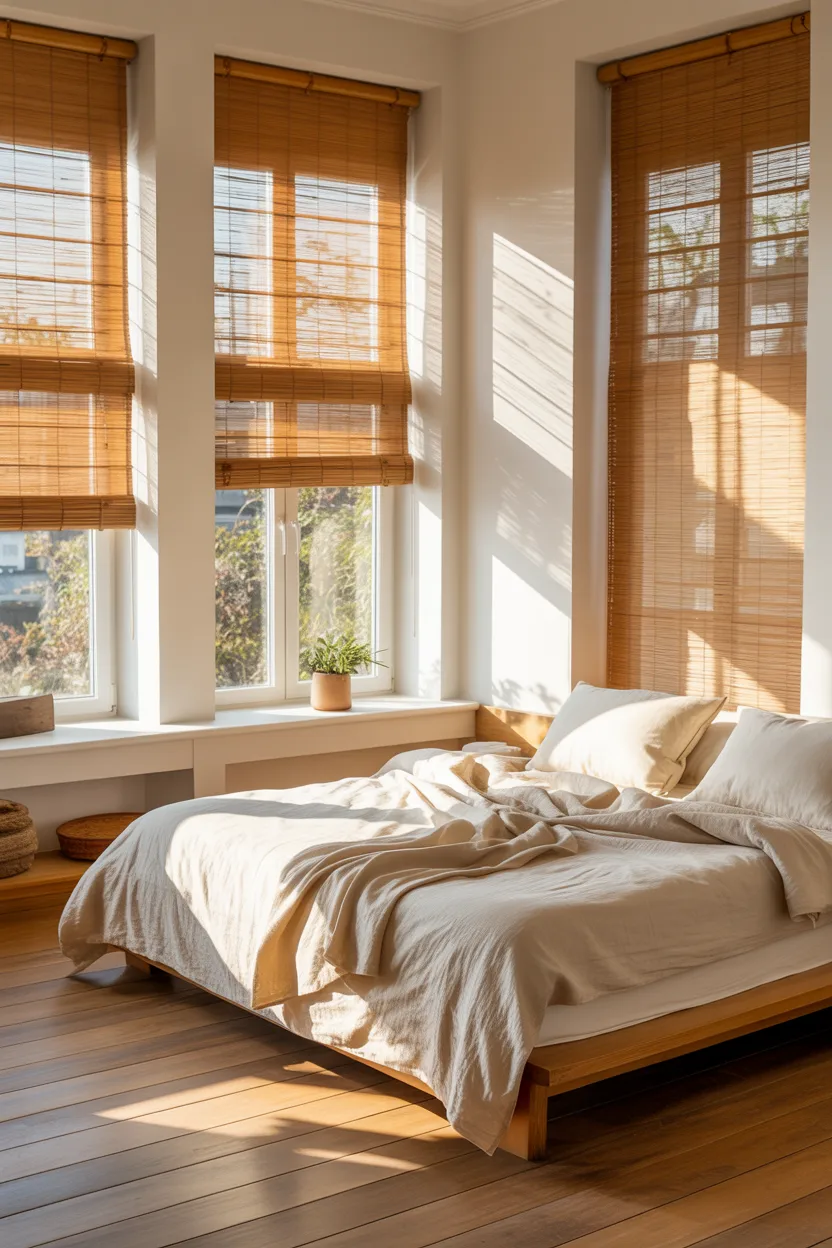
Natural bamboo roll blinds are the window treatment most organically suited to Japandi bedroom ideas because they satisfy every Japandi material principle simultaneously: they are natural, sustainable, honestly textured, warm in tone, and extraordinarily beautiful in the way they filter light. Unlike linen curtains that diffuse light evenly, bamboo blinds create a pattern of warm amber light and shadow across the room’s surfaces — a moving, changing quality that makes the morning light itself a design element.
Rolling the blinds to different heights on each window introduces a deliberate informality — one fully raised, one at mid-height — that prevents the room from feeling rigidly symmetrical or styled. This slight irregularity honors the wabi-sabi principle within Japandi bedroom ideas: the beauty of things that are not quite perfect, not quite matched, but deeply honest in their variation. The warm amber light through bamboo at dawn is one of the most beautiful morning experiences a bedroom can offer.
10. Japandi Bedroom With Minimalist Floating Shelf Bedside
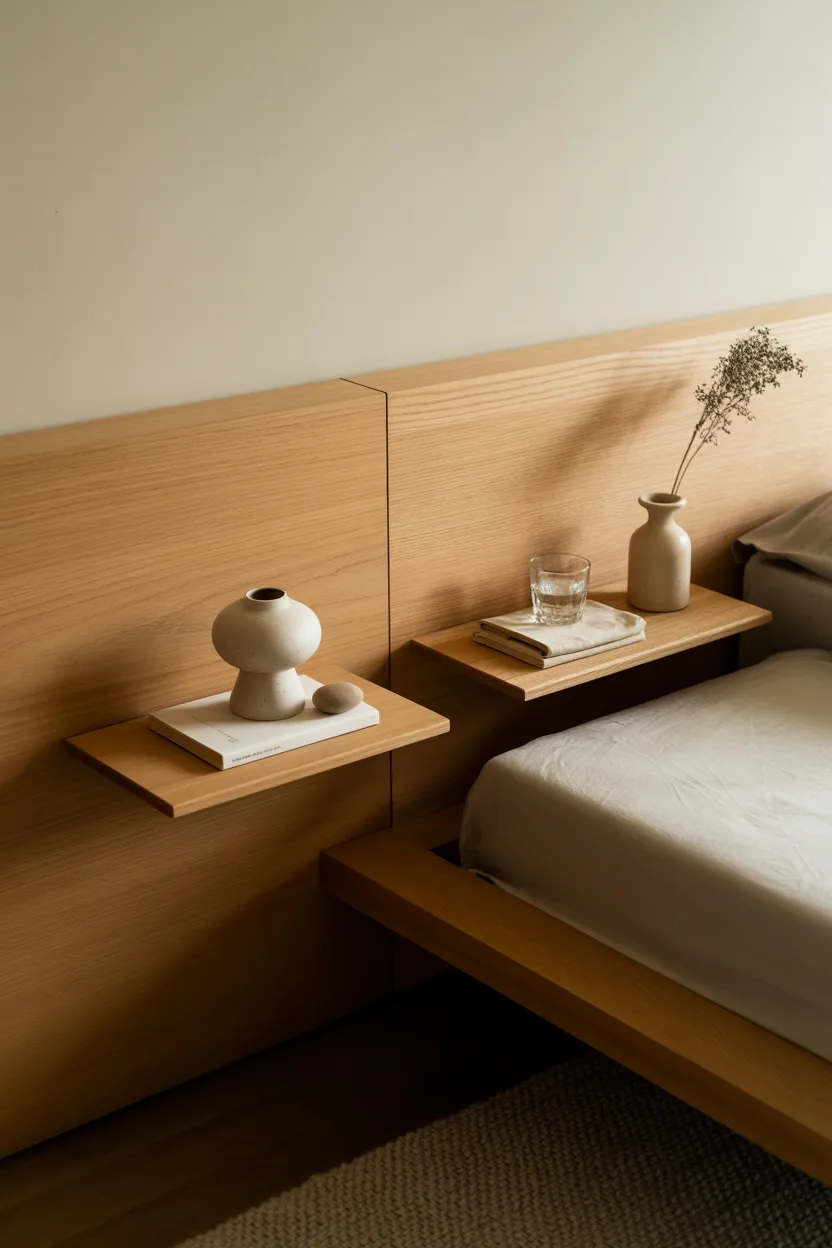
Floating shelf bedside tables are one of the most space-efficient and visually clean of all Japandi bedroom ideas — they replace the visual mass of conventional bedside furniture with two slim oak shelves that appear to grow directly from the wall, holding only what is genuinely needed for sleeping and waking. The absence of bedside table legs keeps the floor plane completely clear, making the bedroom feel more spacious and the platform bed more grounded.
The three-object rule applied to each floating shelf — never more than three items, each one chosen for beauty or necessity — is the styling discipline that makes this approach work. Lamp, book, stone. Vase, cloth, glass. These small collections have a haiku-like completeness: nothing missing, nothing superfluous. When both sides of the bed follow this restrained styling logic, the bedroom achieves a symmetrical calm that is deeply conducive to sleep. Among Japandi bedroom ideas, the floating shelf bedside is the detail that most impresses design-literate guests.
11. Japandi Bedroom With Vertical Wood Slat Headboard Wall
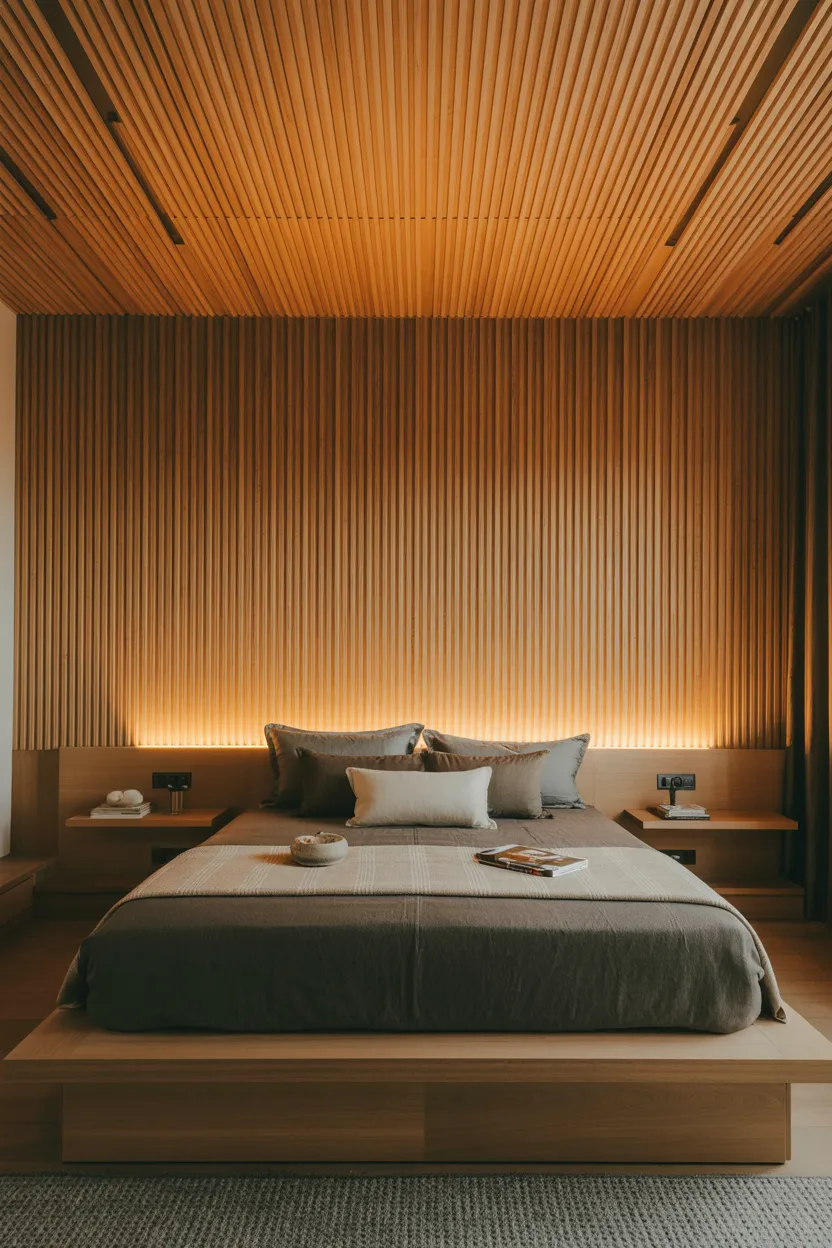
A vertical wood slat headboard wall is the feature that has made Japandi bedroom ideas images go viral across Pinterest and Instagram — its combination of natural wood warmth, architectural precision, and visual rhythm creates a bedroom focal point of extraordinary beauty that satisfies both the Japanese love of crafted wood detail and the Scandinavian commitment to functional aesthetics that earn their presence through genuine material quality.
The warm honey oak of the slats glows against a dark or neutral wall in the evening when the recessed LED strip behind the panels creates a soft backlighting effect — the slats appear to float, each one outlined in warm amber light. This transformation from daytime architectural feature to evening glowing artwork makes the slat wall one of the most dramatically rewarding of all Japandi bedroom ideas. It is the detail that makes every other choice in the bedroom look better simply by being present.
12. Japandi Bedroom With Single Piece of Japanese Artwork
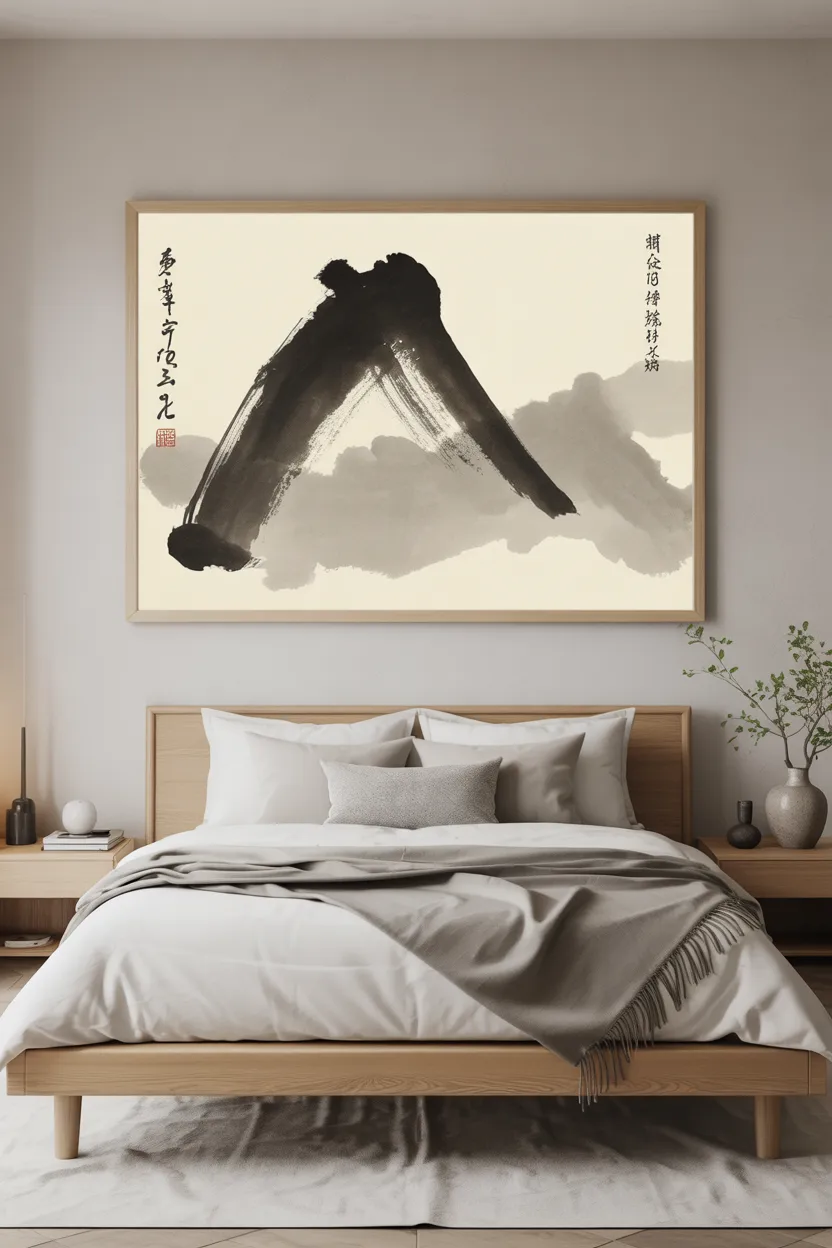
A single piece of Japanese artwork given an entire wall is the most culturally authentic and most visually powerful of all Japandi bedroom ideas — it embodies the Japanese aesthetic principle of ma, the deliberate use of empty space to give a single object its full meaning and impact. A sumi-e ink painting of a mountain, a brushstroke landscape, or a single calligraphic character carries centuries of artistic tradition into the bedroom without any need for supporting decoration.
The pale oak frame is as deliberate as the artwork it contains — it introduces the room’s natural wood material language into the display rather than interrupting the Japandi palette with an ornate or contrasting frame. The wall surrounding the painting should remain completely and unapologetically empty, giving the artwork the silence it needs to speak fully to whoever wakes beneath it each morning. Among Japandi bedroom ideas, the single artwork approach is the most demanding in its confidence requirements and the most rewarding in its daily impact.
13. Japandi Bedroom With Organic Cotton and Linen Layered Bedding

Layered natural bedding is the Japandi bedroom ideas approach to the bed itself — treating the sleeping surface not as a styled display but as a sensory experience built from the most honest, natural textiles available. Organic cotton, undyed linen, and waffle-weave cotton each bring a different tactile quality to the bed: the smoothness of cotton against skin, the slightly rough warmth of linen that softens with washing, the dimensional texture of waffle weave that adds visual interest without pattern.
The tonal layering — each textile a slightly different natural tone from warm white to oatmeal to pale sand — creates depth without color, richness without decoration. This is the Japandi bedding philosophy in its most complete form: every material chosen for how it feels against the body and how it looks in natural morning light, not for how it photographs in a styled shoot. Among Japandi bedroom ideas, naturally layered bedding creates the most genuinely restful sleeping environment.
14. Japandi Bedroom With Indoor Bonsai or Branch Display
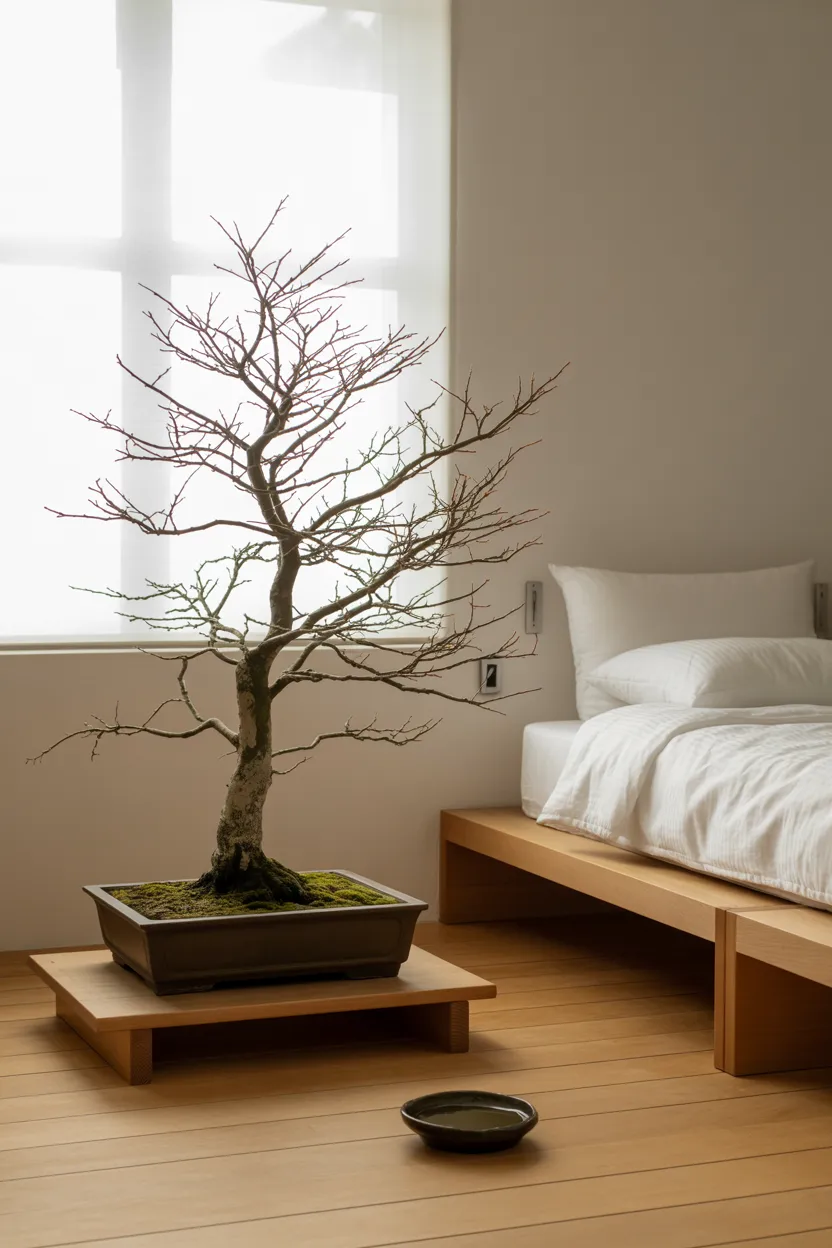
A living bonsai tree in the bedroom is the most quietly revolutionary of Japandi bedroom ideas because it introduces a living, breathing, slowly changing presence into the sleeping space that transforms the room’s quality of stillness from passive to active. Waking each morning to the sight of a carefully tended bonsai maple — its patient, shaped branching, its seasonal color changes, its evidence of years of devoted attention — connects the sleeper to something larger than design.
The bonsai is not a decoration; it is a commitment. It requires daily observation, careful watering, seasonal pruning, and the patience to watch something become more beautiful over years rather than immediately. Placing it in the bedroom rather than a more public room makes this a private relationship between the occupant and the living work. These Japandi bedroom ideas understand that the most beautiful objects in a room are sometimes the ones that are still growing.
15. Japandi Bedroom With Linen Curtains Pooling on the Floor
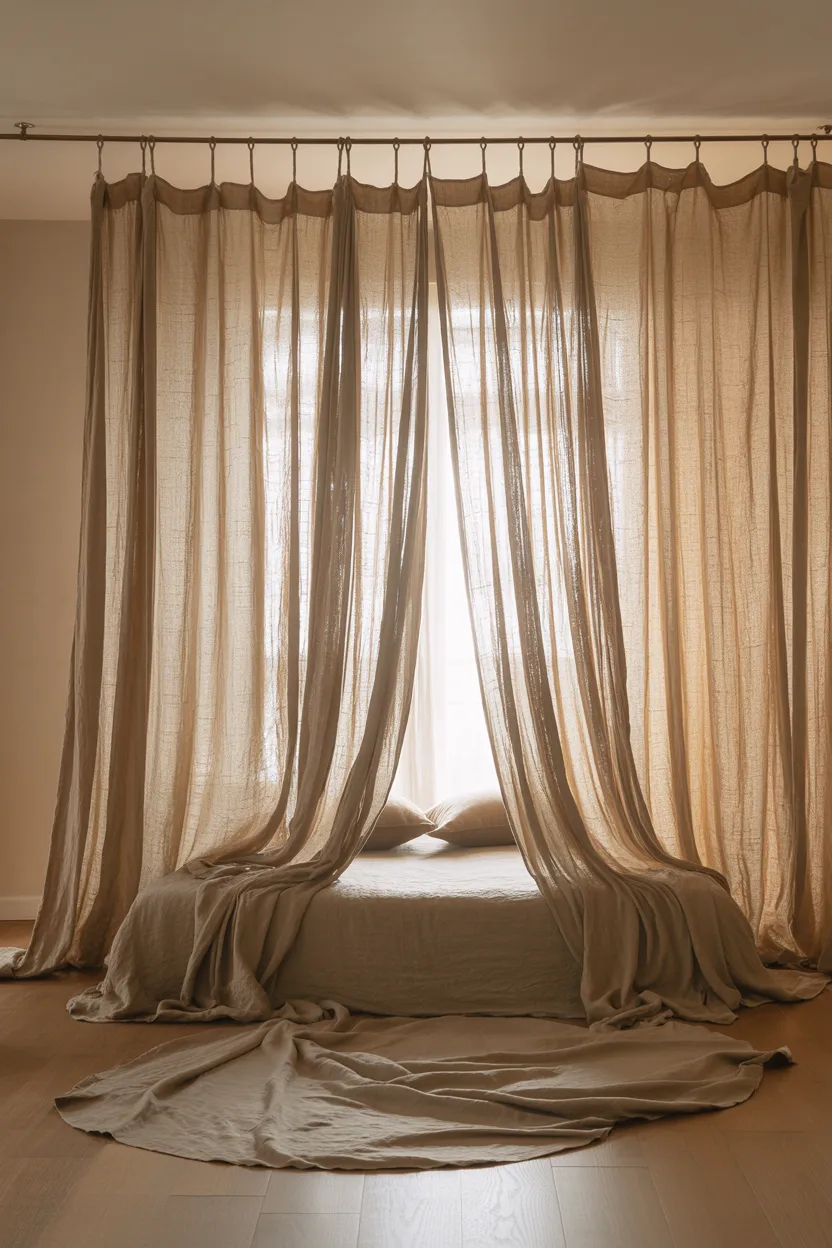
Linen curtains that pool on the floor are the textile detail in Japandi bedroom ideas that introduces softness, movement, and a quiet romanticism without compromising the aesthetic’s fundamental restraint. The pooling of excess fabric on the floor — typically six to twelve inches of material gathering naturally — signals an intentional generosity with the fabric rather than a careless cutting error, and that generosity reads as confident, considered, and beautifully relaxed all at once.
The quality of light that enters through an undyed linen curtain is unlike any other window treatment in its warmth and organic diffusion — it is the light of a Japanese paper lantern rather than the light of a bare window, filtering the directional brightness of the sun into something soft enough to wake gently into each morning. The black iron rod provides a single dark note that grounds the entire pale palette. Among Japandi bedroom ideas, pooling linen curtains make the largest change to a bedroom’s atmosphere for the simplest material investment.
16. Japandi Bedroom With Woven Wool Rug as the Room’s Foundation
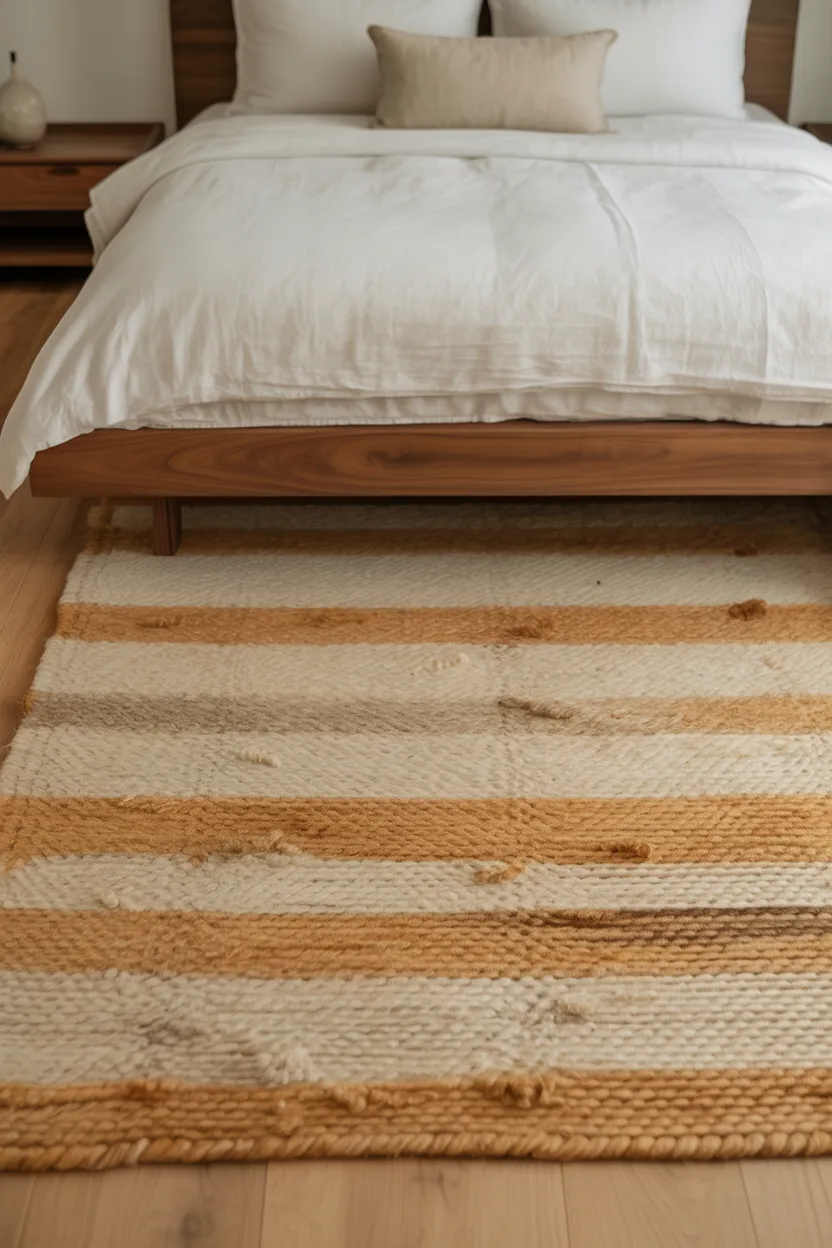
The hand-knotted wool rug as the bedroom’s founding material decision is one of the most enduring and most rewarding Japandi bedroom ideas because it sets the tactile, thermal, and visual tone for everything placed above it. A rug large enough for the platform bed and both bedside areas to sit comfortably within its borders unifies the sleeping zone into a single composed territory — the bed, the bedside shelves, the morning routine all happen within this defined, warm, textural world.
Natural undyed wool in cream and warm sand tones is the Japandi rug palette: no artificial color, no pattern beyond the subtle irregularity of the knotting itself, no visual noise to disturb the room’s quiet. The slight tactile irregularity of hand-knotting — where no two sections are perfectly identical — is a wabi-sabi quality that makes the rug more beautiful on close inspection than it appears from across the room. These Japandi bedroom ideas find their warmest, most grounded quality in the choice of what lies beneath the feet.
17. Japandi Bedroom With Integrated Wooden Wardrobe and Open Shelf
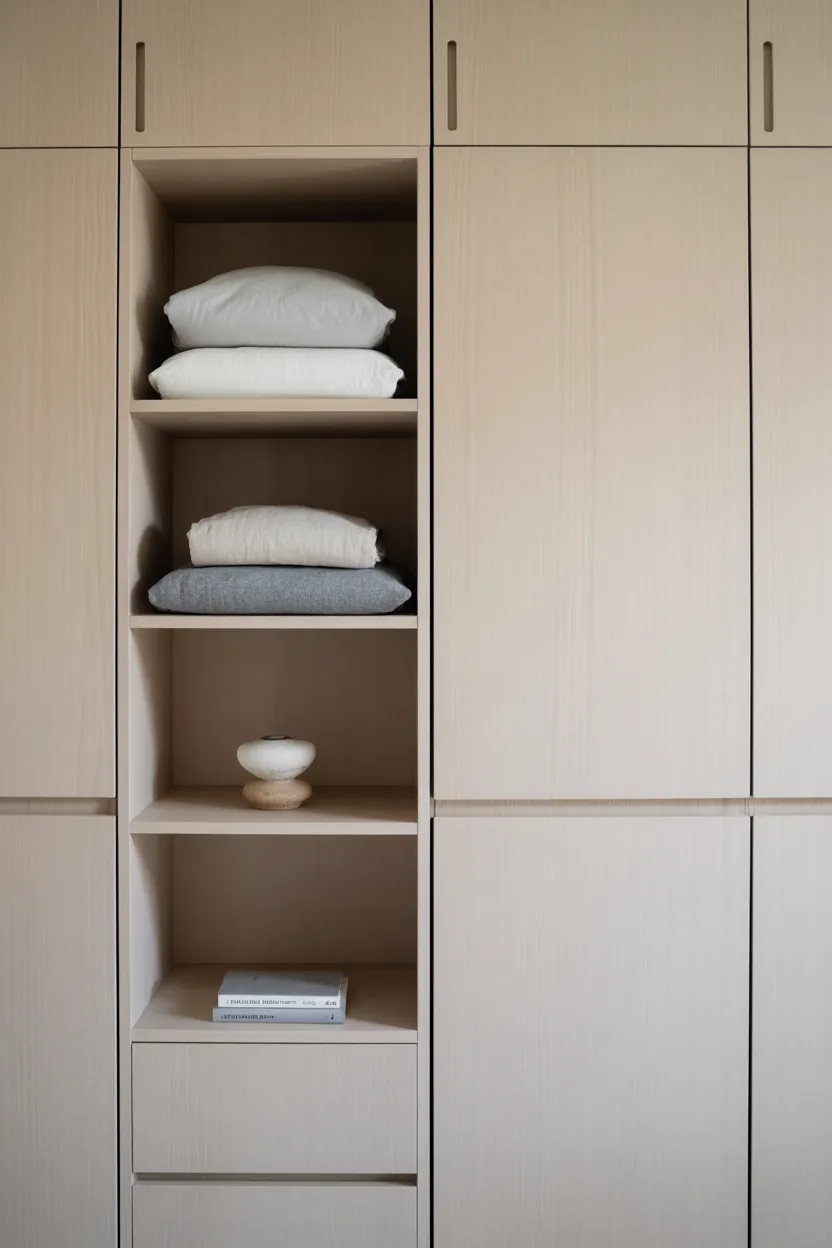
Integrated wardrobes in solid pale ash with flush flat-front doors are the storage solution that makes Japandi bedroom ideas look professionally designed — they hide the visual complexity of clothing and personal items behind a surface so clean and material-consistent that the wardrobe wall reads as architecture rather than furniture. The absence of visible handles, replaced by a routed integrated grip, removes the last visual interruption from the wardrobe face.
The one open shelving section within the integrated wall provides the human moment — a small ceramic, folded linens in warm natural tones, two carefully chosen books — that prevents the storage wall from feeling entirely closed and clinical. This single open section is the room’s breathing aperture, the space where personal identity is allowed to be gently visible within the larger context of organized restraint. Among Japandi bedroom ideas, the integrated ash wardrobe wall is the storage investment that most completely transforms a bedroom’s visual calm.
18. Japandi Bedroom With Paper Pendant Lamp as the Only Light Source
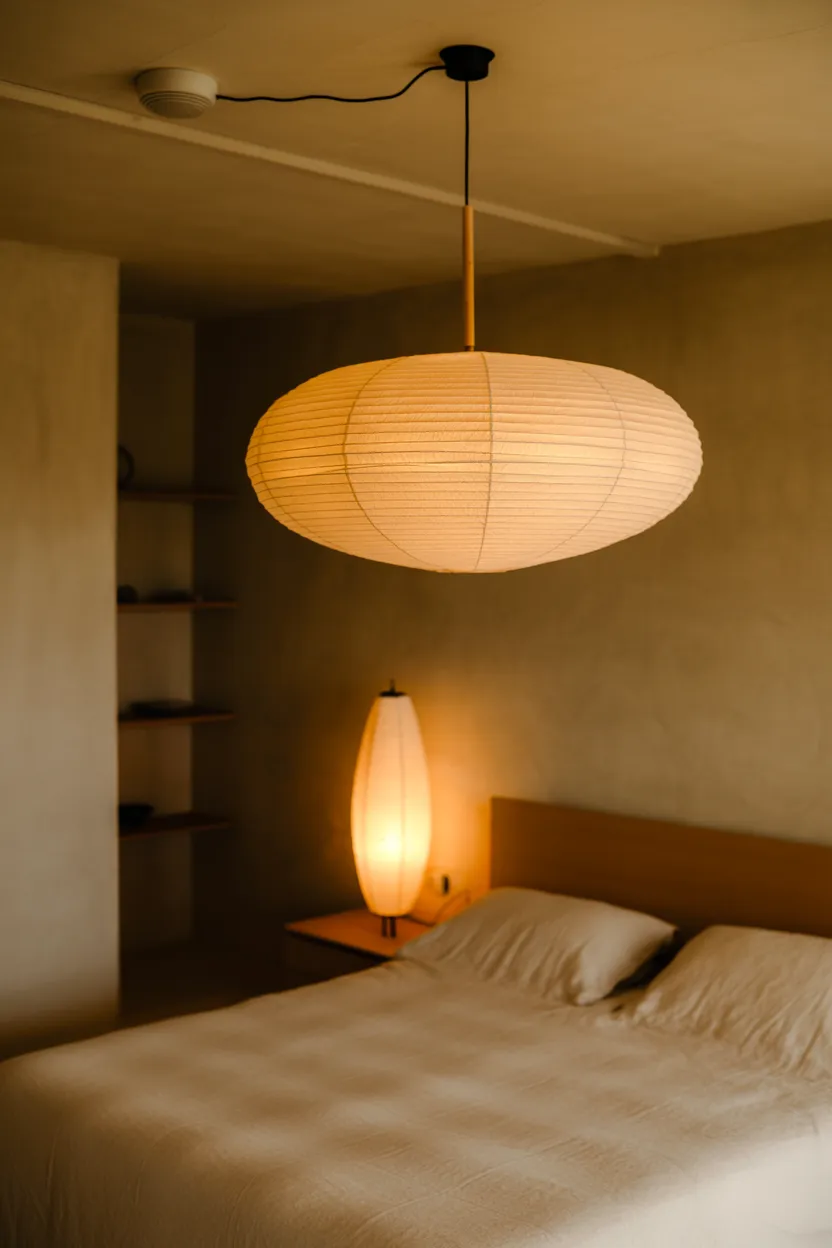
A single paper pendant lamp as the sole light source is among the most committed and most beautiful of Japandi bedroom ideas — it requires the discipline to resist the conventional wisdom of layered bedroom lighting and replace it with one perfect, diffuse source that illuminates the entire room with the quality of light found in Japanese paper lanterns. Washi paper stretched over a slim bamboo or wire armature creates a lampshade that is simultaneously art object and functional fixture.
The quality of light from a well-made paper pendant is unlike any other light source in a bedroom — it diffuses the bulb’s output into a warm, even glow that casts soft shadows rather than harsh ones, makes every surface appear warmer and more beautiful, and creates a quality of illumination that feels meditative and deeply appropriate for a room dedicated to sleep and rest. Among all Japandi bedroom ideas, the single paper pendant lamp makes the most dramatic change to a bedroom’s evening atmosphere for the simplest structural intervention.
19. Japandi Bedroom With Meditation and Morning Ritual Corner
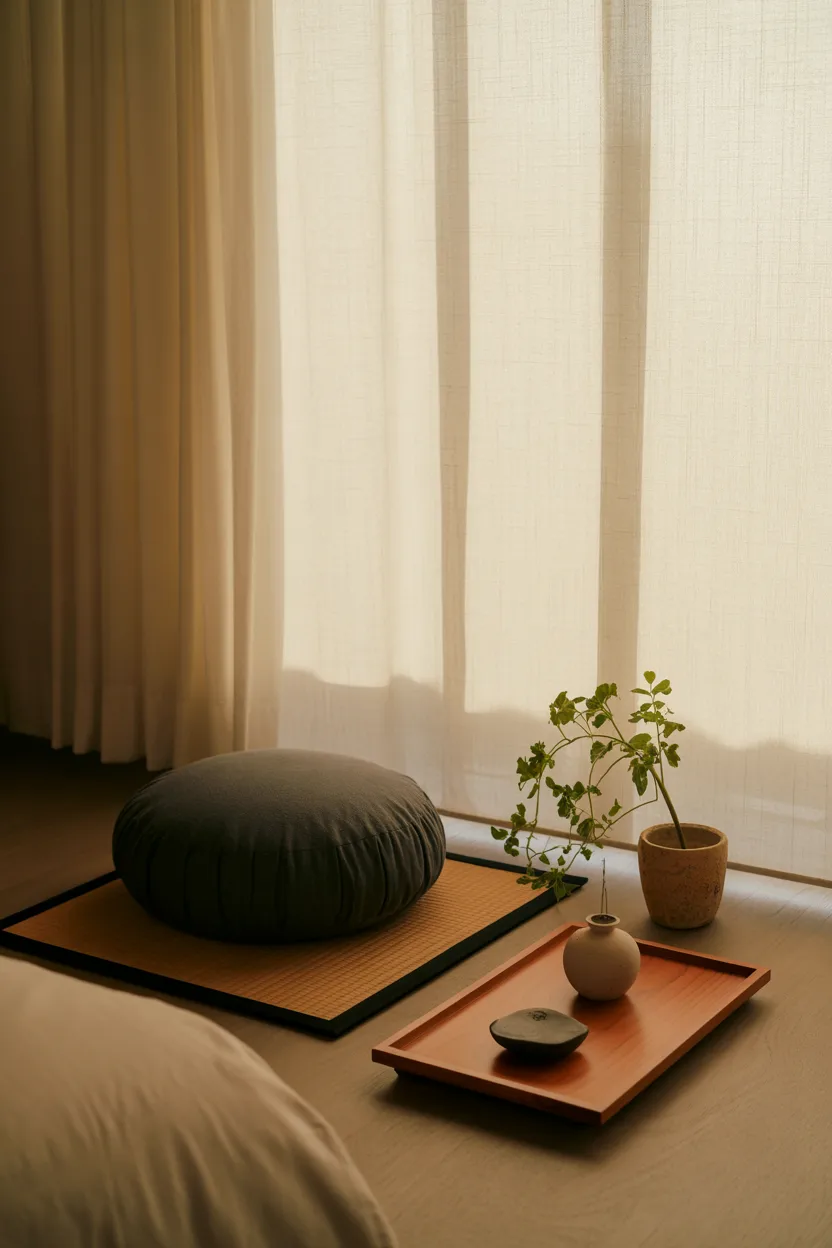
A dedicated morning ritual corner within the bedroom is one of the most intentionally human of all Japandi bedroom ideas because it acknowledges that sleep and waking are not purely physical functions but experiences worthy of ceremonial care. A zafu cushion for meditation, an incense burner for fragrance, a ceramic cup for morning tea — three objects that together define the ritual of waking as something worth designing space for within the room where it naturally begins.
The corner’s paper screen provides gentle separation from the sleeping area without a physical wall — the filter of soft morning light through rice paper creates a quality of illumination in the ritual corner that is distinct from the rest of the bedroom, signaling that this is a different kind of space for a different quality of attention. Among Japandi bedroom ideas, the morning ritual corner is the most personally transformative — not just in how the bedroom looks, but in how each day begins within it.
20. Japandi Bedroom Where Negative Space Is the Design Statement
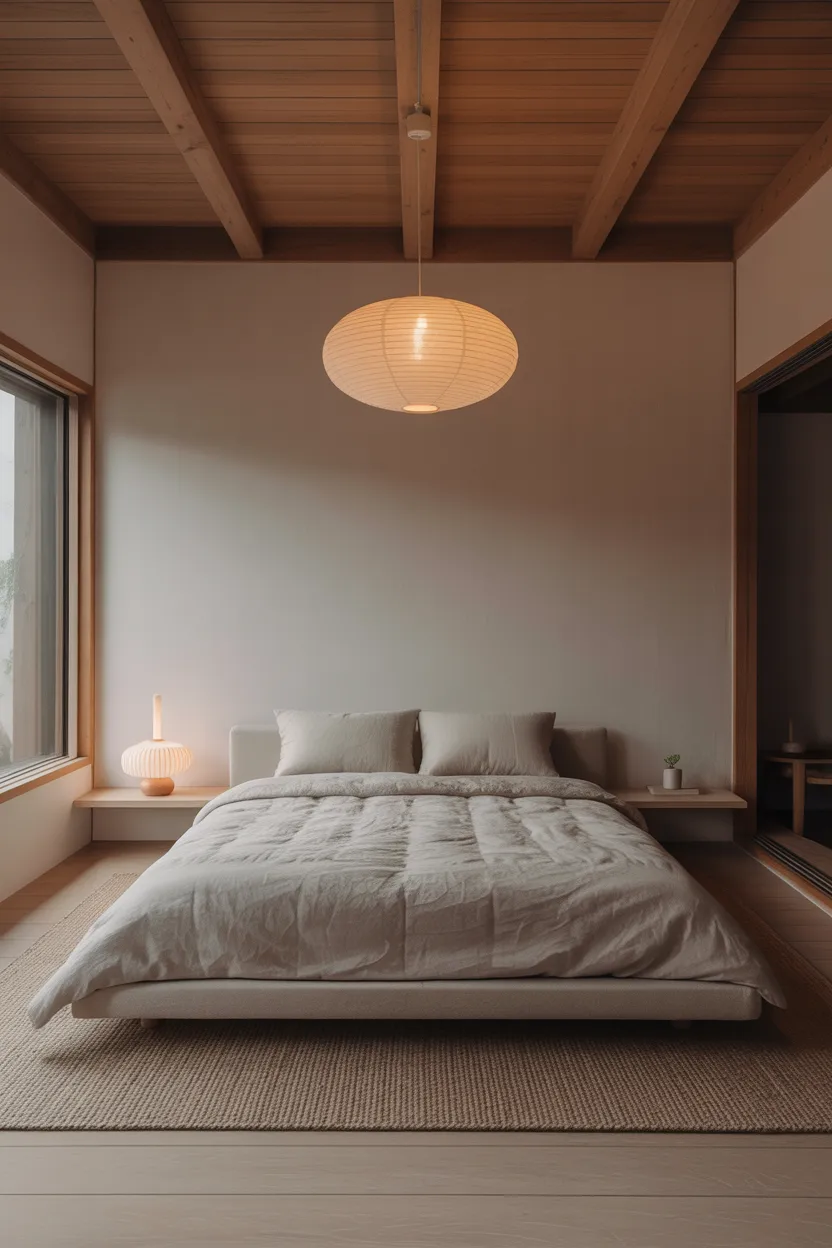
Negative space as the deliberate design statement is the most advanced and most authentically Japandi of all Japandi bedroom ideas — it demands the courage to resist every impulse to fill the room, to add one more piece of furniture, to style one more surface. In the Japanese concept of ma, empty space is not absence but presence — it is the pause that gives the objects within it their full meaning, the silence that makes the few sounds in a room more audible and more beautiful.
In practice, this means one bed, one lamp, one pendant, and the willingness to let the walls, the floor, and the space between things be as considered as any object placed within the room. The emptiness is the design. The restraint is the statement. The room communicates its philosophy most powerfully through what is absent rather than what is present. Among all Japandi bedroom ideas, the negative space bedroom is the most difficult to commit to, the most frequently misunderstood, and the most profoundly beautiful to wake inside every single morning.
Conclusion
The bedroom you sleep in shapes the person you wake up as — and no design approach understands this truth more deeply than Japandi. Every one of these 20 Japandi bedroom ideas begins with the same foundational belief: that less, chosen with genuine care, creates more beauty, more rest, and more meaning than abundance ever can. Whether you begin with a low platform bed, a handmade ceramic lamp, or simply the decision to leave one wall beautifully empty, your Japandi bedroom ideas will reward you every single morning.

Join The Discussion