
Introduction
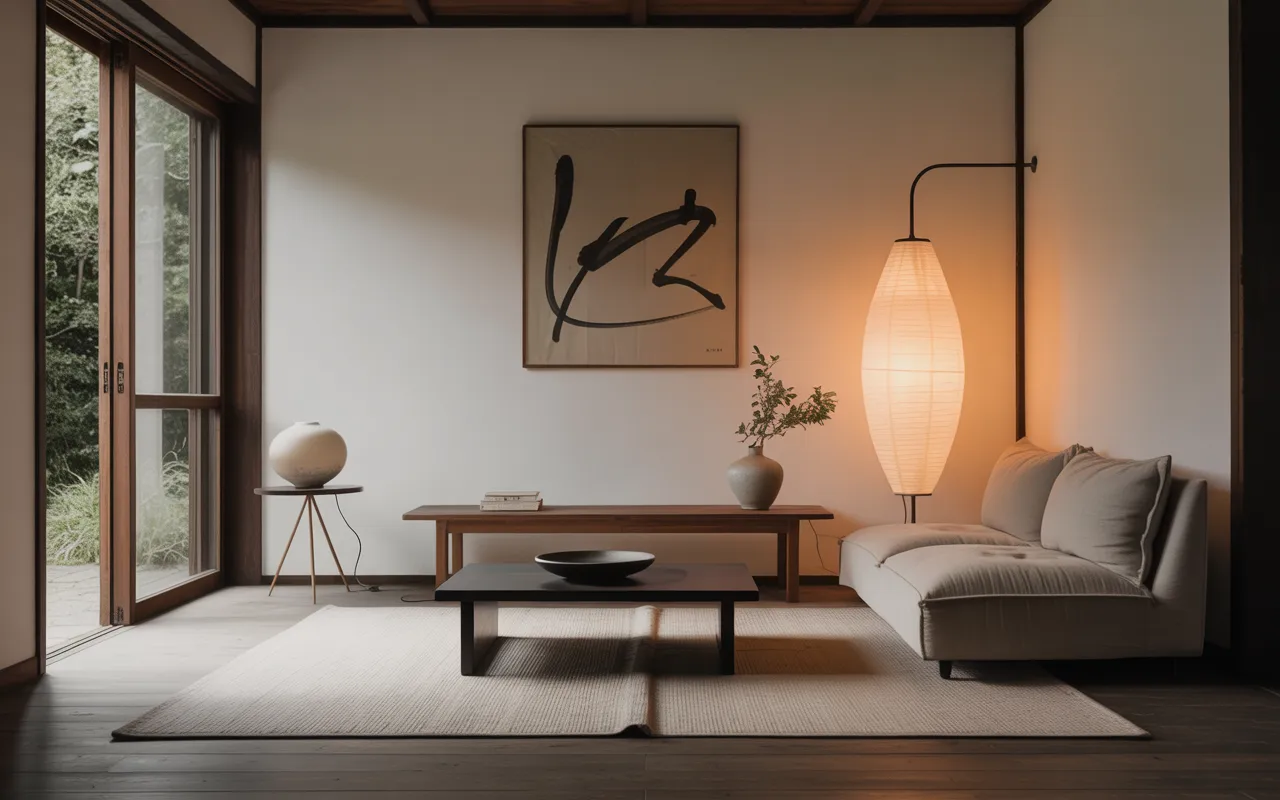
Japandi is the design philosophy the world cannot stop talking about — and for good reason. Born from the marriage of Japanese wabi-sabi and Scandinavian hygge, the finest Japandi living room ideas create spaces that feel simultaneously stripped back and deeply warm, disciplined and completely livable. No clutter, no excess, no trend-chasing — just honest materials, considered proportions, and a profound respect for negative space. These 22 Japandi living room ideas will show you exactly why everyone is trying to copy this aesthetic and how to make it genuinely your own.
1. Low-Profile Sofa With Natural Linen Upholstery
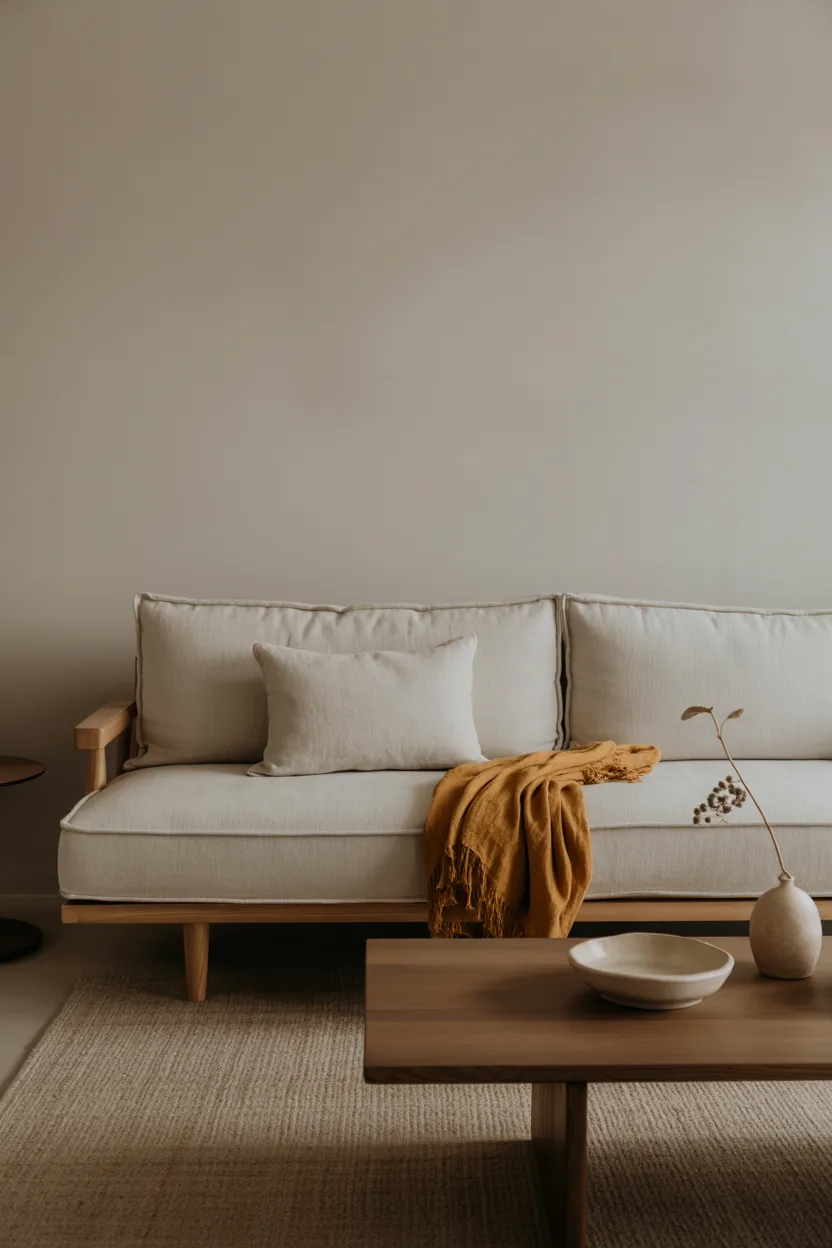
A low-profile sofa is the single most defining furniture piece in Japandi living room ideas — its closeness to the ground connects the seating to the floor in a way that feels grounded, humble, and deeply Japanese in its proportions. Natural linen upholstery in undyed or barely-there tones reinforces the Scandinavian commitment to honest materials — fabric that comes from a plant, used in its most natural state possible.
2. Wabi-Sabi Plaster Walls With Visible Texture
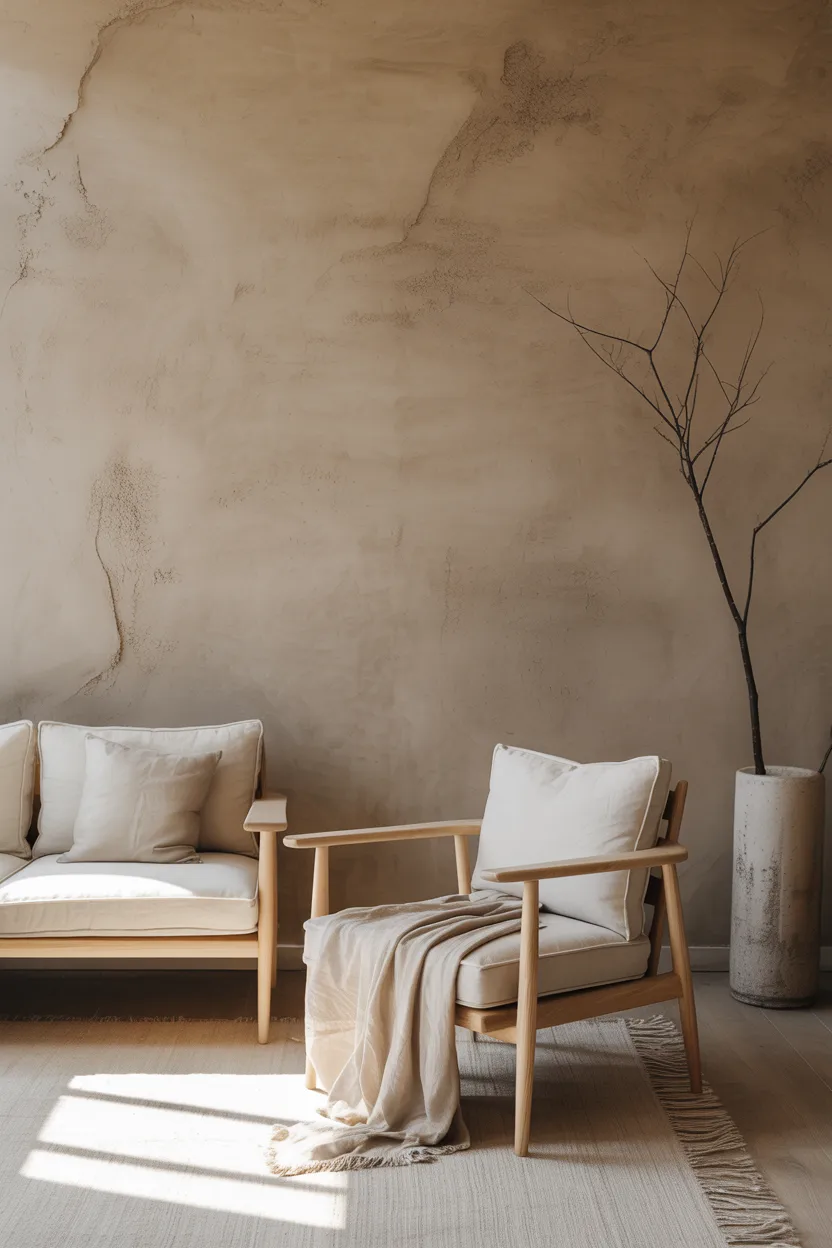
Wabi-sabi plaster walls are among the most authentic Japandi living room ideas because they embody the Japanese philosophy of finding beauty in imperfection. Unlike smooth, painted walls that strive for flawless uniformity, hand-applied plaster celebrates every mark, ridge, and tonal variation left by the plasterer’s trowel. The wall becomes a living surface that changes appearance throughout the day as the light angle shifts — never looking exactly the same twice.
The warm greige tone of the plaster — that nuanced intersection of warm gray and beige — is the ideal Japandi neutral because it reads differently in morning sun, afternoon cloud, and evening lamplight. Against this backdrop, pale ash furniture and cream linen appear luminous while a single sculptural branch in a slim vase provides the organic focal point. Among all Japandi living room ideas, textured plaster walls create the most atmospheric and irreplaceable background for everything that follows.
3. Japandi Living Room With Shoji-Inspired Room Divider
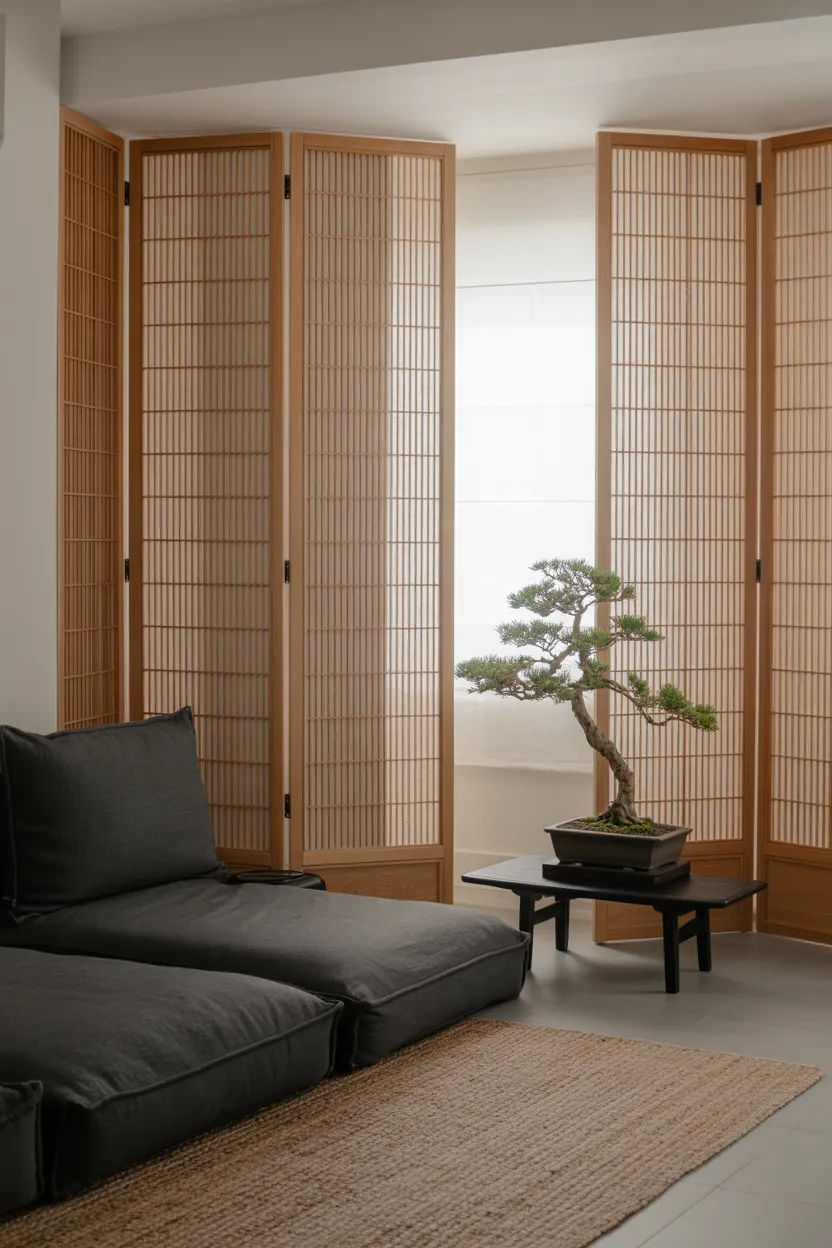
Shoji-inspired room dividers bring an architectural element of Japanese domestic design directly into Japandi living room ideas — the translucent rice paper panels filter light with an extraordinary softness that no curtain or blind can replicate. The light that passes through a shoji screen loses its directionality and becomes diffuse, filling the room with an even, gentle luminosity that feels inherently meditative and calm.
The slim oak frame of a well-crafted shoji divider also functions as a design object in its own right — its grid of perfectly proportioned rectangles adds geometric structure to the living room without the visual weight of a solid partition. A bonsai tree on a low wooden stand beside the divider reinforces the Japanese influence while adding living nature to the arrangement. These Japandi living room ideas understand that the boundary between spaces can itself be beautiful.
4. Neutral Color Palette With Warm Undertones Only
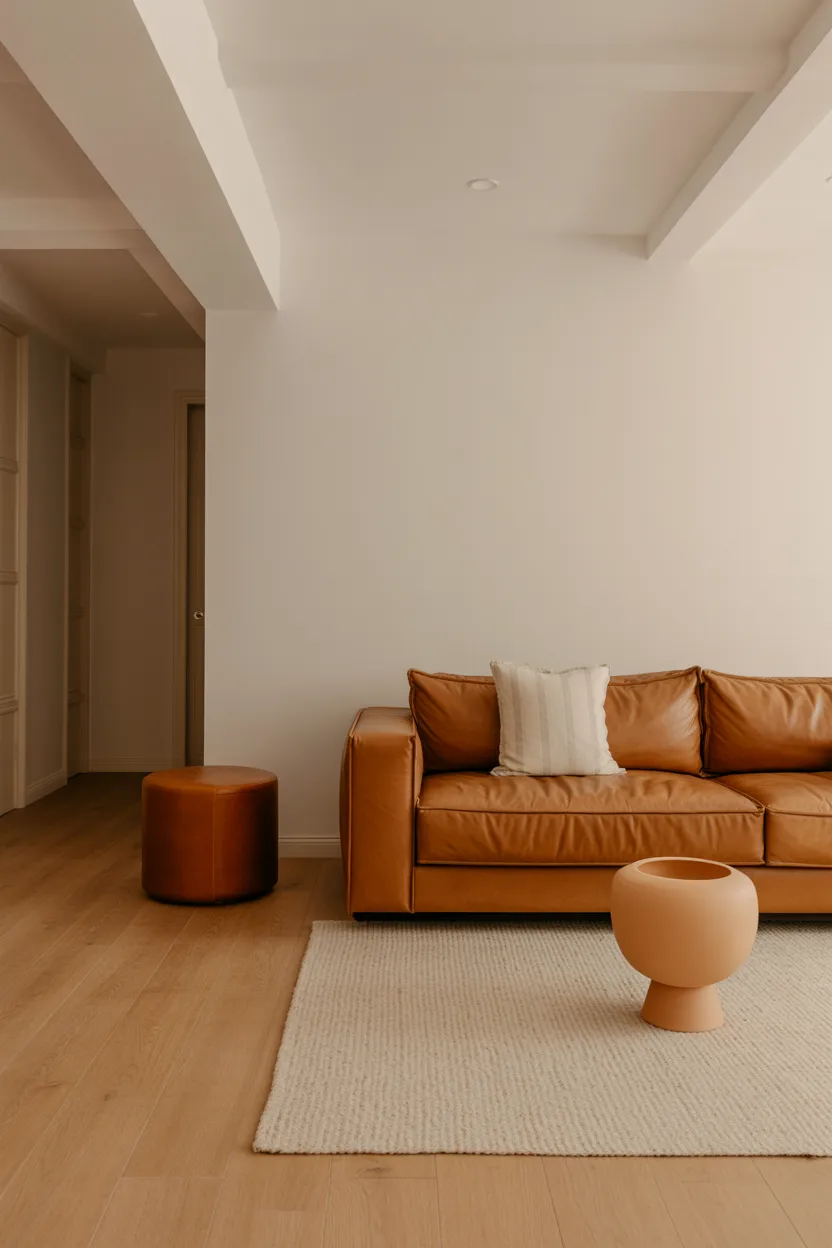
The all-warm-neutral palette is the color philosophy behind the most livable Japandi living room ideas — it creates spaces that feel simultaneously calm and cozy because every tone, from the warmest honey oak to the palest sand linen, belongs to the same family of natural, sun-warmed tones. There are no cool grays to introduce tension, no stark whites to feel harsh — only the gentle gradation of warmth from floor to ceiling.
The discipline required is rejecting any tone with a cool or blue undertone, even subtly. Warm white walls rather than cool white. Oatmeal wool rather than pale silver gray. Honey oak rather than bleached ash. This tonal consistency creates a living room that feels as though it was grown from the earth rather than assembled from a catalog — which is precisely the ambition of the finest Japandi living room ideas at their most sincere.
5. Japandi Living Room With Sculptural Ceramic Vessels
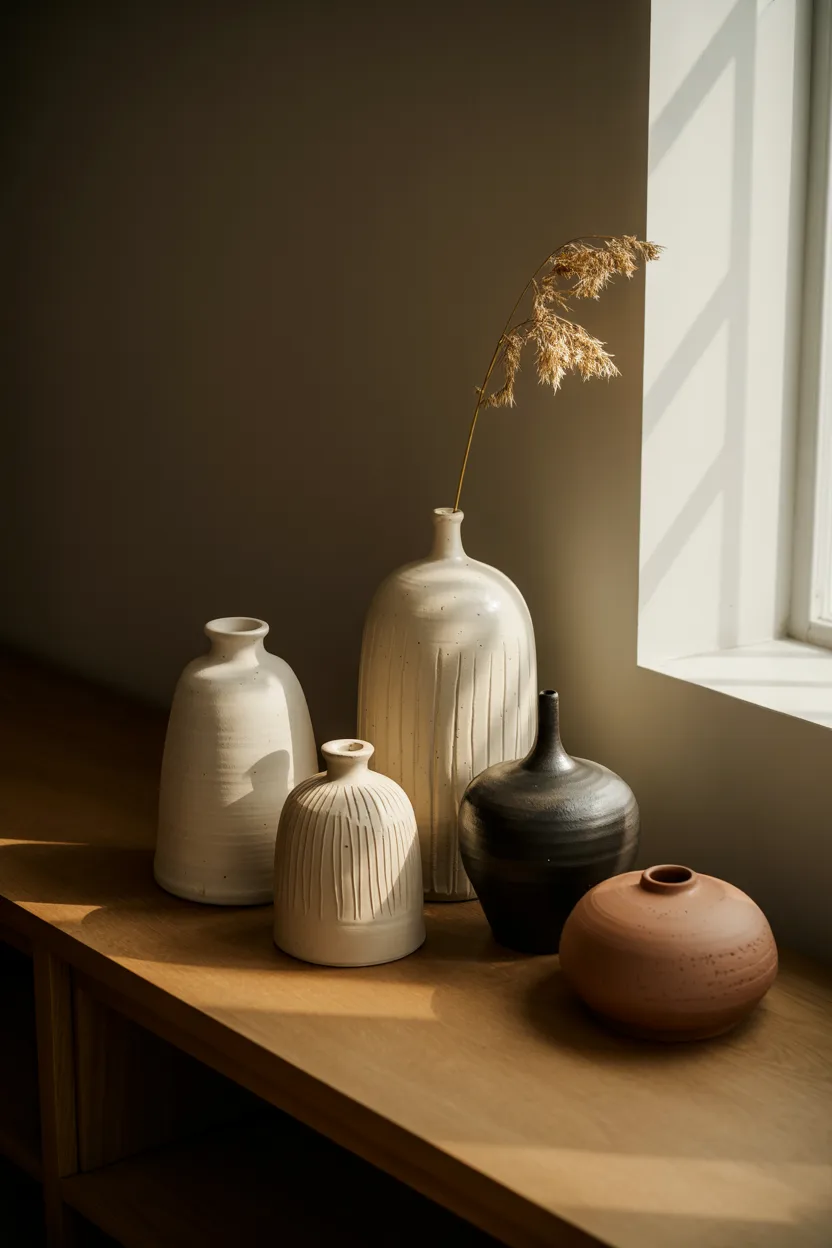
Handmade ceramic vessels are the decorative language of Japandi living room ideas — they are the objects that make a Japandi room feel inhabited by someone with genuine aesthetic sensitivity rather than someone who simply purchased a design look. The irregularities of a wheel-thrown vessel — the slightly off-center rim, the finger impressions, the drip in the glaze — are evidence of a human hand, and that evidence gives the object warmth and authenticity that no factory-made piece can replicate.
Grouping ceramic vessels by height rather than by matching sets creates a composition with visual rhythm — the tallest at the back, medium forms in the middle, the smallest at the front. Vary the finish within a limited palette: one matte white, one charcoal glaze, one raw terracotta. A single dried grass stem in the tallest vessel adds organic height without floral fussiness. These Japandi living room ideas find their soul in the beauty of objects made by hand.
6. Floor Cushions and Zabuton Seating Area
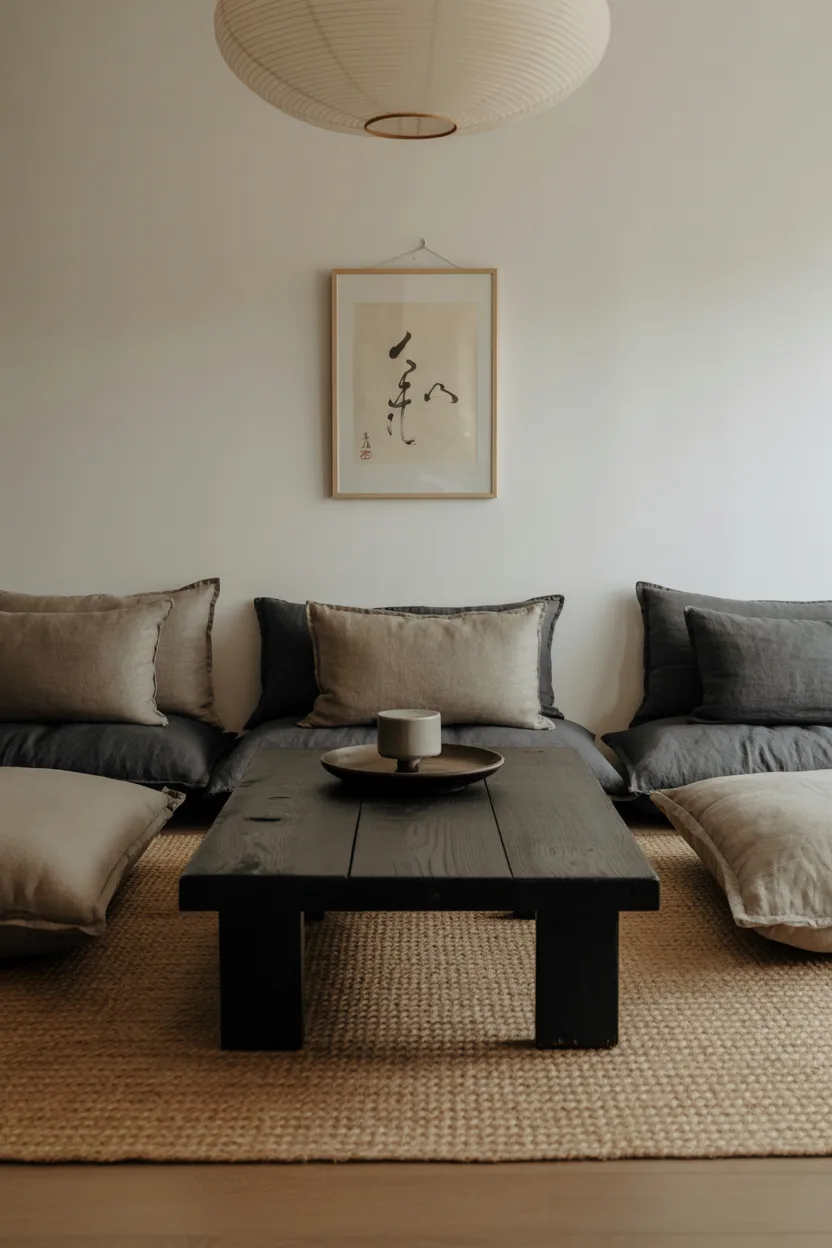
Floor cushion seating is the most radical and most rewarding of all Japandi living room ideas because it completely redefines the relationship between the body and the room. Seated at floor level, the room appears larger, the ceiling seems higher, and the entire spatial experience becomes more intimate and intentional. This is Japanese domestic tradition — the tatami room — translated into a contemporary Western living space with Scandinavian material sensibility.
Large zabuton-style floor cushions in charcoal and warm gray linen are firm enough for extended sitting while soft enough for genuine comfort. A very low blackened oak table at knee height holds tea cups, books, or a candle — everything needed for a long, unhurried afternoon. A paper lantern overhead provides the room’s characteristic soft, diffuse light. Among Japandi living room ideas, floor seating creates the most immersive and genuinely transportive experience of the aesthetic.
7. Japandi Living Room With Raked Sand Garden View
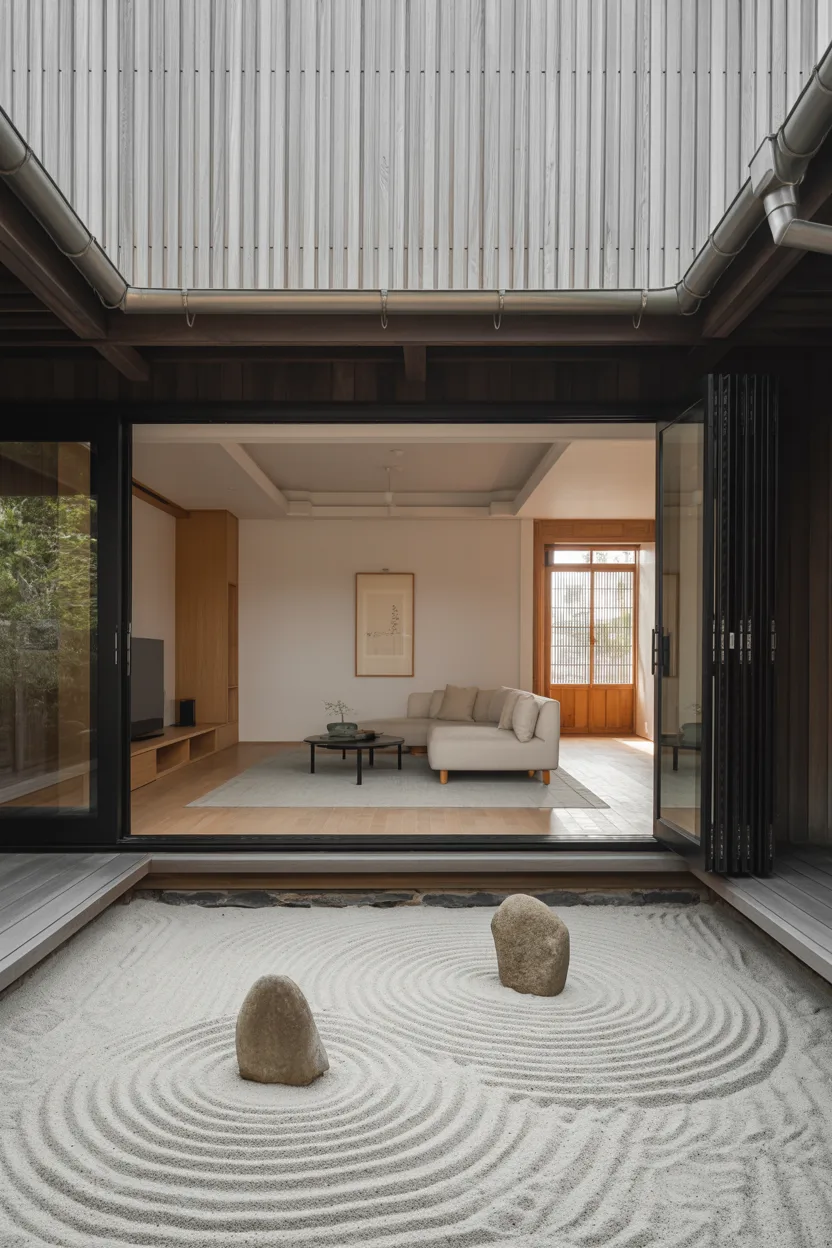
A raked sand garden — karesansui — viewed from the living room is the ultimate expression of Japandi living room ideas in their most architecturally integrated form. The garden is not a decoration added to the room; it is the room’s primary artwork, its meditation object, its connection to a centuries-old Japanese practice of contemplating the world through abstracted natural forms. Water suggested by raked gravel. Mountains suggested by placed stones.
The living room interior that faces this garden must match its visual silence — pale ash furniture, bare walls, no pattern, no color beyond the warmest natural neutrals. When the interior and the garden speak the same language of restraint, the sliding glass door between them becomes invisible, and the room and garden merge into one continuous experience of calm. These Japandi living room ideas are for homes that understand design as a spiritual practice.
8. Exposed Wooden Beams With White Plaster Ceiling
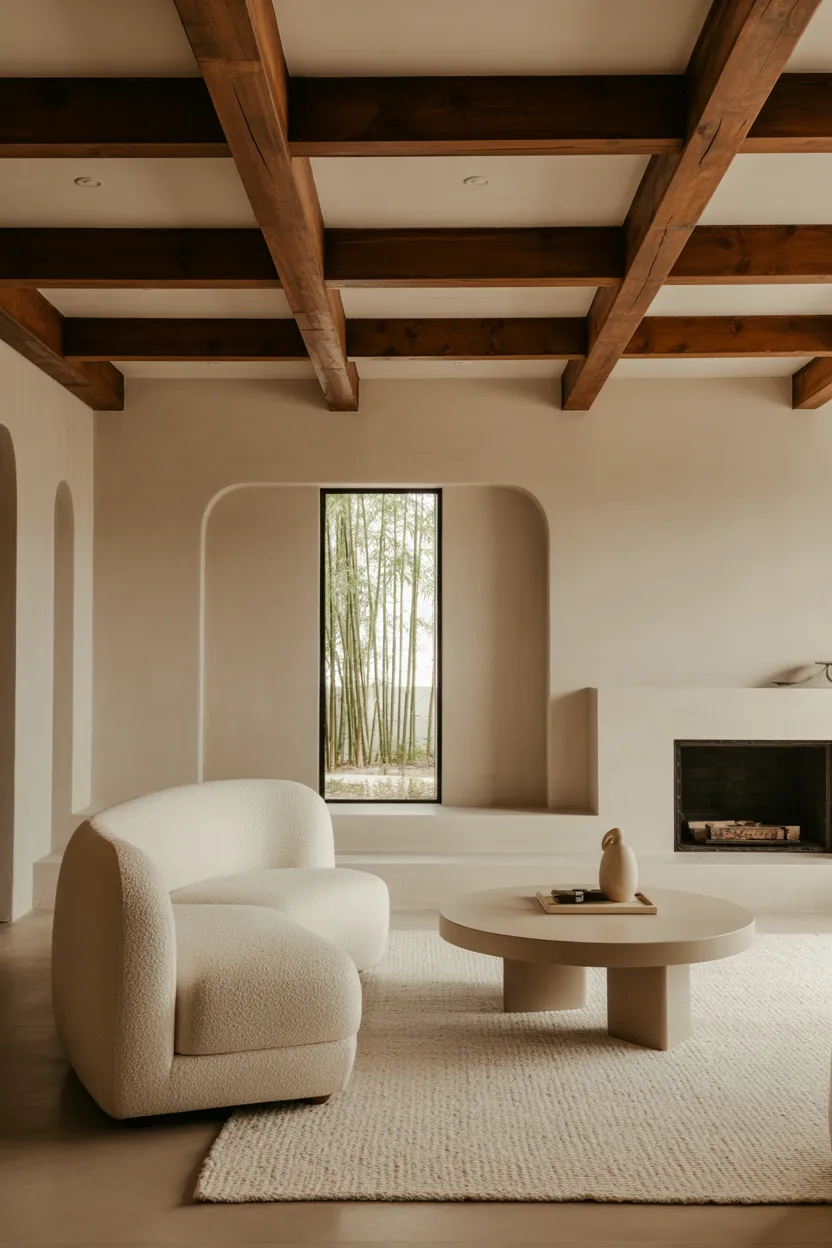
Exposed wooden ceiling beams are one of the most authentically Japandi architectural features because they satisfy both design traditions simultaneously — the Japanese reverence for honest, visible structural materials and the Scandinavian appreciation for natural wood in its most elemental form. Dark oak beams against a smooth white plaster ceiling create a graphic contrast that adds visual complexity overhead without introducing any decorative excess.
The furniture below should have the visual weight to anchor the room under those beams — a substantial cream bouclé sofa, a solid low table, a hand-knotted rug with physical presence underfoot. A tall narrow window framing a view of outdoor bamboo completes the composition by connecting the interior warmth of the beams to the living greenery outside. Among Japandi living room ideas, exposed beam ceilings add the most architectural permanence and the most enduring visual reward.
9. Japandi Living Room With Ikebana-Style Floral Arrangement
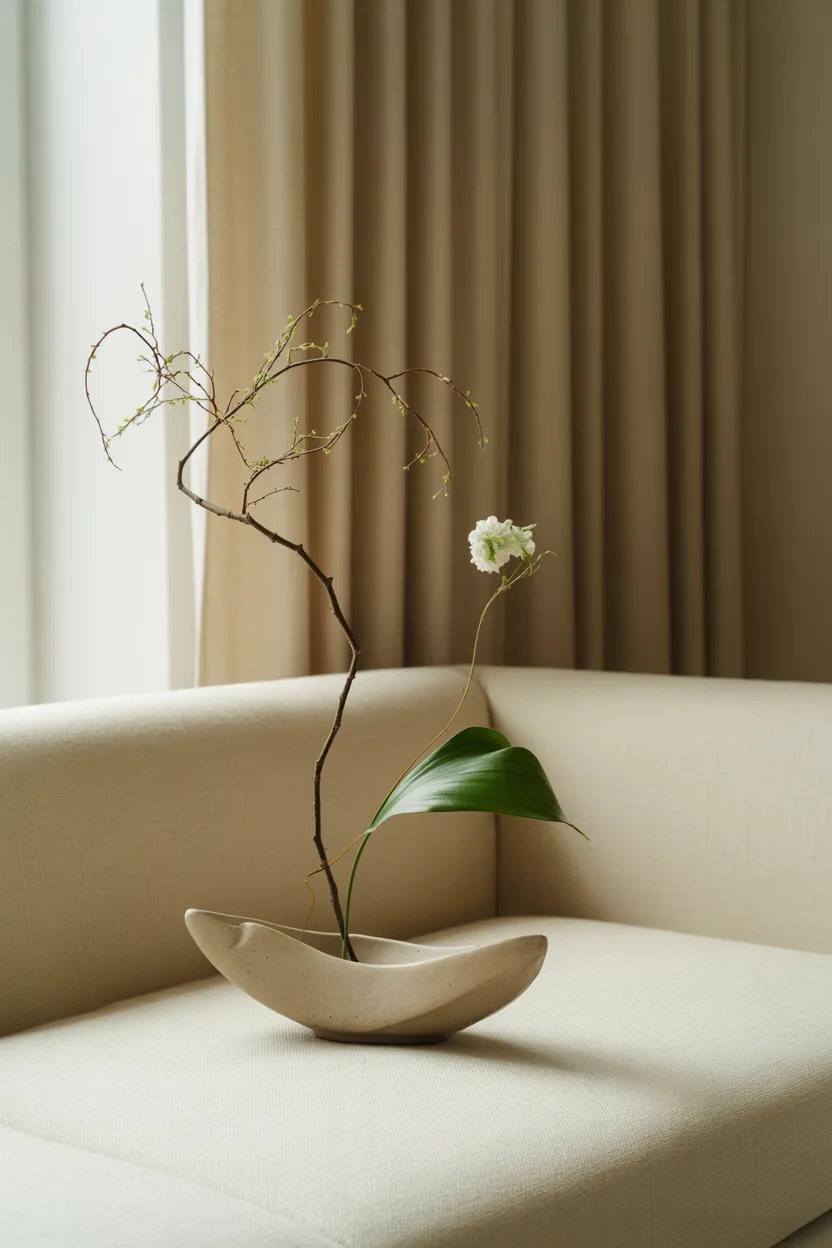
Ikebana — the Japanese art of flower arrangement — is one of the most meaningful contributions Japanese aesthetics make to Japandi living room ideas because it redefines what a floral arrangement should be. Where Western floral design tends toward abundance and symmetry, ikebana works with three elements maximum, arranged asymmetrically to suggest movement, growth, and the relationship between heaven, earth, and humanity. One branch, one bloom, one leaf — and the arrangement is complete.
Placing an ikebana arrangement in a living room signals an understanding of Japandi living room ideas philosophy at its deepest level — the willingness to find a single flower arrangement more beautiful than a vase full of blooms. The low wide ceramic vessel from which the arrangement rises is itself a design object. The negative space around and between the three elements is as important as the elements themselves. This is Japandi thinking in its most distilled and beautiful form.
10. Dark Japandi With Charcoal Walls and Warm Wood
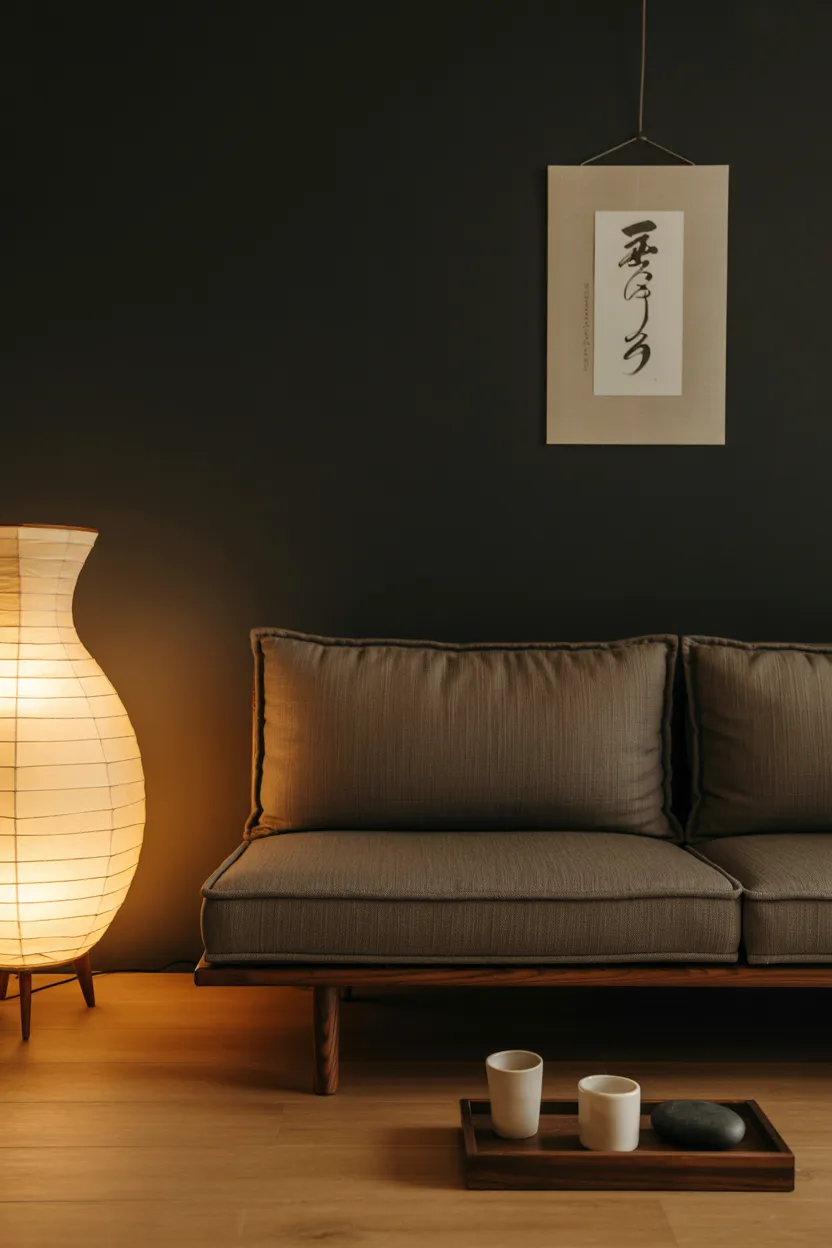
Dark Japandi is one of the most compelling variations of Japandi living room ideas — it proves that the aesthetic is not defined by pale, light-filled spaces alone but by the consistent application of its principles to any tonal register. Deep charcoal walls create an enveloping intimacy that pale rooms cannot achieve, and against that dark backdrop, warm honey oak flooring and walnut furniture legs glow with an extraordinary richness they might not show against lighter walls.
A paper floor lamp in warm white light is the ideal Japandi light source for a dark room — it is soft, organic in form, and provides the diffuse, non-directional light that Japandi rooms favor over harsh spotlight fixtures. Japanese calligraphy on the dark wall adds cultural authenticity and artful restraint — the brush strokes are beautiful as visual art regardless of their meaning to viewers unfamiliar with Japanese script. These Japandi living room ideas prove that depth and warmth are the same quality.
11. Japandi Living Room With Bonsai Tree as Focal Point
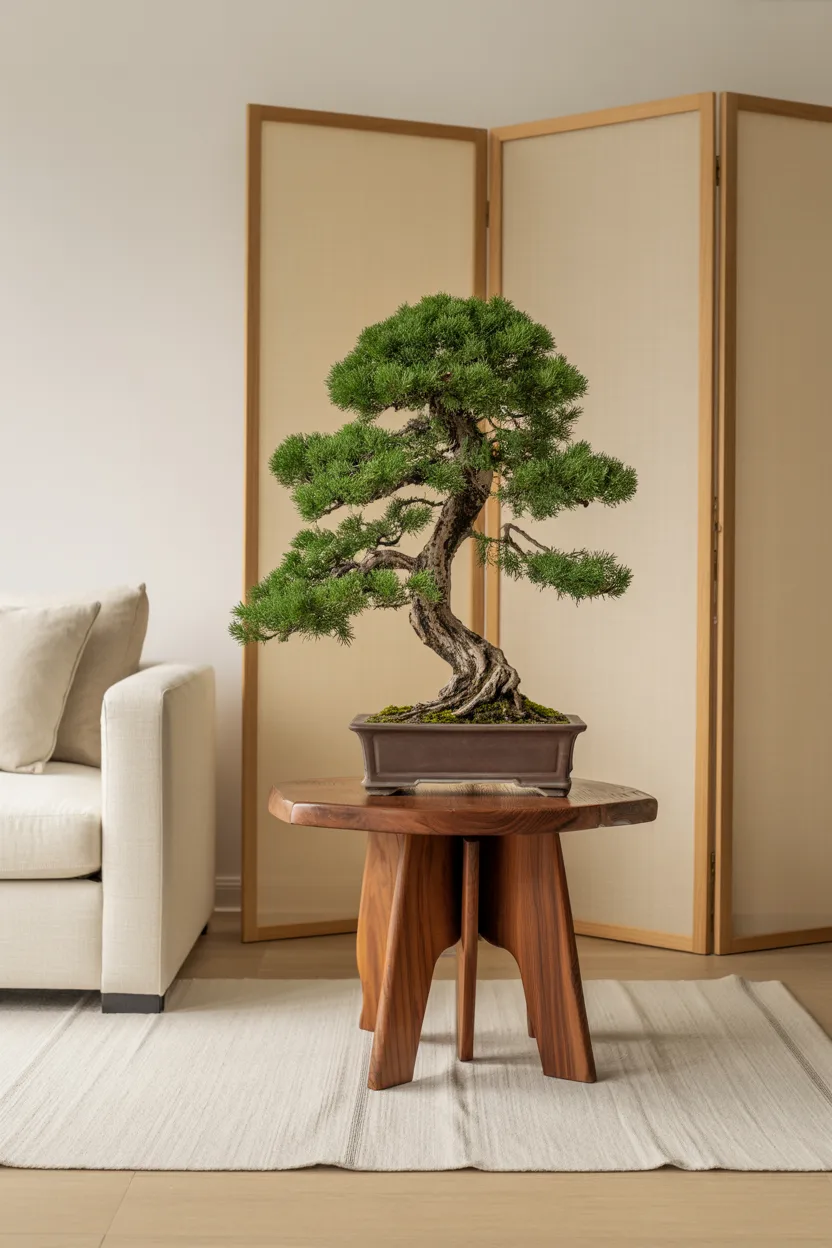
A mature bonsai tree as a living room focal point is one of the most distinctly Japanese of all Japandi living room ideas — and one of the most powerful. A well-tended juniper or Japanese maple bonsai is decades of patient cultivation made visible: its twisted trunk, its carefully shaped canopy, its miniaturized perfection all communicate a relationship between human patience and natural growth that no purchased decorative object can replicate.
Giving the bonsai its own dedicated corner — with a tatami mat beneath its stand and a plain paper screen behind it — treats the living tree as the artwork it genuinely is, providing it with the physical and visual space it deserves. The rest of the room should arrange itself around the bonsai with a respect that mirrors the maker’s own relationship to the living work. Among Japandi living room ideas, the bonsai focal point is the most living, breathing, and ever-changing design decision a room can make.
12. Japandi Living Room With Floating Wall Shelves in Solid Oak
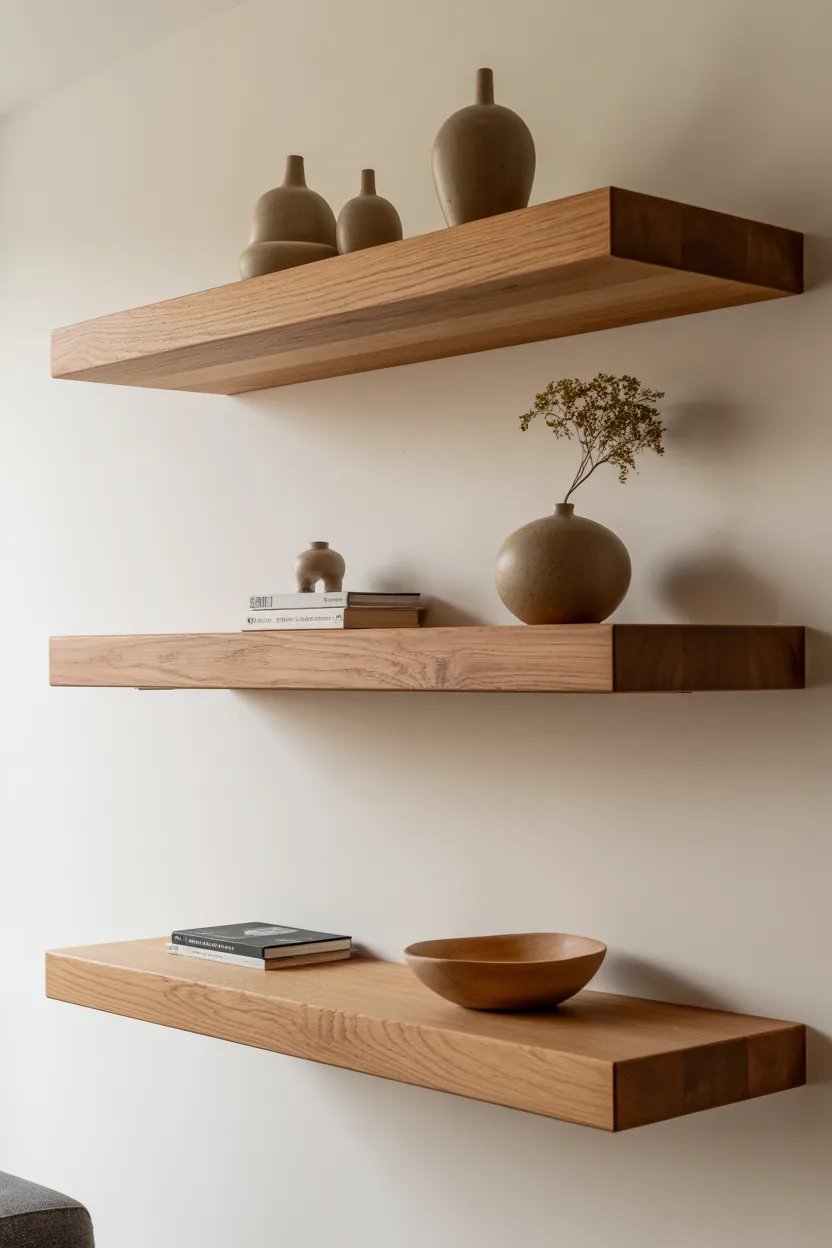
Floating shelves in solid thick-cut oak are among the most versatile Japandi living room ideas because they add storage, display, and architectural warmth without the visual weight of a full bookcase unit. The thickness of the oak shelf — a full 40mm rather than the thin veneer of flatpack options — is a Japandi-critical detail. Thickness communicates material honesty, solid craftsmanship, and the enduring quality that both Japanese and Scandinavian design traditions revere.
The styling of each shelf should follow the same principle as the room itself: one to three objects maximum per shelf, with generous breathing space around each. The empty portion of a shelf is not a failure to fill it but a deliberate decision to give the present objects more visual prominence and calm. The oak grain of the shelf is itself beautiful enough to be considered a design element. Among Japandi living room ideas, floating oak shelves offer the most daily satisfaction for the simplest investment.
13. Japandi Living Room With Tatami Mat Flooring Section
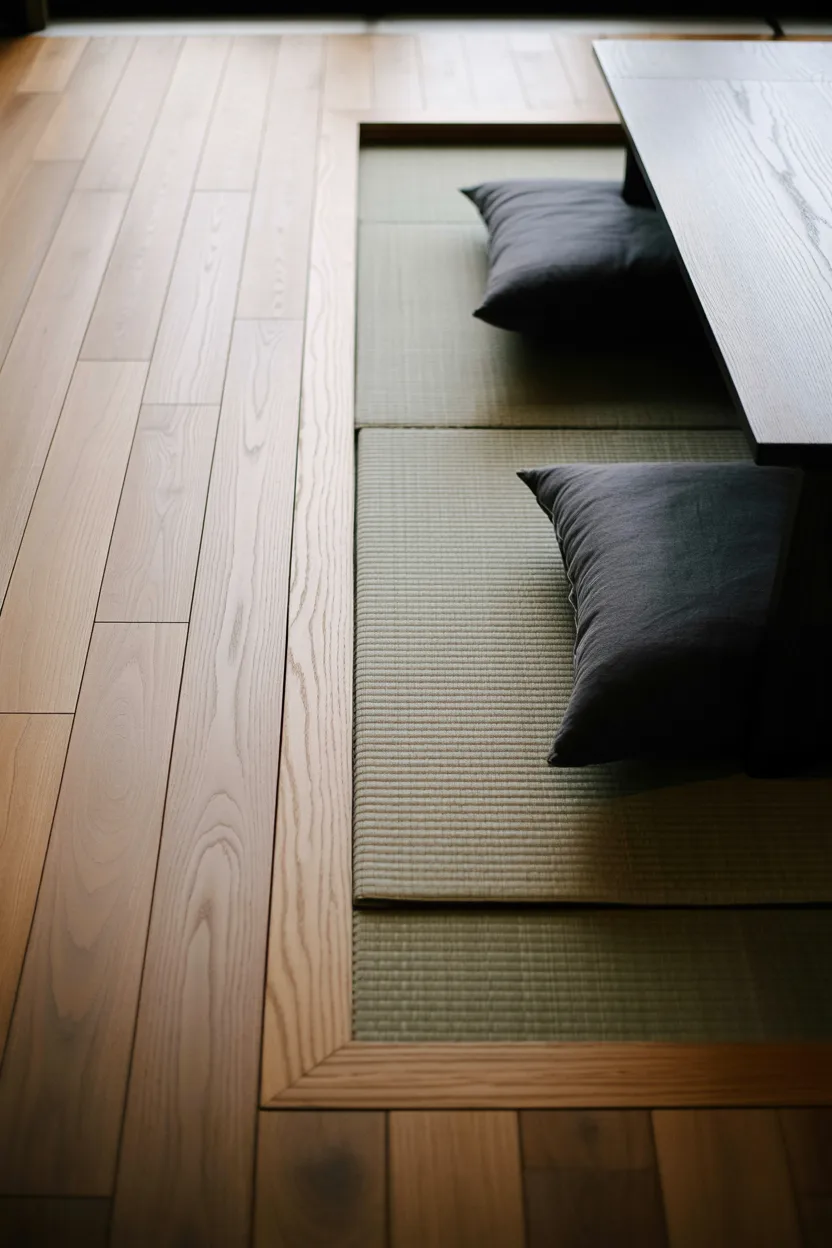
A tatami mat section within a contemporary Japandi living room is one of the most architecturally ambitious Japandi living room ideas — it requires forethought at the structural level, embedding the recessed tatami area into the floor plan itself, and the result is a room that contains two distinct domestic worlds in one continuous space. The tatami zone brings the Japanese tradition of floor-level living into dialogue with a Western-height sofa arrangement without either compromising the other.
The slim oak border at the transition between materials is the critical detail — it frames the tatami area like a picture frame, acknowledging the material change as a design event rather than hiding it. The different heights of living — floor level in the tatami zone, sofa height adjacent — create a spatial variety that makes the living room feel larger and more experientially rich. These Japandi living room ideas honor the full depth of Japanese domestic culture rather than borrowing only its surface aesthetic.
14. Japandi Living Room With a Single Large-Scale Art Piece
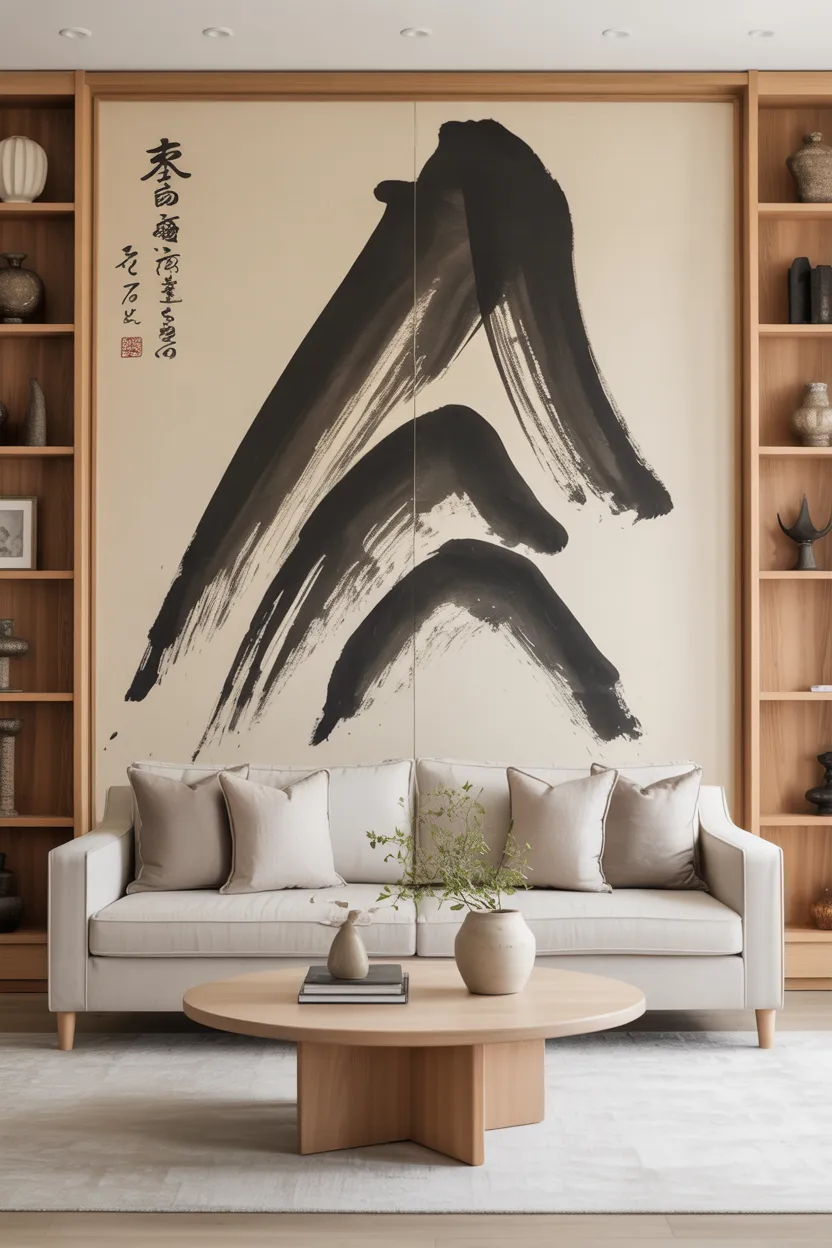
Single large-scale art in Japandi living room ideas embodies one of the aesthetic’s most important principles: the courage to choose one great thing and give it the entire wall rather than filling that wall with many smaller things. A large sumi-e ink painting — the ancient Japanese art of painting with black ink and natural brushes — has a quality of spontaneous precision that the most skilled hand produces in seconds and the viewer contemplates for hours.
The framing in plain pale oak is as deliberate as the artwork itself — it introduces the room’s warm wood material language into the artwork display rather than interrupting it with an ornate gilded frame. The wall around and below the painting should remain completely empty, giving the artwork the silence it needs to communicate fully. Among all Japandi living room ideas, the single large artwork approach requires the most confidence and produces the most lasting impression.
15. Japandi Living Room With Wool Rug as the Foundation
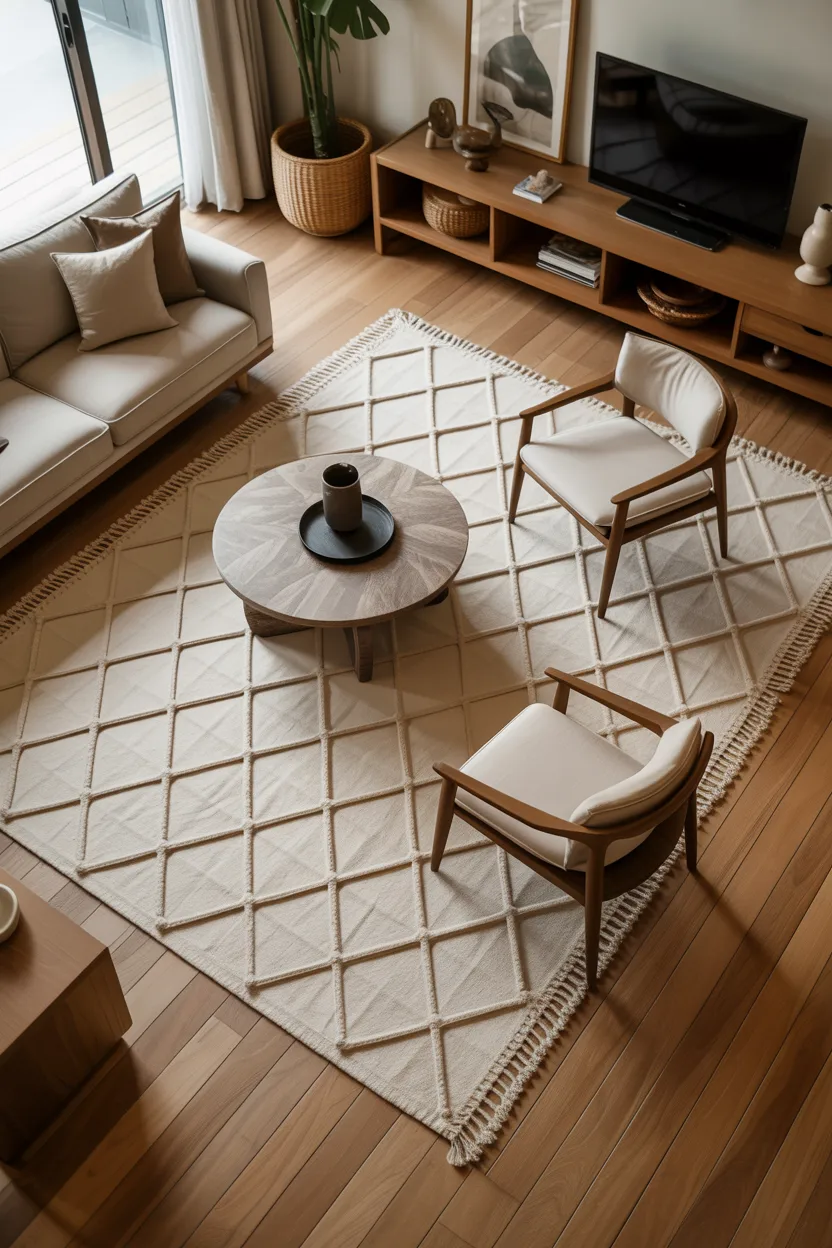
The hand-knotted wool rug is the foundation piece in the most successful Japandi living room ideas — it literally grounds every other element in the room, giving the floating arrangement of sofa, coffee table, and chairs a physical territory and a visual anchor. A rug large enough for all furniture legs to sit comfortably within its borders makes the conversation area read as a unified composition rather than a collection of separate pieces.
Undyed natural wool in cream and pale oatmeal maintains the Japandi commitment to honest materials while adding the tactile warmth and acoustic softness that hard floors alone cannot provide. The subtle diamond pattern in the same natural tones as the base field adds visual interest without introducing decorative complexity — it is pattern felt more than seen. Among Japandi living room ideas, the right rug makes every other design decision easier because it provides the room’s quiet foundation from which everything rises.
Visit more https://www.pinterest.com/Dreamgardenshome/
16. Japandi Living Room With Bamboo and Natural Fiber Accents
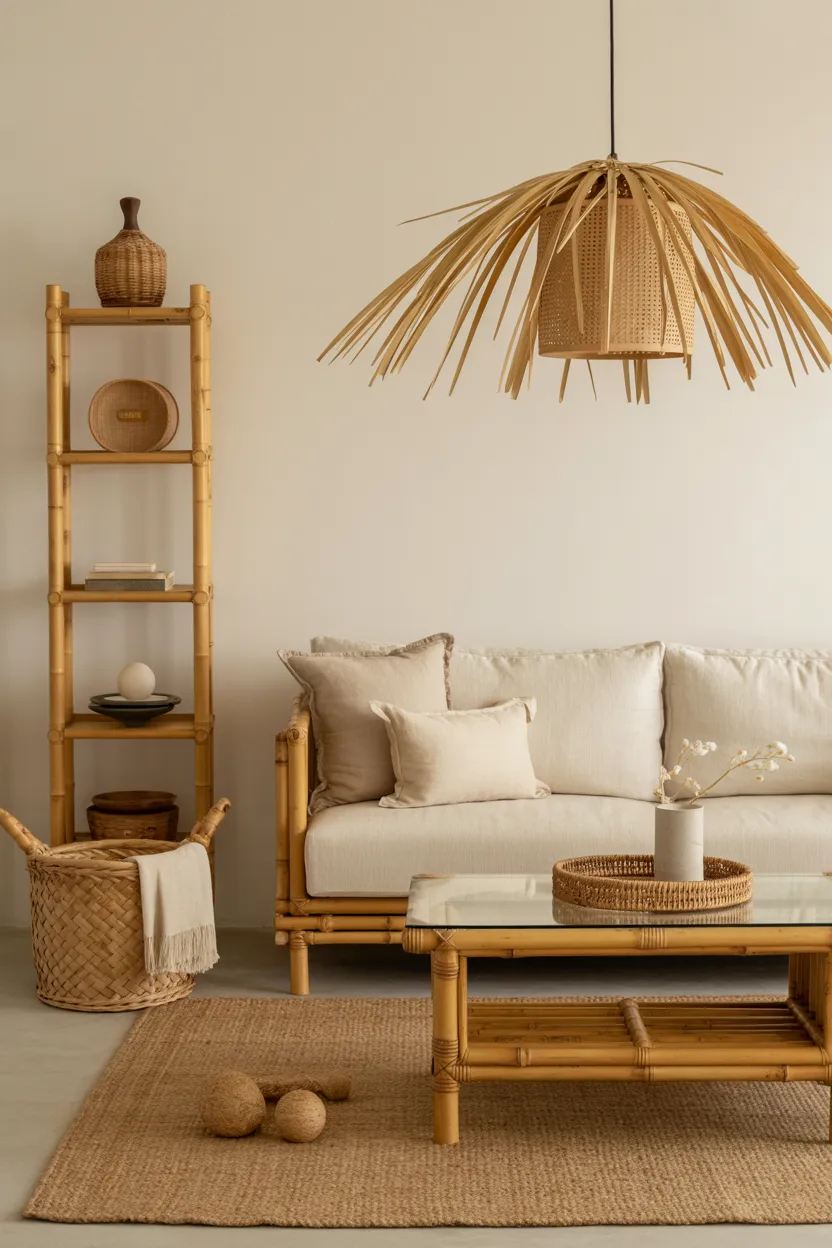
Bamboo and natural fiber Japandi living room ideas build their design logic from an ecological philosophy as much as an aesthetic one — choosing materials that come from the earth, can return to the earth, and are beautiful at every stage of their existence. Bamboo is the Japandi material that most explicitly bridges Japanese and Scandinavian sensibilities: it grows in Japan and throughout Asia, and it resonates with the Scandinavian appreciation for functional, sustainable natural materials.
A bamboo side table, a seagrass basket, a jute rug, a rattan tray — these four natural fiber objects can transform any living room into something that reads as Japandi-considered without requiring significant structural or furniture investment. Each material has its own texture family, and together they create a layered natural richness that feels collected from nature rather than purchased from a shop. These Japandi living room ideas are the most accessible and the most genuinely sustainable.
17. Japandi Living Room With Engawa-Inspired Window Bench
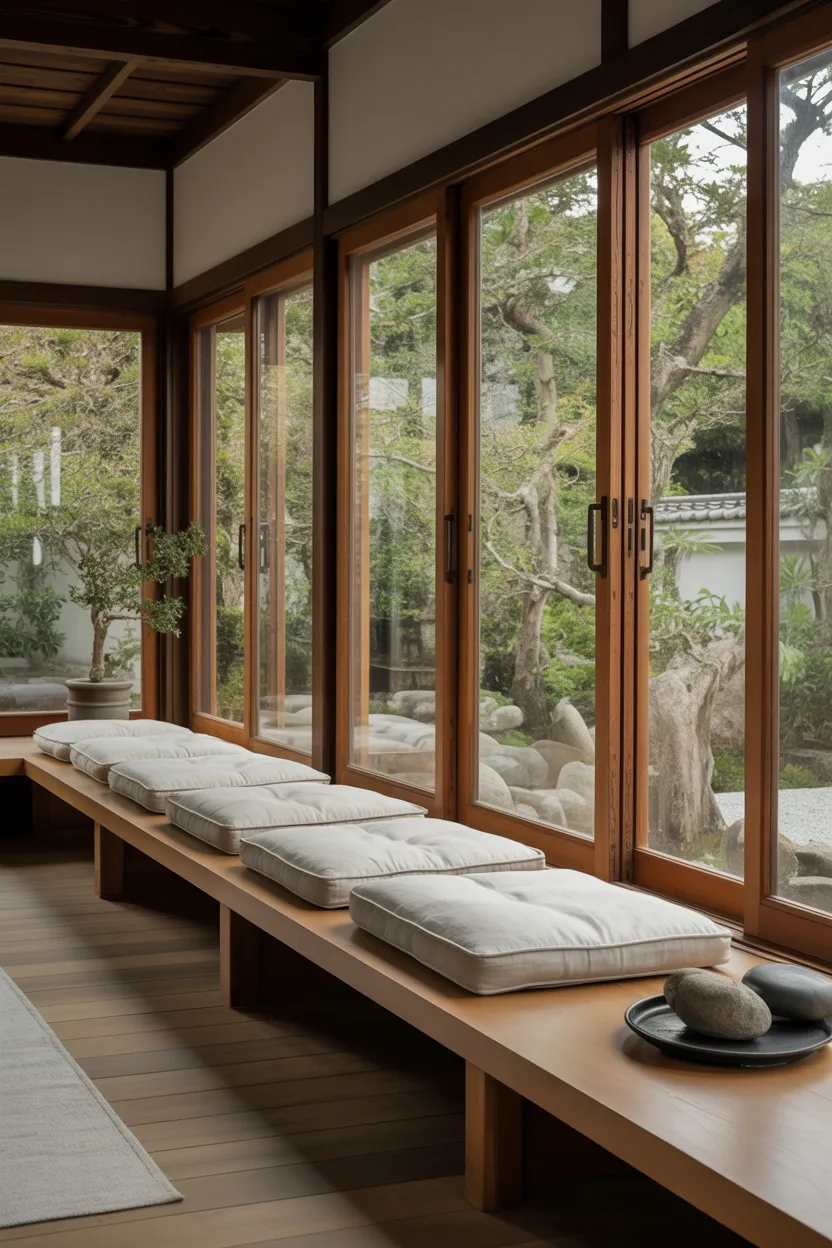
An engawa — the traditional Japanese transitional space between interior rooms and the exterior garden — inspired window bench is one of the most architecturally poetic of all Japandi living room ideas. In traditional Japanese homes, the engawa is a narrow wooden platform running along the outside of the main rooms, a liminal zone between inside and outside where people sit to view the garden. Translated into a contemporary living room as a full-length window bench, this concept brings that meditative garden-viewing tradition indoors.
The bench provides additional seating, a display surface for a small bonsai and smooth stones, and most importantly, an invitation to sit and look — at the garden, the changing sky, the birds, the seasons. In a living room full of screens and distractions, a bench whose sole orientation is toward a window of nature is a profoundly intentional design choice. Among Japandi living room ideas, the engawa-inspired bench is the most quietly revolutionary.
18. Japandi Living Room With Integrated Fireplace and Stone Surround
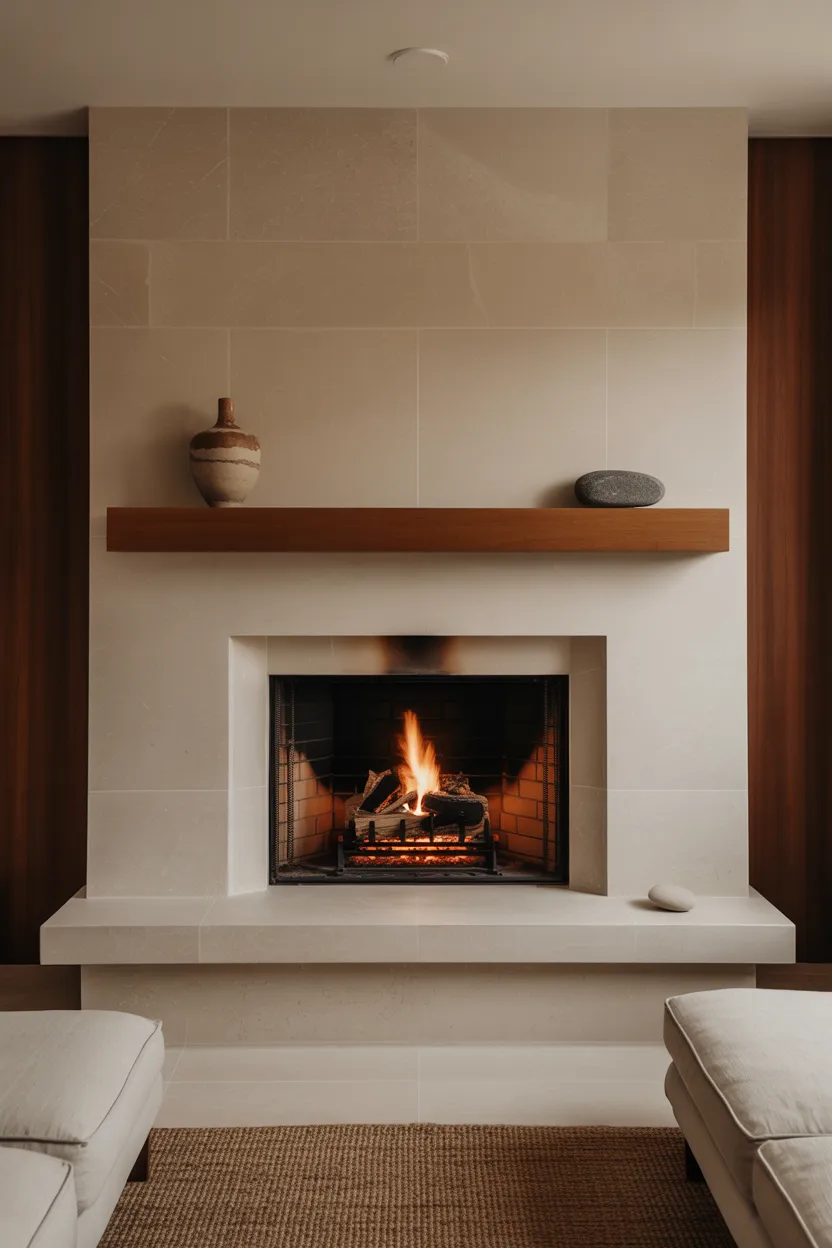
A fireplace with a honed stone surround is the warmth-generating heart of Japandi living room ideas that aim for year-round livability rather than aesthetic photography alone. Pale limestone in a smooth honed finish — not polished, not rough — achieves the wabi-sabi middle ground between refined and raw that Japandi design consistently seeks. The fire itself is the most ancient form of warmth and light, and its inclusion in a Japandi room connects the space to something far older than any design trend.
The fireplace mantle in a Japandi room should be styled with the same discipline as every other surface — one ceramic vessel, one smooth stone, and the courage to leave the rest empty. The fire is the focal point; everything else on the mantle exists only to frame it gently. A wool rug connecting the sofa to the hearth bridges the material warmth of the textile to the radiant warmth of the fire. These Japandi living room ideas create the most inhabitable rooms when the temperature drops.
19. Japandi Living Room With Vintage Japanese Woodblock Print
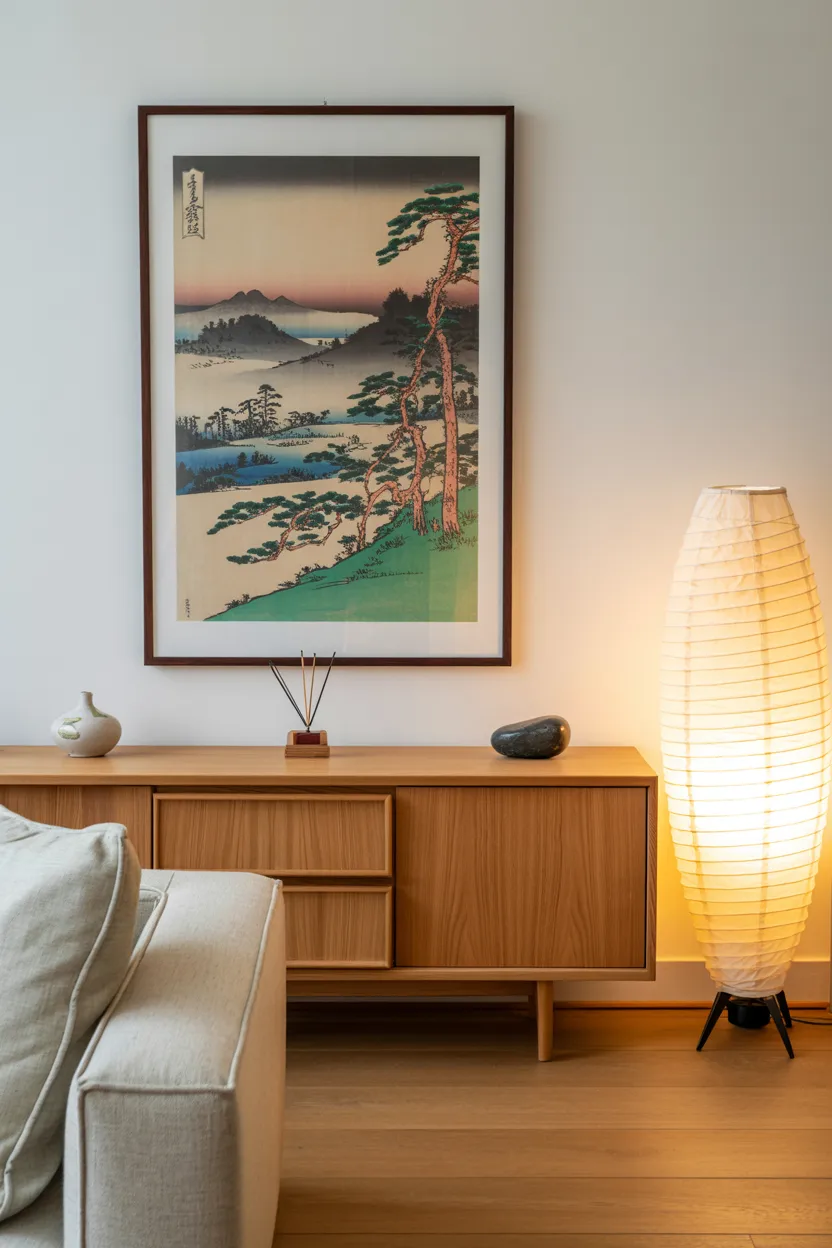
A vintage Japanese woodblock print — ukiyo-e — is one of the most culturally authentic art choices in all Japandi living room ideas because it connects the room directly to a centuries-old Japanese artistic tradition of representing nature through masterful printmaking technique. A Hiroshige or Hokusai landscape — misty mountains, solitary pines, crashing waves rendered in flat planes of color and extraordinary linear skill — brings genuine art history into a contemporary living room without pretension or pastiche.
Hanging the print alone on a generous expanse of wall, with nothing competing beside or above it, gives the artwork the respectful silence it requires. A low oak credenza beneath the print provides a physical connection between the art on the wall and the floor below — the print, the credenza, the ceramics on its surface, and the floor beneath form a vertical composition from ceiling to floor. Among Japandi living room ideas, the woodblock print approach offers the deepest cultural resonance and the most timeless visual beauty.
20. Japandi Living Room With Acoustic Wood Slat Panel Wall
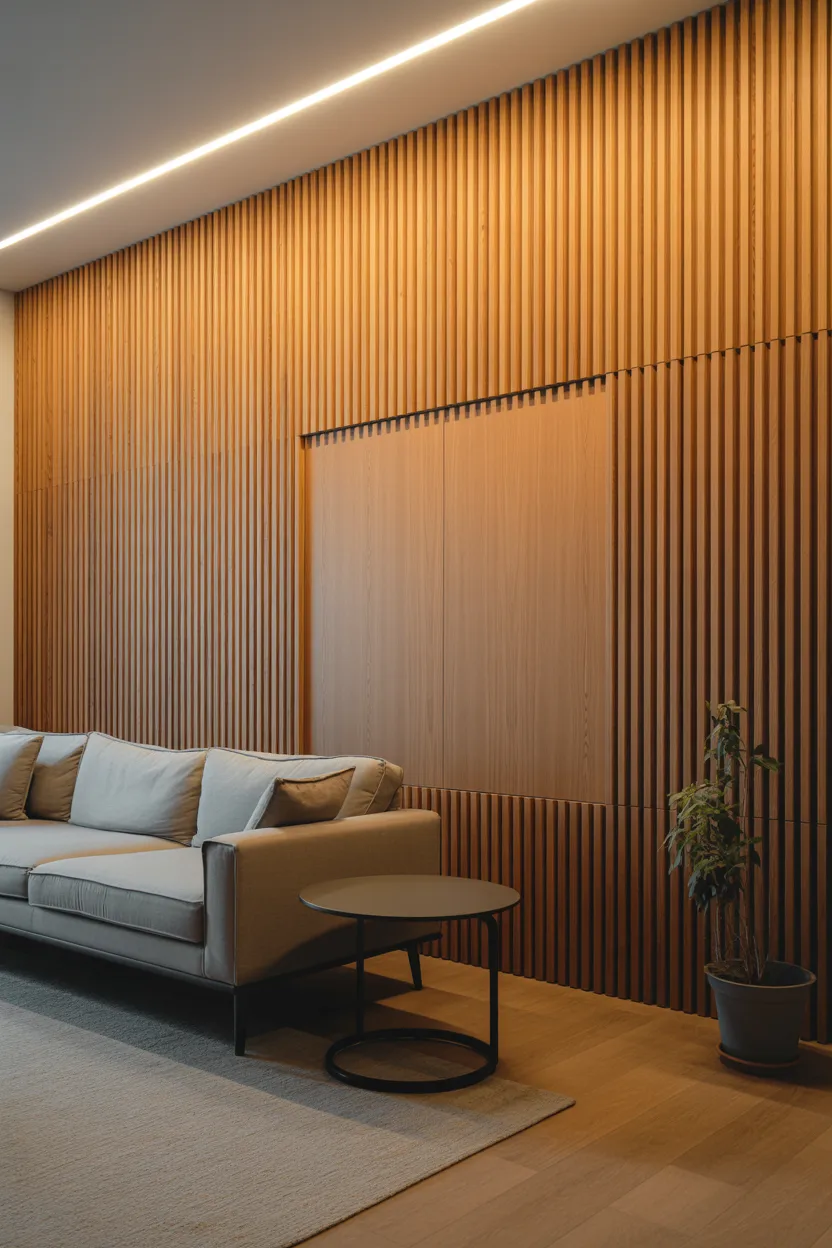
Wood slat panel walls are one of the most sought-after features in contemporary Japandi living room ideas because they combine the Japanese love of visible wood craftsmanship with a modern architectural precision that feels entirely at home in Scandinavian-influenced interiors. The vertical slats create a rhythm of light and shadow across the wall surface that shifts throughout the day as natural light moves — making the wall a living, changing feature rather than a static backdrop.
The recessed LED strip behind the panels is the evening transformation — warm backlight filters through the gaps between slats, creating a glowing grid of amber light that makes the wall appear to radiate warmth from within. Acoustically, the slatted wall also softens sound reflection in the room, making conversation feel more intimate and music more enveloping. Among Japandi living room ideas, the wood slat panel wall is the single most requested feature by homeowners who encounter it in photographs and cannot rest until they have it.
21. Japandi Living Room With Meditation Corner
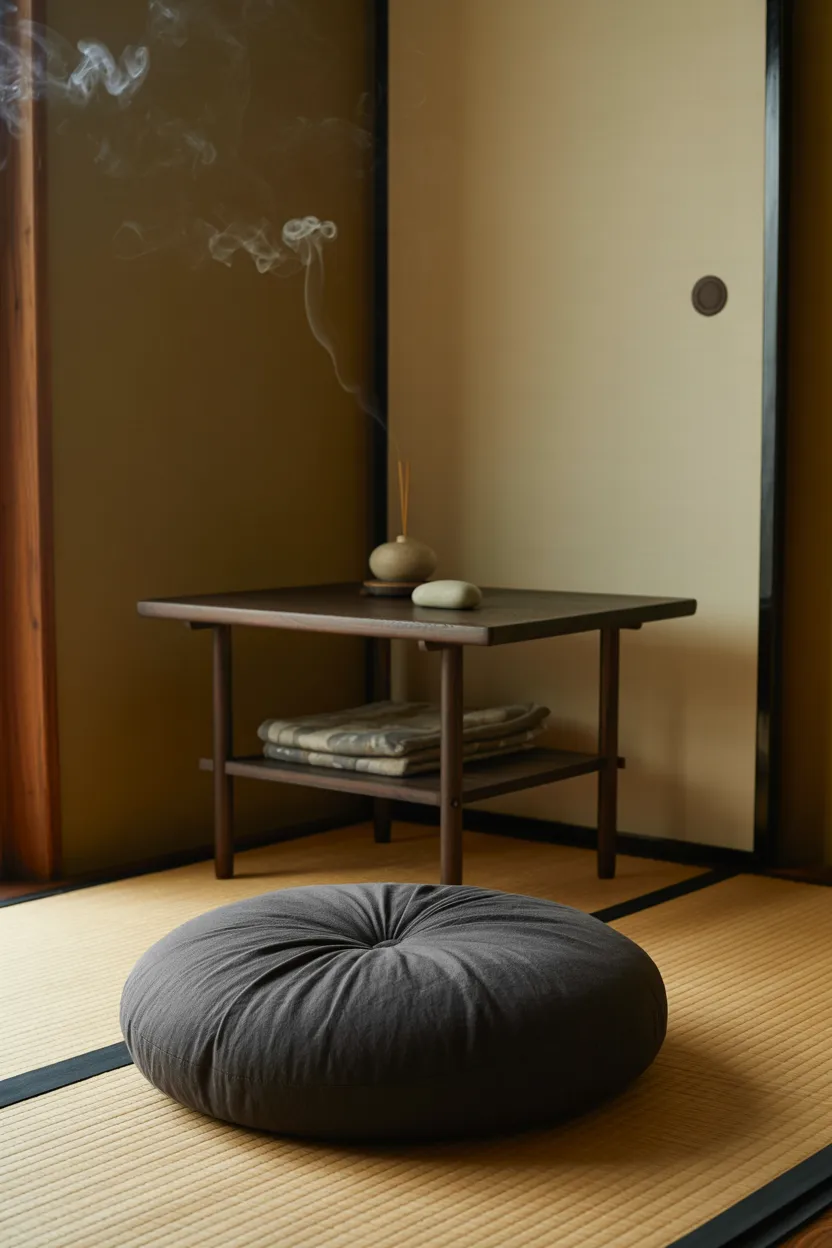
A dedicated meditation corner within the living room is one of the most genuinely functional of all Japandi living room ideas because it acknowledges that a truly designed life includes intentional time for stillness — and that this time deserves its own physical space within the home. A single zafu cushion on a tatami mat, a low altar table with an incense burner, one folded blanket: these four elements are sufficient to create a zone of complete purpose within the larger room.
The meditation corner works in a Japandi living room because the room’s broader aesthetic already honors stillness and restraint — the corner is not a contradiction of the room’s character but an intensification of it. A paper screen behind the corner provides visual separation without a physical wall, filtering light into the corner with a quality that supports inward attention. These Japandi living room ideas understand that the most important design question is not what the room looks like — it is how the room makes you feel.
22. Japandi Living Room With Negative Space as the Design Hero
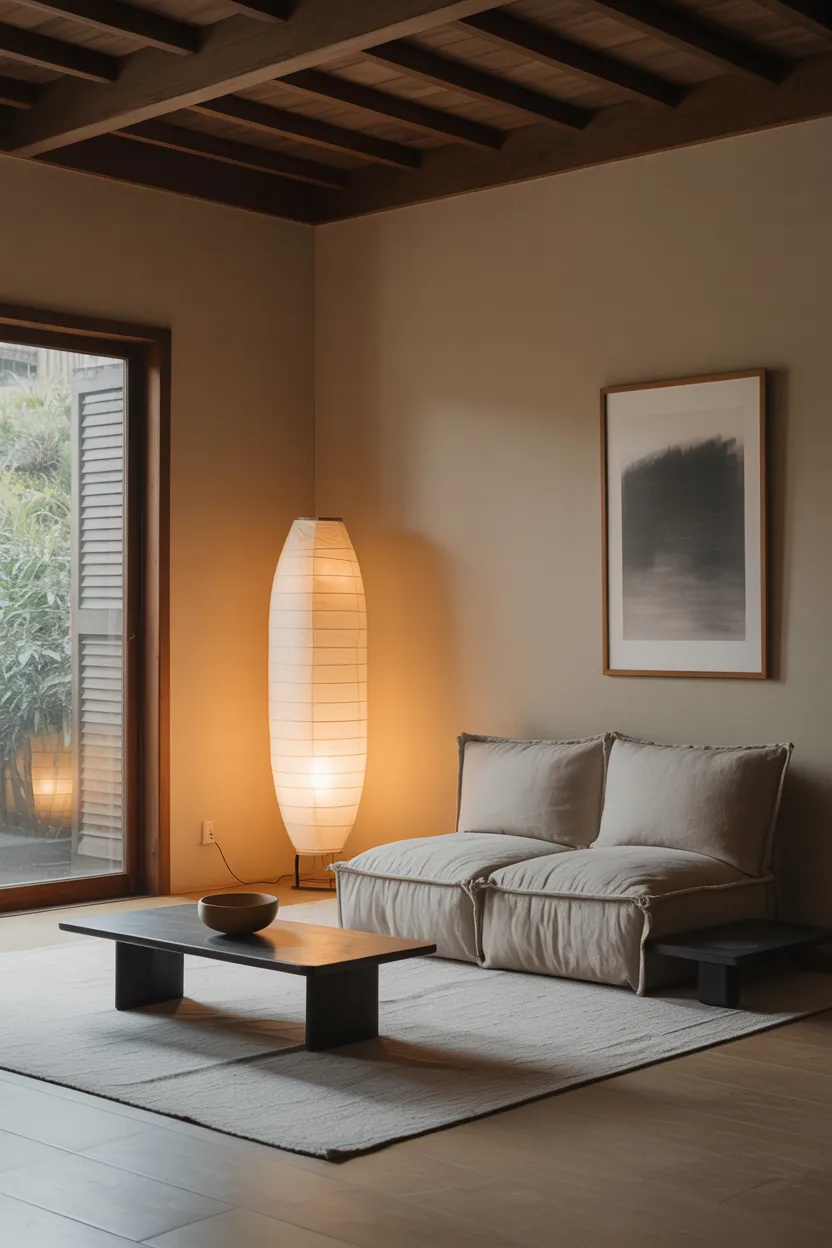
Negative space as the deliberate design hero is the most advanced and most authentically Japandi of all Japandi living room ideas — it requires the confidence to resist the cultural pressure to fill every corner, to style every surface, to add one more thing. In the Japanese aesthetic tradition, ma — negative space, the pause between notes, the gap between objects — is considered as important as the objects themselves. A room that honors ma feels spacious, calm, and deeply intentional.
In practice, this means choosing fewer, better objects and allowing each one breathing room that no other object competes with. One sofa. One table. One lamp. The emptiness between them is not a sign of incompletion — it is the room’s most deliberate statement. Every object appears more beautiful, more considered, and more significant when surrounded by unhurried space. Among all Japandi living room ideas, the negative space approach is the most difficult to commit to and the most rewarding to inhabit every single day.
Conclusion
Japandi is not a trend — it is a philosophy about how spaces should make people feel, and that philosophy never goes out of style. Every one of these 22 Japandi living room ideas begins with the same commitment: choose less, choose better, and honor the space between things as much as the things themselves. Whether you start with a low sofa, a handmade ceramic, or simply the courage to leave a wall empty, your Japandi living room ideas journey begins the moment you decide that calm is the highest form of beautiful.

Join The Discussion