
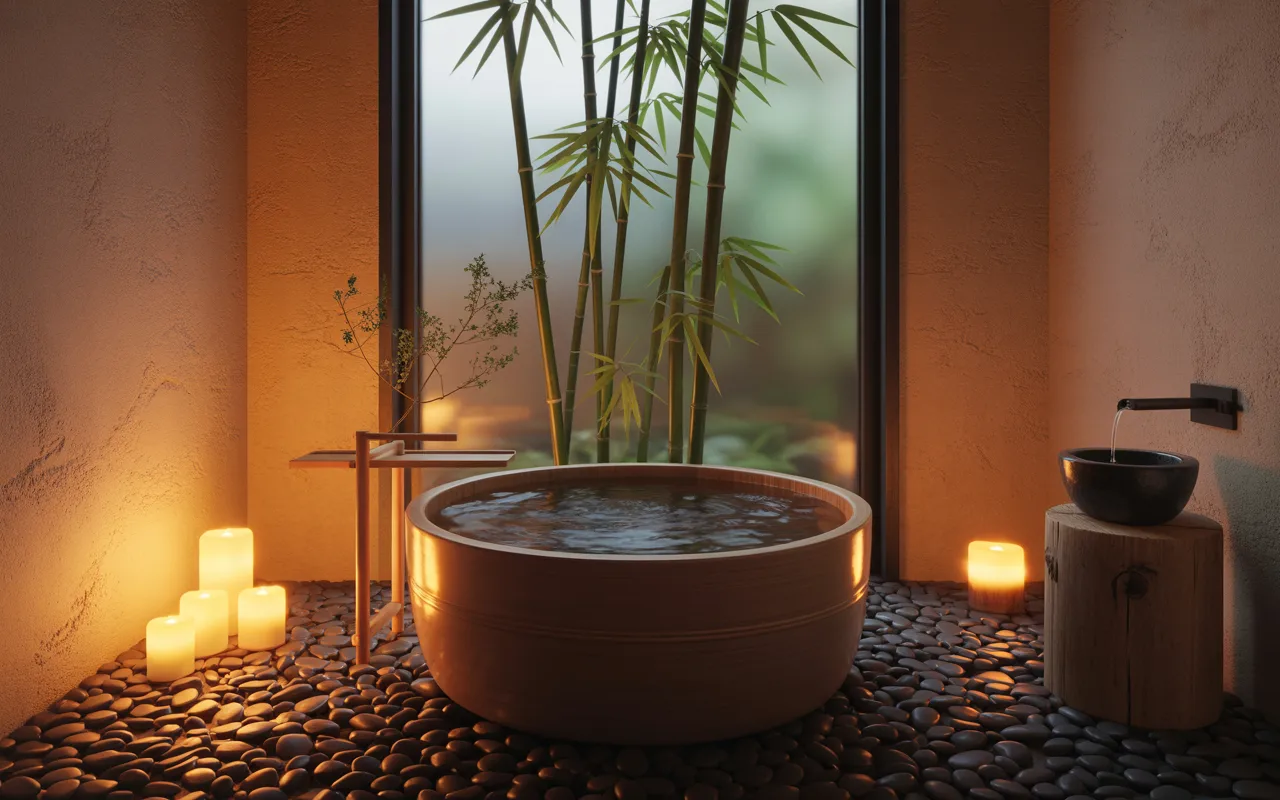
Introduction
Somewhere between a Japanese onsen and a Scandinavian sauna, a new kind of bathroom has emerged — and it is completely rewriting the rules of what relaxing actually looks like. Japandi bathrooms strip away every unnecessary surface, every fussy fixture, every decorative excess, and replace all of it with honest materials, grounded proportions, and a quality of stillness that the most expensive spa cannot manufacture. These 21 bathrooms will show you that what relaxing actually looks like has very little to do with luxury — and everything to do with intention.
1. Deep Soaking Tub in Honed Black Slate
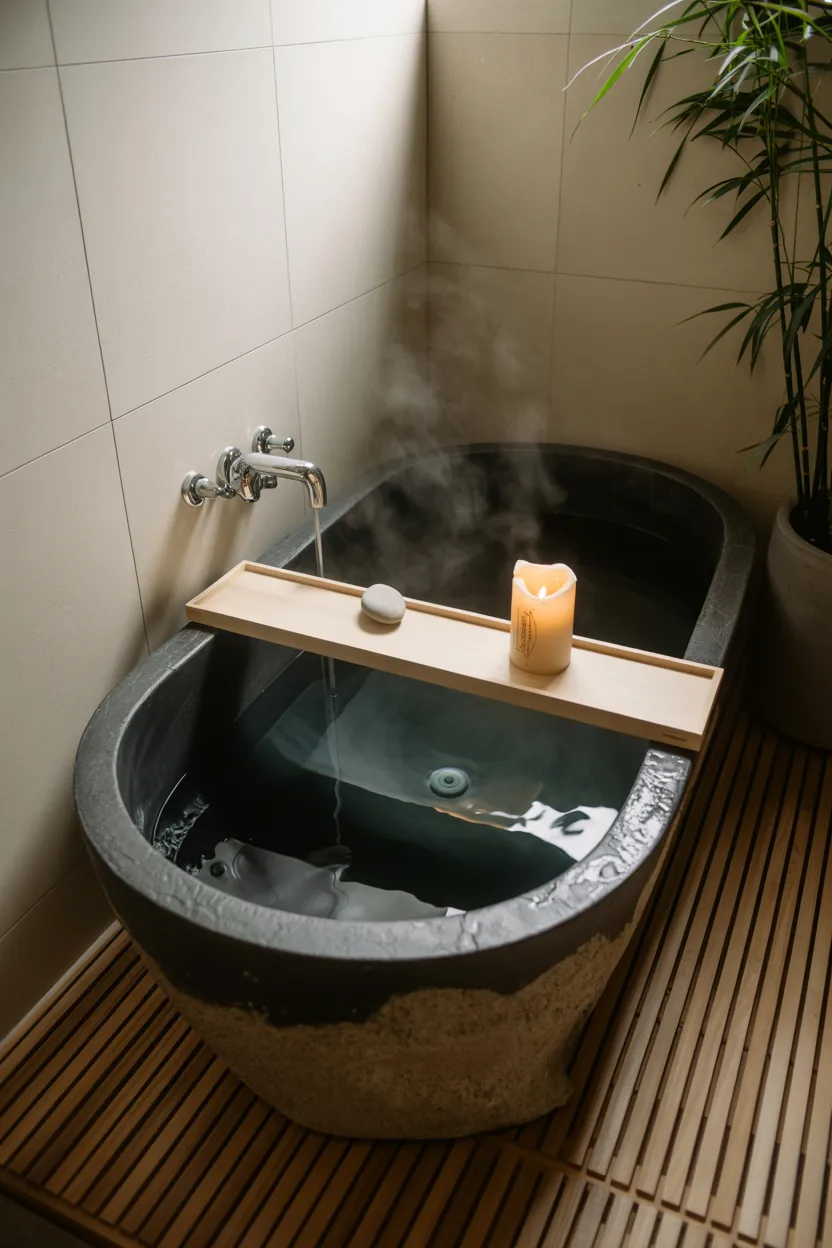
A deep soaking tub in honed black slate redefines what relaxing actually looks like by replacing the conventional white acrylic bathtub with something that feels geological in its permanence and beauty. The matte black surface of honed slate absorbs heat slowly and releases it gradually, making the bath water stay warmer longer — a functional luxury that the stone material provides without any additional engineering. Against pale plaster walls and an oak slatted floor, the black slate tub becomes the room’s unambiguous focal point.
The white ceramic tray across the tub’s edge holding only a smooth river stone and a beeswax candle is the Japandi styling decision that completes the composition — three objects maximum, each chosen for sensory contribution. The stone provides tactile weight, the candle provides warm light and subtle fragrance, the tray provides structure. Nothing more is needed. In a bathroom this honest about its materials and this restrained in its styling, the bath itself becomes the experience of what relaxing actually looks like at its most elemental.
2. Japanese Hinoki Wood Bath With Steam and Candlelight
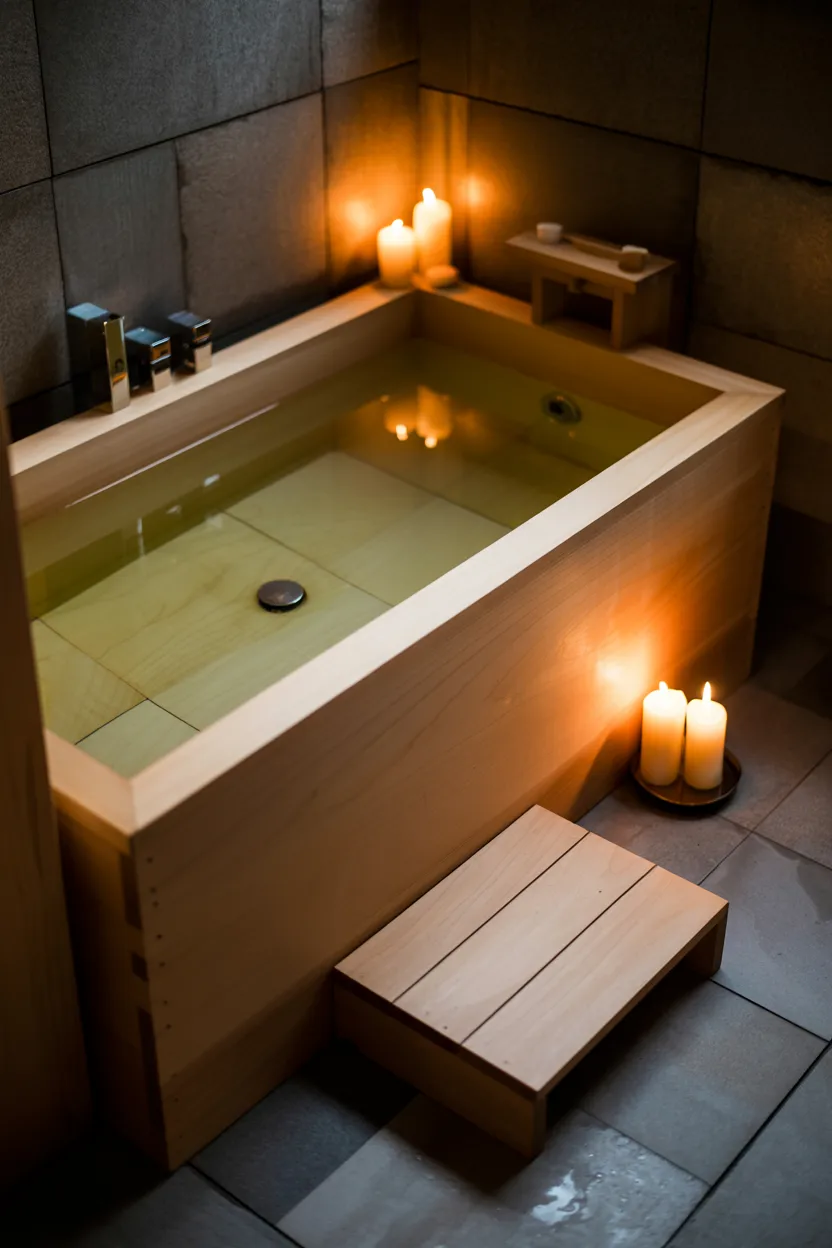
The hinoki wood bath is the most deeply Japanese expression of what relaxing actually looks like in a Japandi bathroom — hinoki cypress has been used in Japanese bathhouses and imperial bath chambers for over a thousand years because of its extraordinary sensory properties. The wood releases a clean, slightly citrusy fragrance when it contacts warm water, its grain is extraordinarily fine and smooth against the skin, and its pale honey tone warms the entire bathroom with an organic luminosity that no tile or stone can replicate.
Bathing in a hinoki tub is the full-body sensory experience that Japandi bathroom design aspires to create — the warmth of the wood, the fragrance rising with the steam, the visual simplicity of a single beautifully crafted vessel holding warm water. Candlelight rather than electric illumination is the ideal companion to a hinoki bath, honoring the ancient quality of the material with an equally ancient quality of light. This is what relaxing actually looks like when design meets centuries of bathing culture.
3. Wabi-Sabi Plaster Shower With Pebble Floor
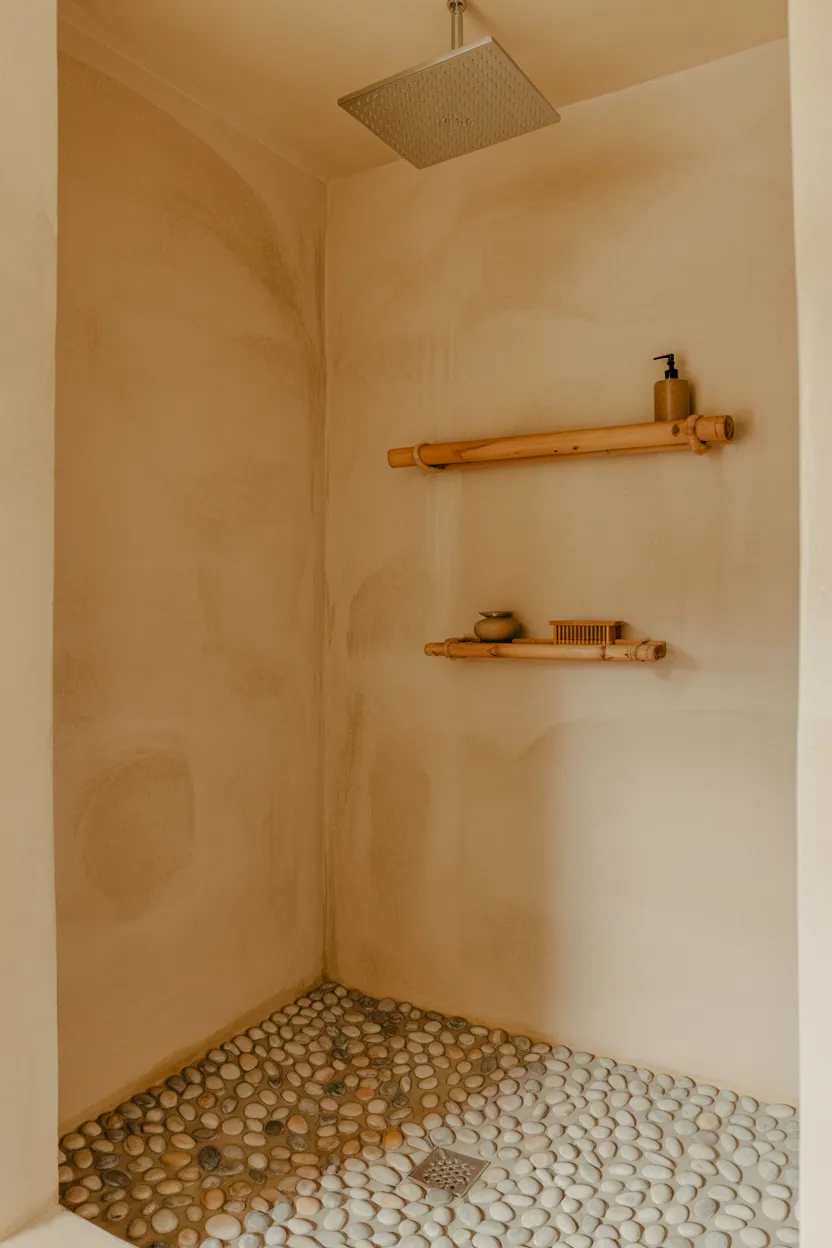
The wabi-sabi plaster shower redefines what relaxing actually looks like at a purely sensory level — every surface in this shower is organic, warm, and imperfect in the precise way that natural materials are imperfect: the plaster shows the marks of the hand that applied it, the river pebbles are each a different size and tone, the bamboo shelf was once a living plant. Together these materials create a shower that feels grown rather than manufactured, ancient rather than designed.
The river pebble floor is a reflexology experience built directly into the daily routine — the varied sizes and surfaces of the smooth stones massage the soles of the feet with every step, connecting the body to a sensation of walking by a stream while standing under warm rainfall. This is the Japandi bathroom philosophy made physical: that what relaxing actually looks like is not a white marble spa but a space that engages every sense with honest, natural materials that have been used for bathing since human civilization began.
4. Japandi Bathroom With Bamboo Stool and Natural Accessories
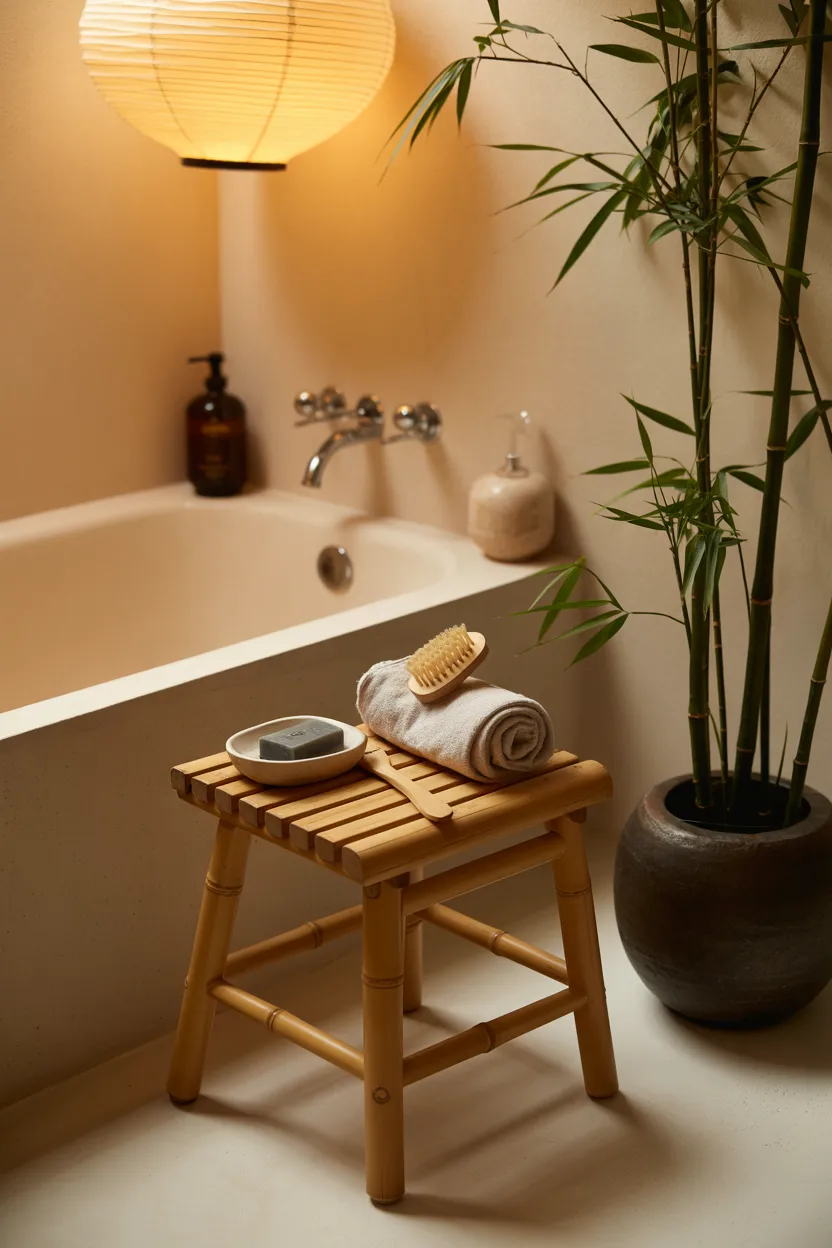
The bamboo bath stool is a Japanese bathing tradition brought directly into the contemporary Japandi bathroom to redefine what relaxing actually looks like through ritual rather than luxury. In Japanese bathing culture, the low stool is used for the cleansing ritual that precedes soaking — sitting at floor level, washing thoroughly before entering the communal or private bath. In a Japandi bathroom, this piece of cultural furniture becomes a beautifully functional accessory holder and a daily reminder of the intentional, ritual quality of Japandi bathing.
Natural bristle brushes, charcoal soap, wooden accessories, and ceramic dishes are the material companions to the bamboo stool — each one chosen for its natural origin and its sensory contribution to the bathing ritual. A paper lantern overhead provides the warm, diffuse light that makes this collection of natural objects glow with the quality of a still life painting. The bamboo plant in the corner brings living nature into the most private room of the house. These Japandi bathroom choices reshape what relaxing actually looks like one natural object at a time.
5. Japandi Bathroom With Exposed Concrete and Warm Wood
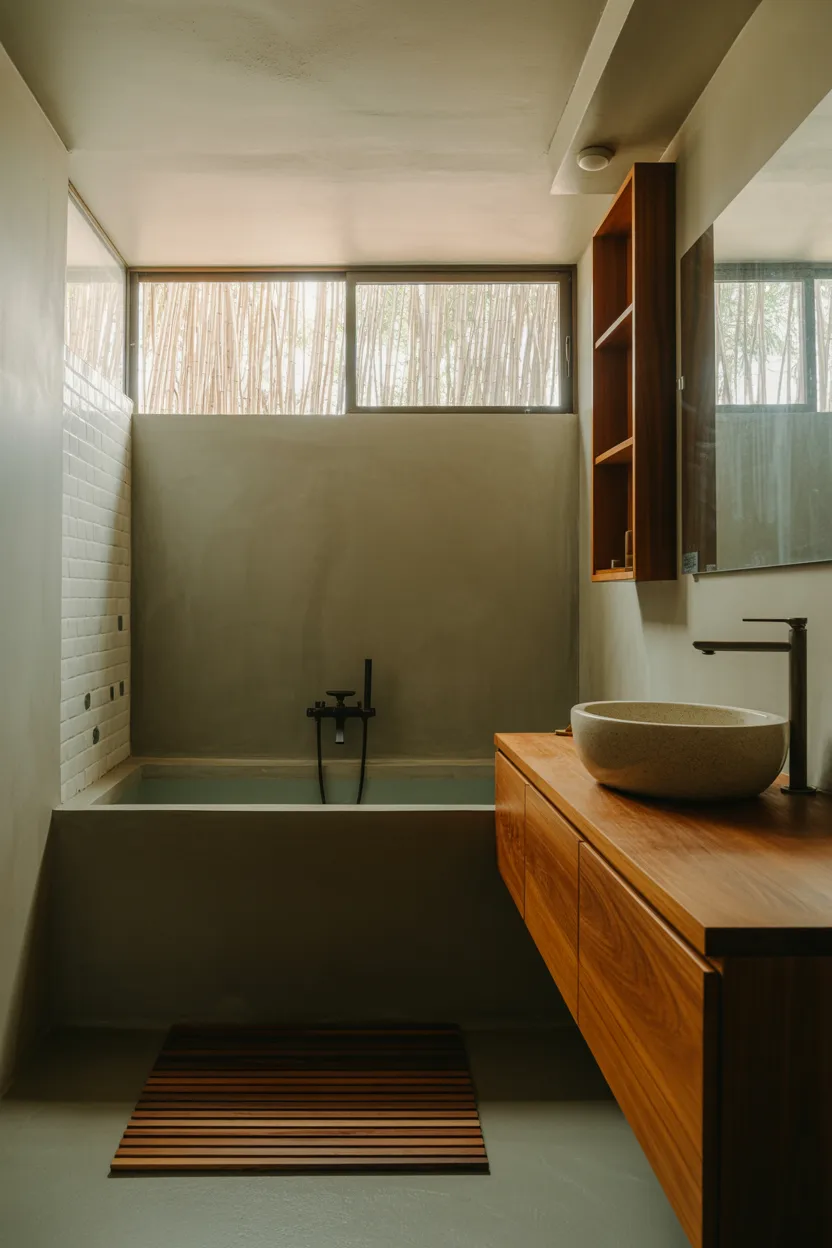
Exposed concrete paired with warm teak wood is the material combination that most completely captures what relaxing actually looks like in a Japandi bathroom that bridges the industrial and the organic. Polished concrete in a warm dove gray tone has a meditative quality — its surface is cool to the touch but warm in color, reflecting light in a diffuse, even way that painted walls cannot replicate. Against this mineral backdrop, teak wood accents introduce biological warmth with extraordinary effectiveness.
Teak is ideally suited to bathroom environments because it is naturally water-resistant, dimensionally stable, and becomes more beautiful with exposure to moisture over time — developing a silvery patina that deepens the contrast between its grain lines and base tone. A teak bath mat eliminates the need for a textile mat entirely while providing the barefoot warmth of natural wood. The matte black faucet against white ceramic provides the single graphic accent in an otherwise all-natural palette. This bathroom is redefining what relaxing actually looks like through the tension between mineral and organic.
6. Minimalist Japandi Bathroom With Negative Space as Design
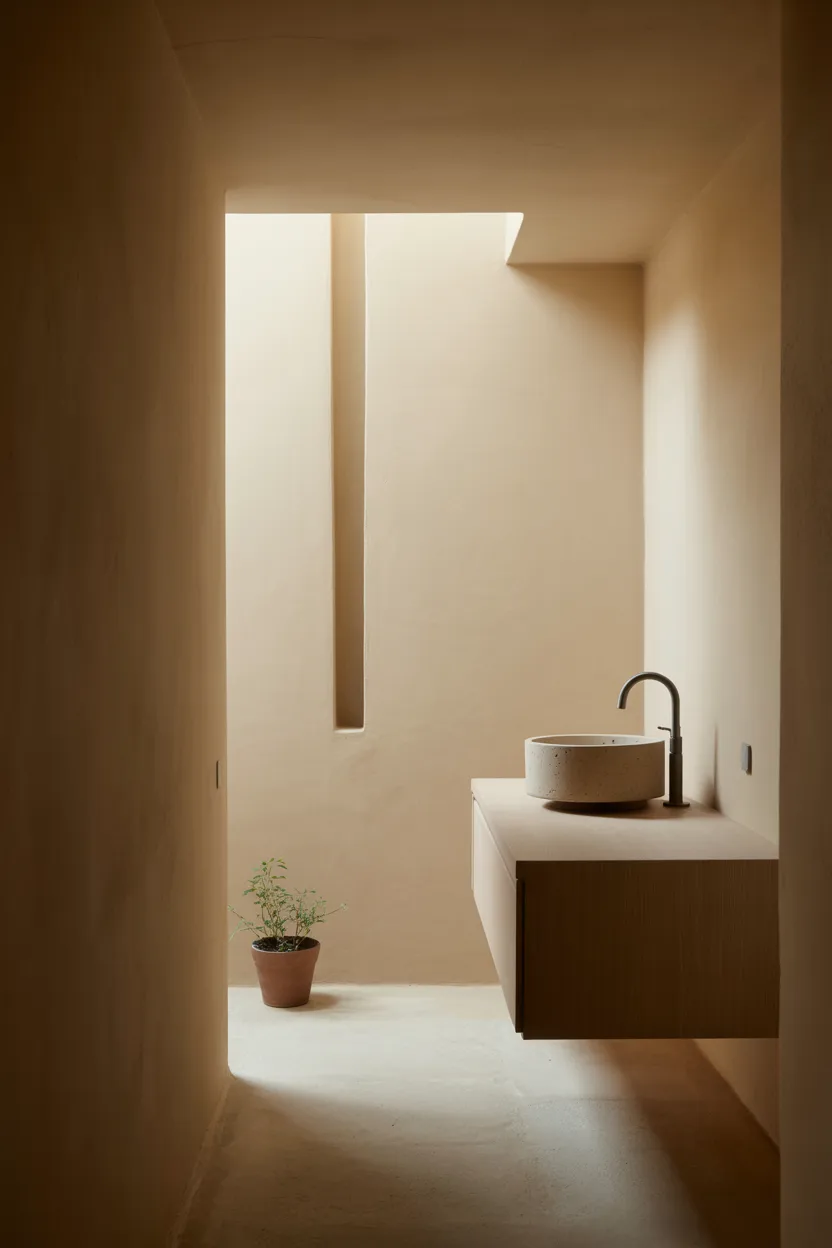
A Japandi bathroom designed around negative space forces a complete reconsideration of what relaxing actually looks like — it asks whether a bathroom needs to be filled with products, accessories, and surfaces at all, or whether the experience of bathing and preparing might be made more restorative by the deliberate removal of visual complexity. A floating vanity in pale ash, one ceramic vessel sink, one matte black tap — three elements that provide every functional necessity while taking up a fraction of the visual space a conventional vanity would claim.
The bare warm white plaster walls extending around these minimal fixtures create a quality of spaciousness that makes even a small bathroom feel generous and unhurried. The single narrow window sending a shaft of light across the plaster wall changes throughout the day — moving slowly from one side of the room to the other like a sundial, marking the passage of time with the most ancient light source available. In a Japandi bathroom that honors negative space this completely, the act of washing becomes genuinely meditative. This is what relaxing actually looks like when restraint becomes a form of care.
7. Japandi Bathroom With Rainfall Shower and River Stone Wall
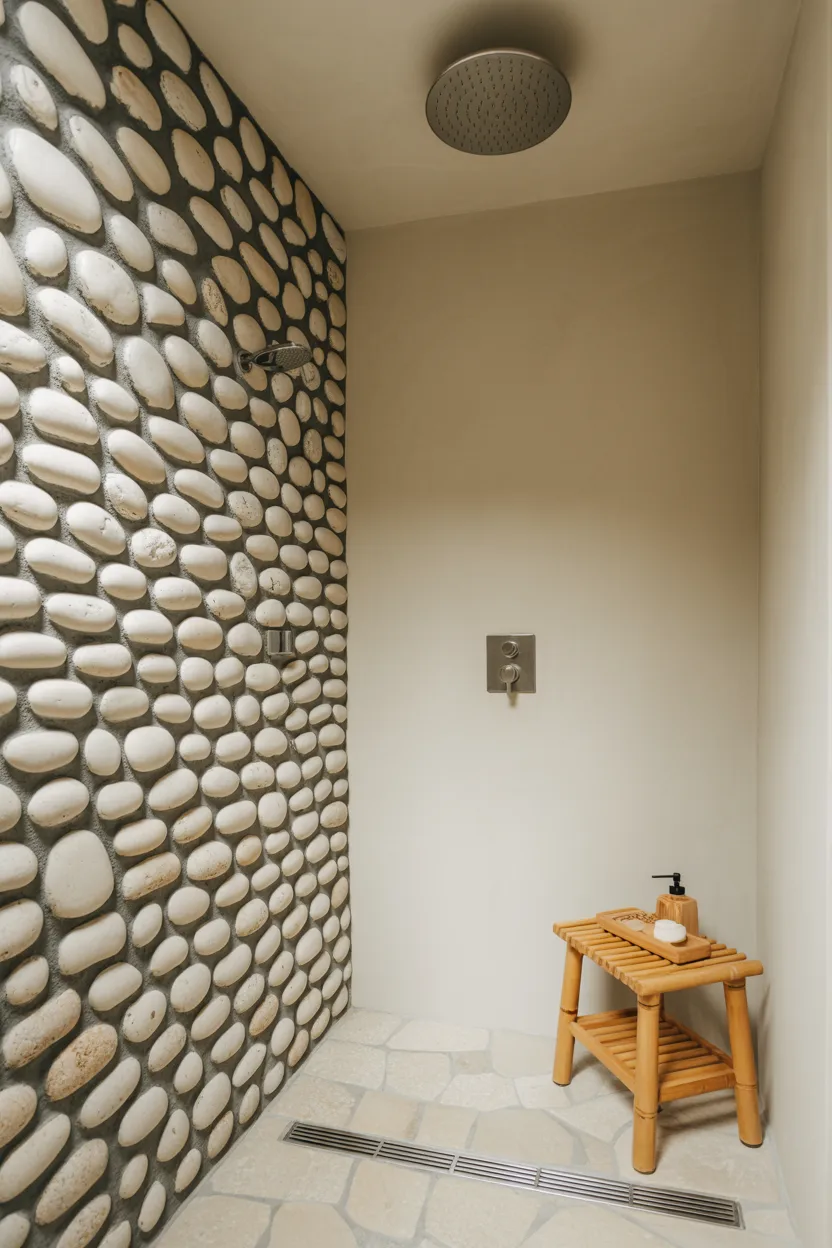
A river stone accent wall in a Japandi shower is the design decision that most dramatically redefines what relaxing actually looks like by bringing the visual and tactile experience of a natural riverbank directly into the shower enclosure. The tumbled stones in their irregular, organic pattern create a surface that is entirely unlike any manufactured tile — each stone is a different size, a different tone, a different surface texture, and together they form a wall of natural complexity that changes appearance depending on whether it is wet or dry, in morning light or artificial light.
Under the rainfall showerhead, water runs down the river stone wall in shifting paths that are never exactly the same twice — finding the irregular channels between stones in a way that is unpredictably beautiful and deeply calming to observe while showering. The contrast between this ancient, geological wall surface and the smooth pale limestone floor creates a material tension that feels primal and grounding. Standing under warm rain in a room of smooth stone, surrounded by what relaxing actually looks like when design borrows from nature without apology.
8. Japandi Bathroom With Japanese Noren Textile Divider
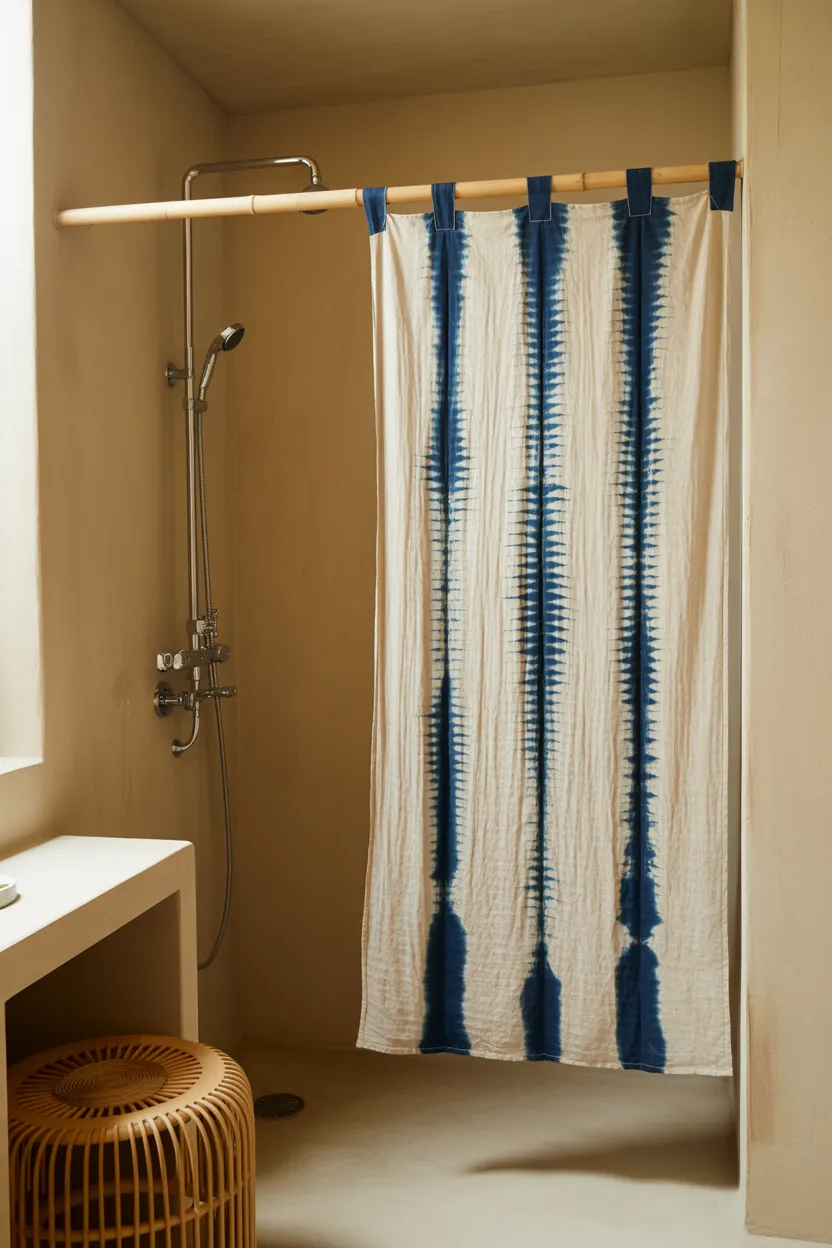
A Japanese noren curtain used as a bathroom divider introduces what relaxing actually looks like from a cultural textile tradition that dates back centuries in Japanese domestic and commercial spaces. In Japanese culture, a noren hanging in a doorway signals welcome, marks a transition between spaces, and communicates the aesthetic sensibility of the home’s inhabitants through its material, pattern, and color. A shibori-dyed indigo noren in a Japandi bathroom brings all of this cultural meaning into a contemporary bathing space with extraordinary visual impact.
The shibori technique — a form of resist dyeing that creates the beautiful, irregular indigo patterns unique to each piece — produces a textile that is itself wabi-sabi in its philosophy: the imperfect dye penetration is not a flaw but the mark of the process, and that mark is what makes each noren unique and beautiful. As the only color note in an otherwise all-neutral Japandi bathroom, the indigo noren claims the eye completely while everything around it remains calm and supportive. This is what relaxing actually looks like when textile tradition meets contemporary spatial design.
9. Japandi Bathroom With Floating Teak Vanity and Vessel Sink
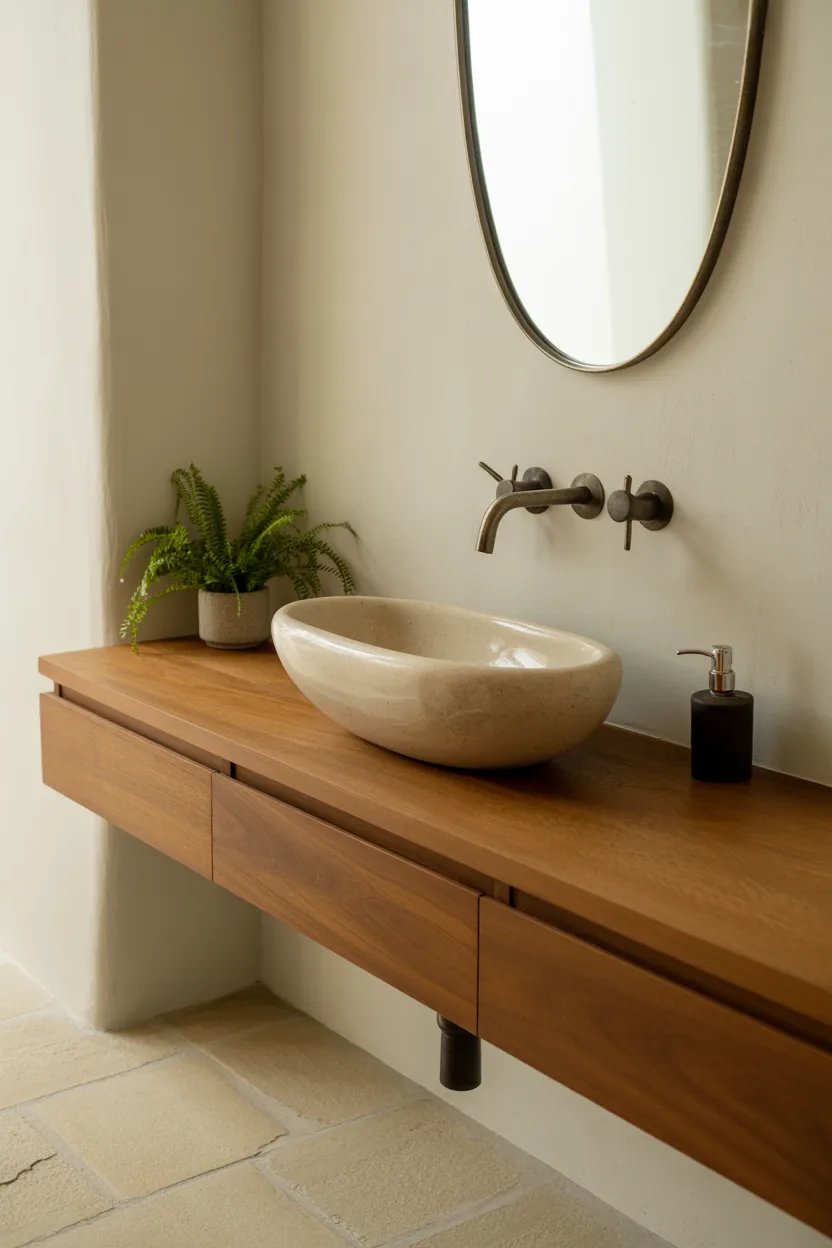
The floating teak vanity is the piece of furniture that most efficiently communicates what relaxing actually looks like in a Japandi bathroom — by suspending the vanity off the floor, it creates a visual lightness and a practical ease of floor cleaning that ground-level vanities cannot offer. The gap between the vanity and the limestone floor is both functional and beautiful: the clean line of pale stone uninterrupted by the vanity’s base makes the floor appear to extend further and the room feel more spacious.
An unglazed clay ceramic vessel sink is the Japandi bathroom’s answer to the conventional porcelain basin — its matte, slightly rough surface in a warm terracotta or sandy clay tone introduces the wabi-sabi quality of imperfect beauty into the daily ritual of hand washing. The clay vessel sits on the teak wood surface with the quiet authority of an object that belongs exactly where it is. An aged brass mirror overhead completes the material story — three natural tones (teak, clay, brass) in perfect organic harmony. This bathroom knows what relaxing actually looks like through material honesty.
10. Japandi Bathroom With Open Shelf Displaying Towels as Art
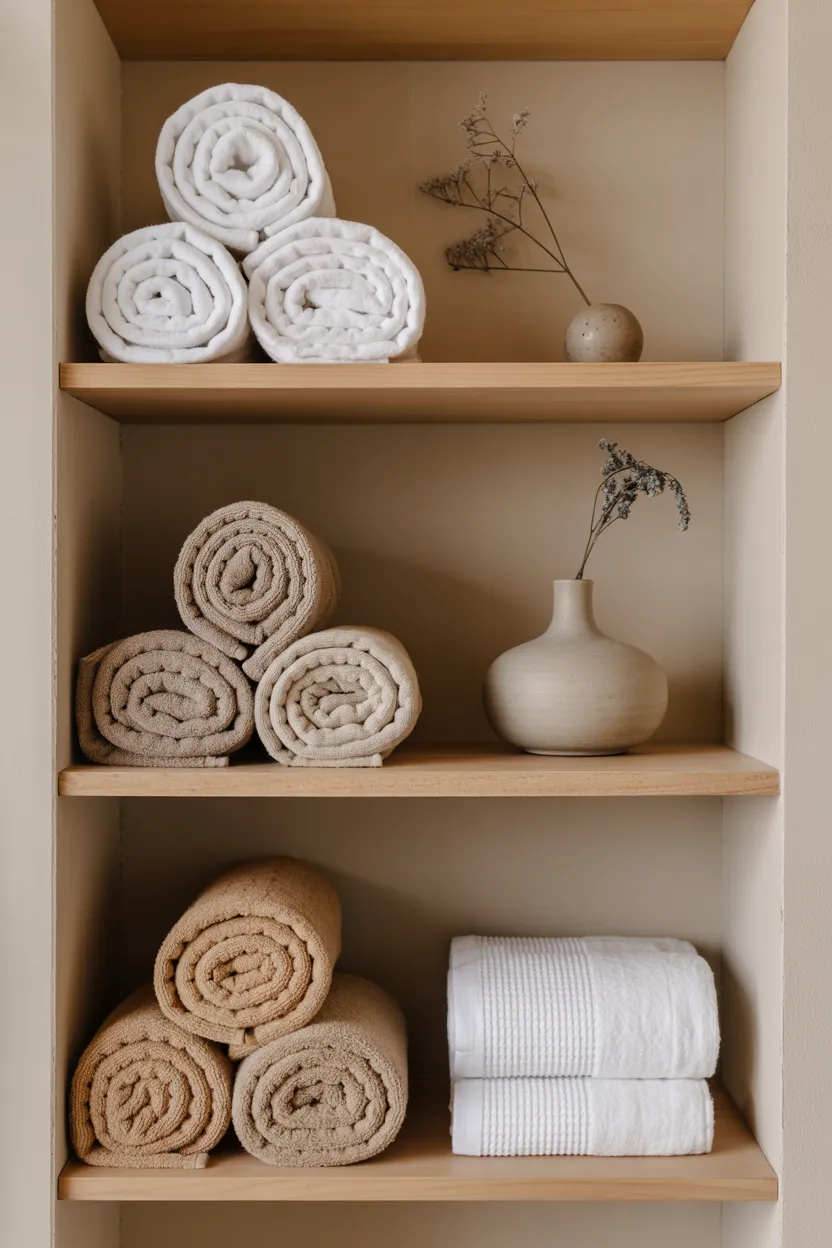
Open towel shelving styled with the care of a Japanese textile display is one of the Japandi bathroom practices most responsible for redefining what relaxing actually looks like in a domestic setting. In a conventional bathroom, towels are functional items stored for access. In a Japandi bathroom, towels in undyed linen and organic cotton are also textural objects of natural beauty — their rolled or neatly folded forms, arranged by tonal gradation on a pale ash shelf, create a display that the eye rests on with genuine pleasure.
The discipline of limiting each shelf to three or four towels — and maintaining that limit through daily discipline rather than cramming in extras — is a bathroom practice that mirrors the Japandi philosophy of the entire home: quality over quantity, beauty over convenience, intentionality over accumulation. A single ceramic vessel and one dried botanical stem among the towels elevate the shelf from storage to still life. This daily-reset display is what relaxing actually looks like when the organization of a bathroom becomes a form of mindfulness.
Visit more https://www.pinterest.com/Dreamgardenshome/
11. Japandi Bathroom With Ikebana Arrangement on the Bathtub Edge
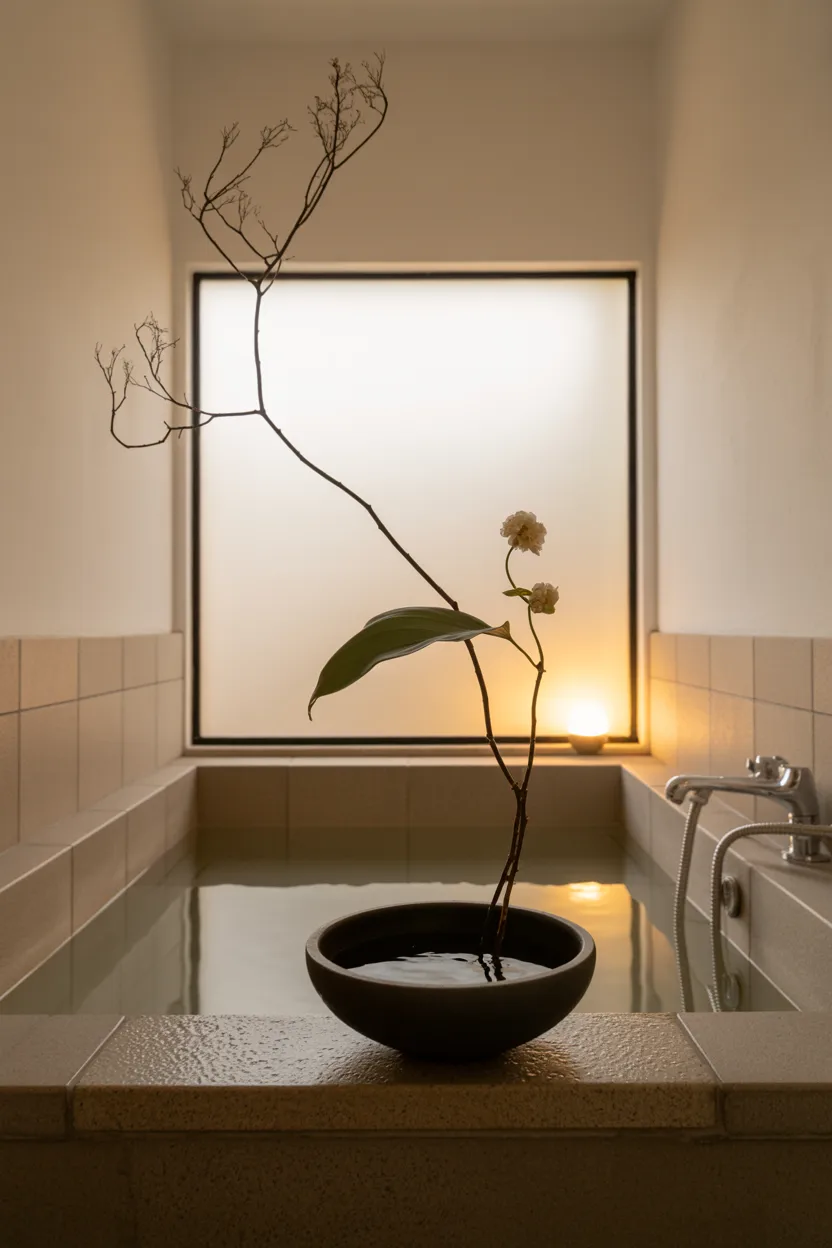
An ikebana arrangement on the bathtub edge brings the Japanese art of intentional flower arrangement into the most intimate room of the house, redefining what relaxing actually looks like by making the act of bathing an occasion worthy of art. Ikebana works with a maximum of three plant elements arranged to suggest the relationship between heaven, earth, and humanity through asymmetric composition — one arching branch reaching upward, one bloom at the middle height, one broad leaf grounding the arrangement at the vessel’s lip.
Placed on the wide stone edge of a soaking tub, the ikebana arrangement becomes the bath companion — present at eye level when the bather is submerged, close enough to observe the individual beauty of each element, and positioned so that the arrangement and its reflection in the water are both visible simultaneously. Late afternoon light through a frosted window behind the arrangement creates a backlit glow that makes the branch and bloom appear three-dimensional and otherworldly. This is the Japandi bathroom at its most aesthetically refined — and what relaxing actually looks like when art and bathing become inseparable.
12. Japandi Bathroom With Dark Walls and Warm Candlelight
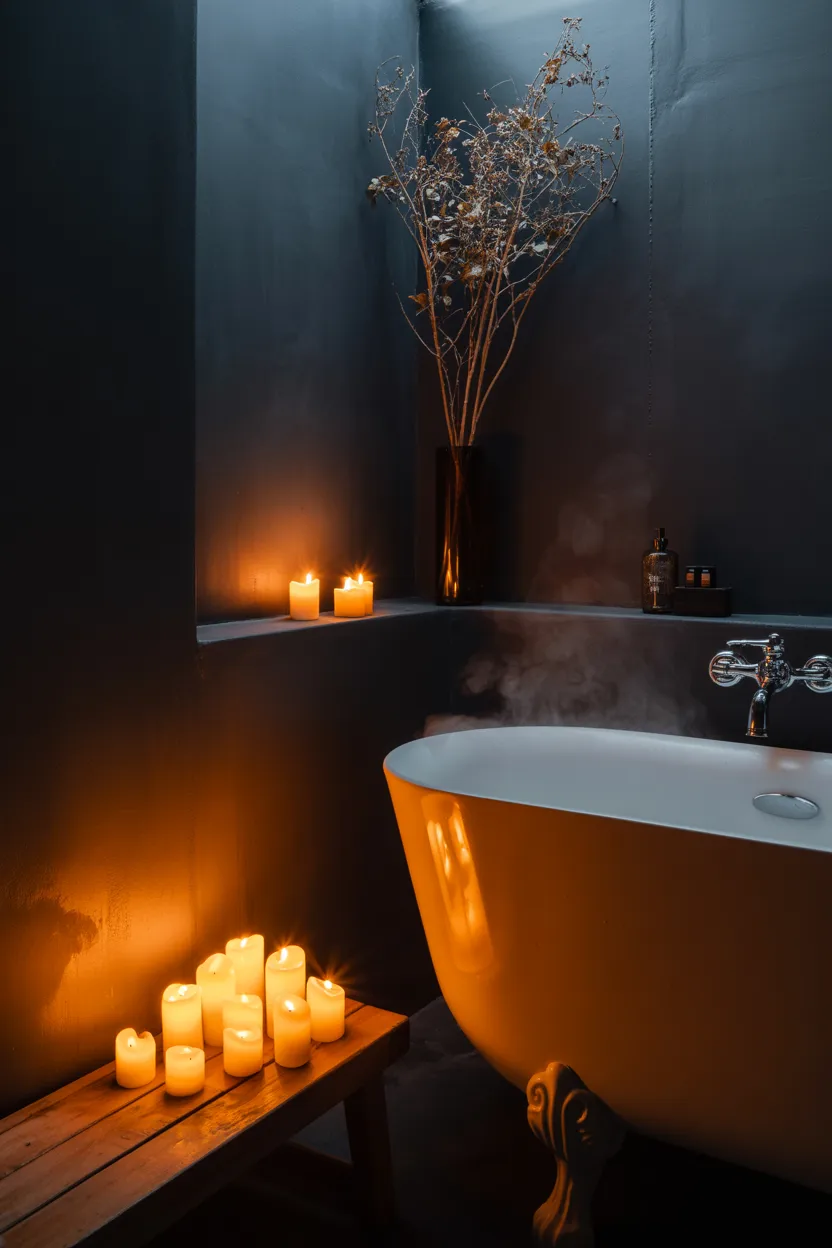
Dark-walled Japandi bathrooms redefine what relaxing actually looks like by creating an enveloping intimacy that pale bathrooms fundamentally cannot achieve. Deep charcoal or near-black walls absorb all ambient light, making the bathroom feel cave-like in the most primal, sheltering sense — and in that darkness, a matte white freestanding tub and the warm amber glow of beeswax candles become extraordinarily beautiful, luminous against the deep backdrop in a way that they could never appear against pale walls.
Candlelight is the only appropriate illumination for a dark Japandi bathroom because it produces the warm, flickering, diffuse quality of light that makes faces, water, and surfaces appear more beautiful than any electric source can manage. The way candlelight reflects off the water surface in a white soaking tub, sending moving patterns of amber light across dark walls, creates a visual experience of profound warmth and hypnotic beauty. In this bathroom, what relaxing actually looks like is a room of controlled darkness and warm living light — ancient, elemental, and completely transformative.
13. Japandi Bathroom With Wooden Lattice Window for Privacy
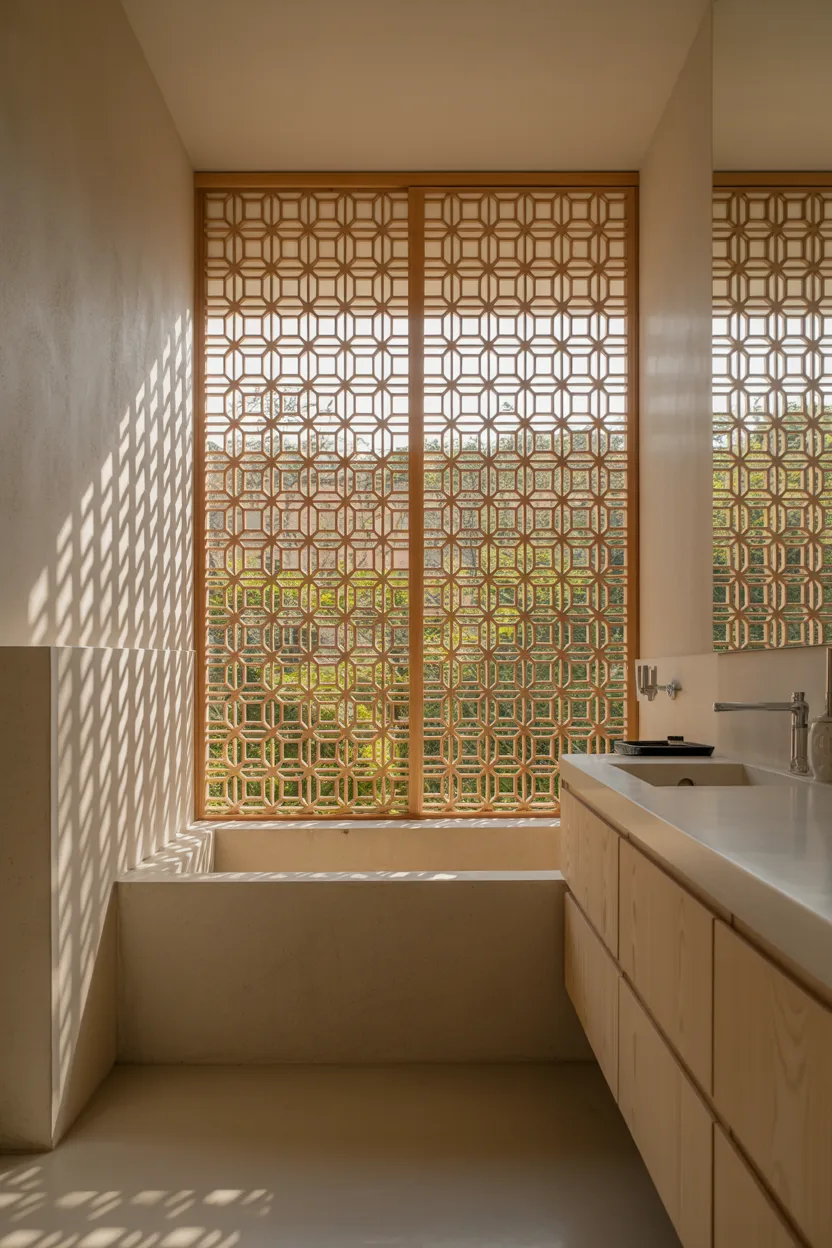
A Japanese kumiko wooden lattice window is the most architecturally refined of all Japandi bathroom features — kumiko is an ancient Japanese woodworking technique that creates complex geometric patterns from precisely cut and fitted wood pieces without nails or glue. A kumiko panel installed as the bathroom window is a work of extraordinary craftsmanship, and it makes what relaxing actually looks like an experience of living with fine art in the most functional room of the house.
The shifting shadow patterns that a kumiko lattice casts across plaster walls and limestone floors throughout the day create a bathroom that is different every hour — the morning sun creates long, dramatic shadow lines; midday light creates sharp geometric patterns; late afternoon light creates soft, warm overlapping shapes. The bathroom is never static because the light through the lattice is never static. Bathing in a room where the walls change throughout the day connects the daily routine to the movement of the sun — which is exactly what relaxing actually looks like when architecture and nature work together.
14. Japandi Bathroom With Outdoor Shower and Garden View
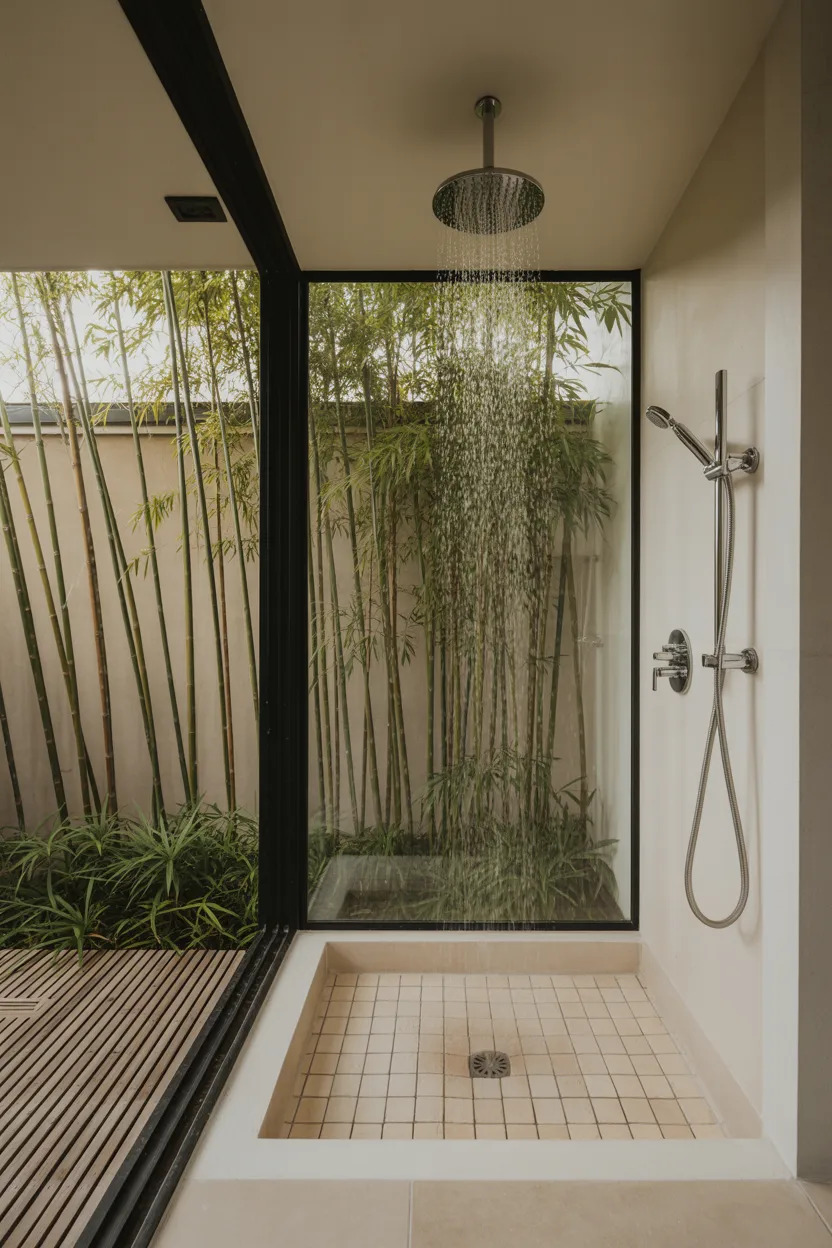
A Japandi bathroom with an outdoor shower connection and garden view completely redefines what relaxing actually looks like by dissolving the boundary between the interior bathing space and the natural world outside it. Showering under a ceiling-mounted rainfall head while looking directly at a private bamboo grove — with no visual barrier except transparent glass — creates a bathing experience so connected to nature that the separation between outside and inside becomes philosophical rather than physical.
The seamless sandstone floor extending from inside through the glass wall to the outdoor deck is the material device that makes this connection feel inevitable rather than designed — when the floor surface is continuous, the eye reads inside and outside as the same territory. A bamboo grove is the ideal Japandi garden for this bathroom because its vertical density creates total privacy while its organic movement in the breeze provides constant, living visual interest. This is what relaxing actually looks like when the bathroom and the garden become one continuous experience of water, warmth, and nature.
15. Japandi Bathroom With Shou Sugi Ban Accent Wall
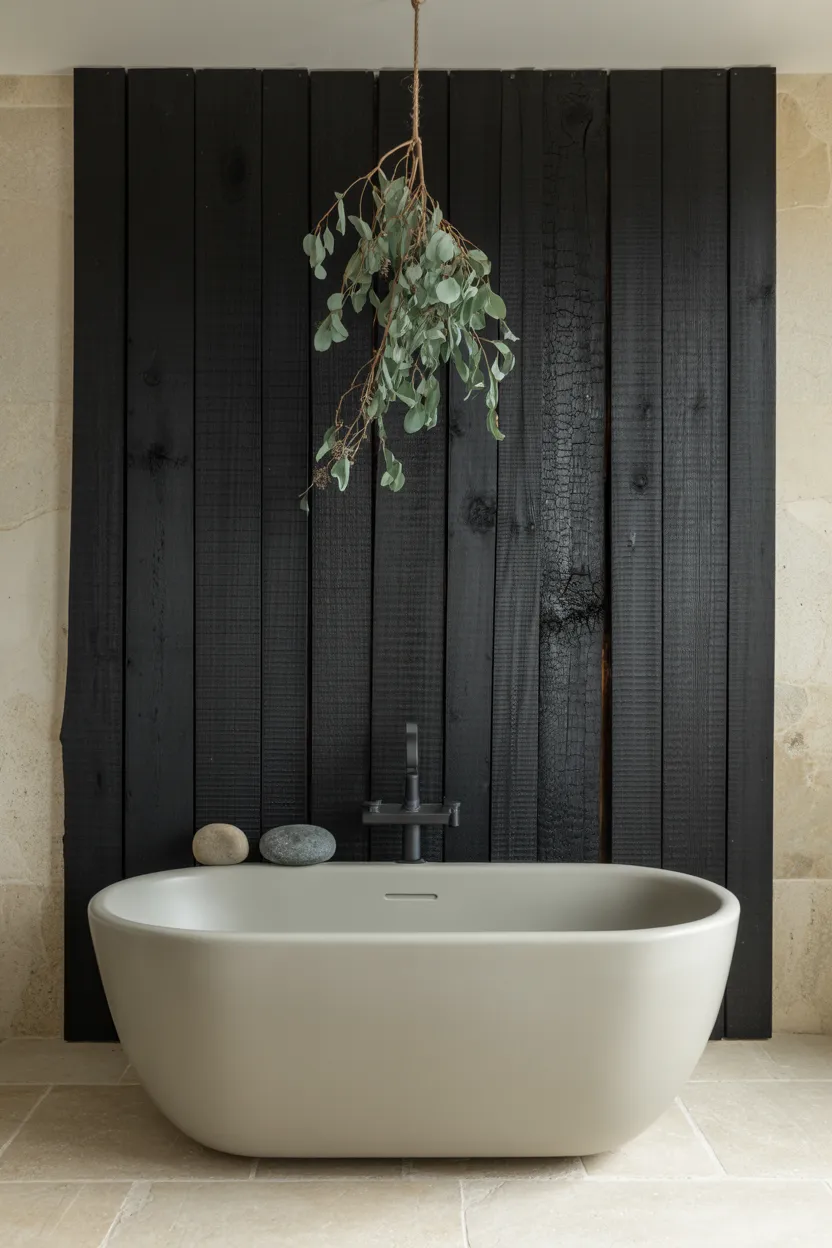
Shou sugi ban — the ancient Japanese technique of charring wood to preserve and beautify it — brings one of the most visually extraordinary materials into a Japandi bathroom to redefine what relaxing actually looks like at an elemental, almost primal level. The charred cedar surface has a depth and complexity that no paint or stain can achieve: the fire treatment creates irregular crackled patterns within the black char, and the combination of graphite tones, deep blacks, and occasional amber undertones makes the wall appear to be still smoldering with very slow, beautiful heat.
Against this dramatically dark wall, a matte white freestanding bathtub appears luminous — pure and clean against the darkened wood in a contrast so stark and beautiful it feels almost theatrical. The preserved eucalyptus hanging from the ceiling above the tub adds fragrance and organic softness to the sharp drama of the charred wall. River stones on the tub edge ground the composition in the natural world from which all these materials — charred wood, limestone, eucalyptus — originally came. This is absolutely what relaxing actually looks like when elemental materials are handled with complete design confidence.
16. Japandi Bathroom With Steam Room and Eucalyptus Ritual
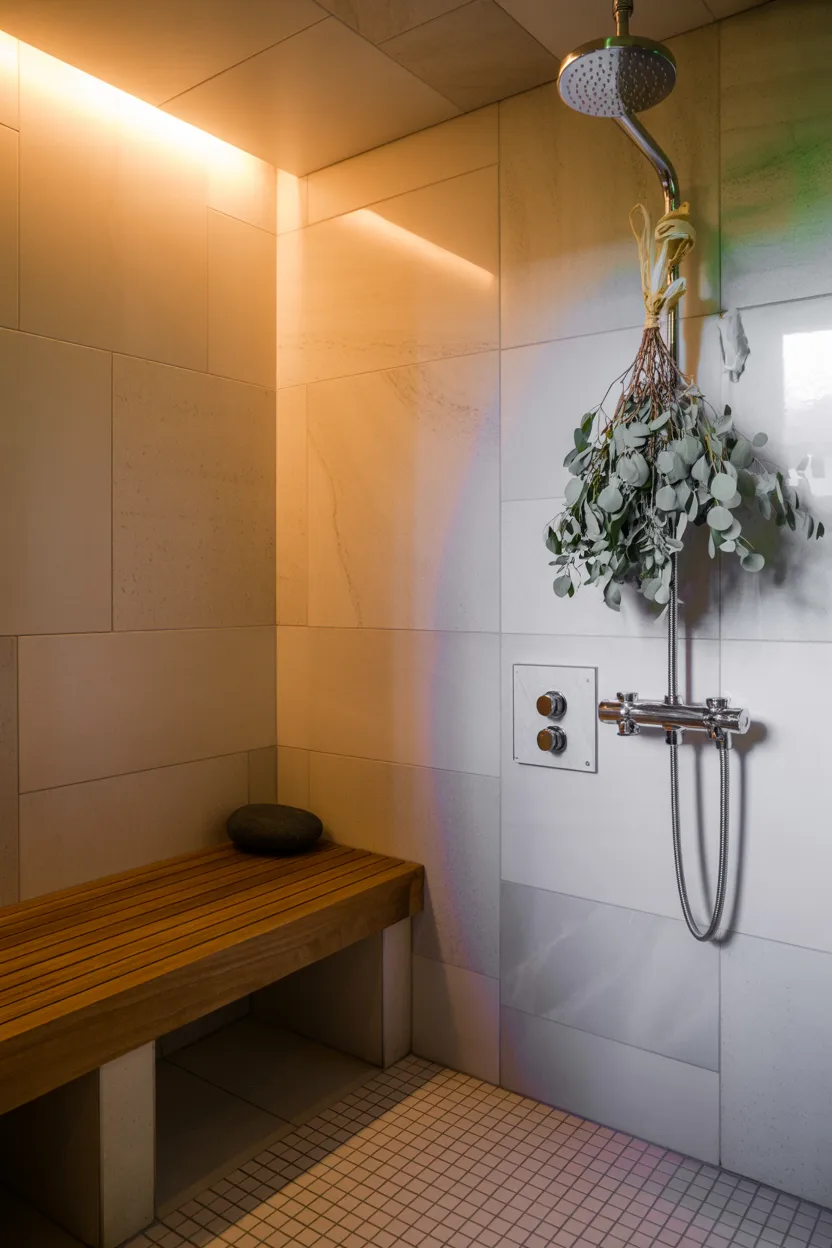
A Japandi steam room with the eucalyptus bundle ritual redefines what relaxing actually looks like by engaging every sense simultaneously — the heat of the steam, the sharp, clean fragrance of eucalyptus oil released by the warmth, the smooth teak wood beneath the hands, the amber glow of recessed lighting dimmed to its lowest level. This is bathing as a complete sensory experience rather than a functional routine, and the Japandi bathroom makes space for this experience by treating it as worthy of architectural consideration.
The eucalyptus bundle tied to the showerhead with natural twine is a ritual object — changed weekly, chosen for its fragrance intensity, its visual contribution to the steam room, and its connection to the natural world from which the entire Japandi bathroom aesthetic draws its deepest inspiration. Teak wood for the bench is the ideal steam room material because it remains cool enough to sit on comfortably while being completely water and moisture resistant. A single smooth black river stone on the bench is the meditation object — something to hold in the hand during the steam. This bathroom knows what relaxing actually looks like when ritual becomes architecture.
17. Japandi Bathroom With Moon-Phase Frosted Window
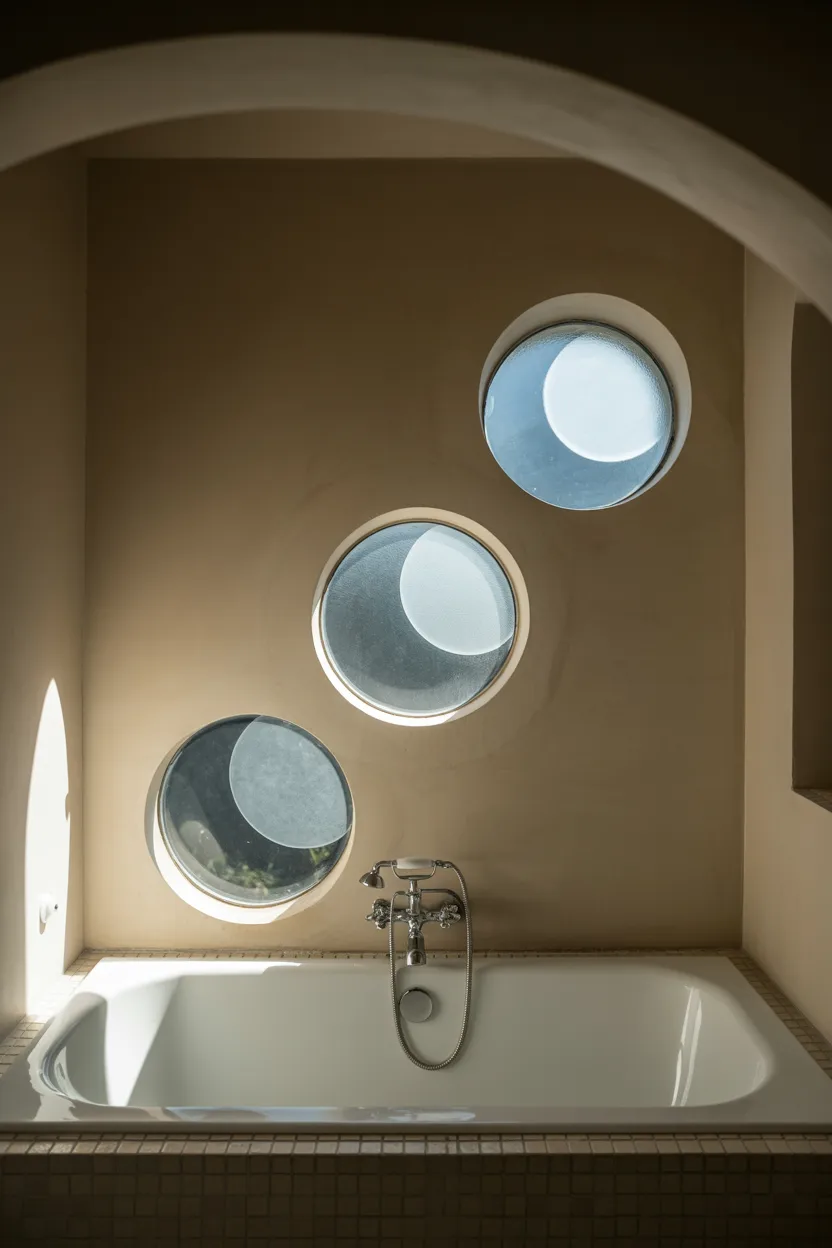
Moon-phase frosted windows in a Japandi bathroom introduce a quality of poetic natural beauty into the daily ritual of bathing, redefining what relaxing actually looks like by connecting the bathroom to the rhythm of the lunar cycle through its architecture. Three frosted glass windows in increasing circular sizes — small waxing crescent, full moon, waxing gibbous — suggest the moon’s monthly progression while admitting natural light in soft, diffuse circles that move across the opposite plaster wall throughout the day.
The philosophy behind this design choice is deeply aligned with the Japanese appreciation for seasonal awareness and natural cycles — the concept of mono no aware, or the gentle sadness of transience, expressed here not in autumn leaves but in the changing quality of light through circular frosted glass as the sun moves overhead. A long soak in the tub beneath these moon circles, watching the light disks move slowly across the warm white wall, is a meditation on time and impermanence made available in the most ordinary room of the home. This is what relaxing actually looks like when architecture speaks the language of the natural world.
18. Japandi Bathroom With Organic Cotton Robe and Ritual Dressing Area
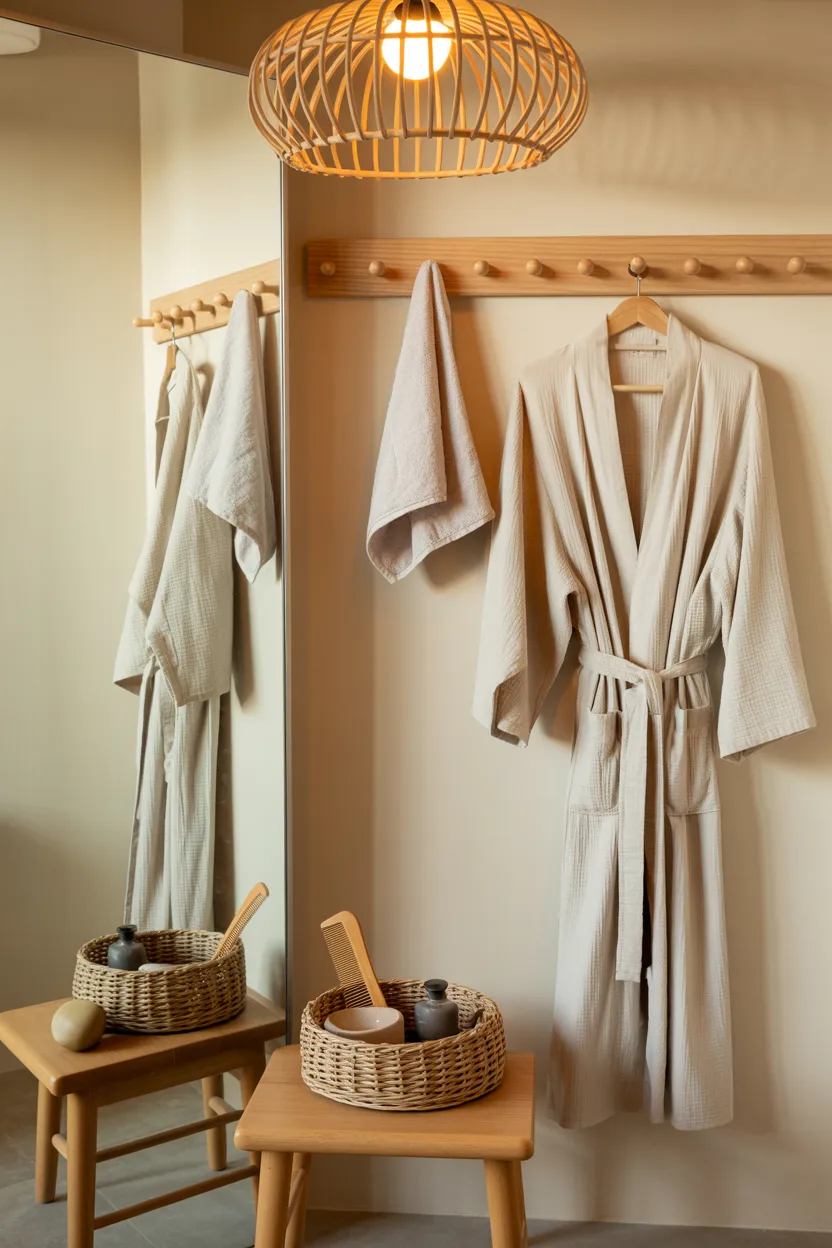
A dedicated ritual dressing area within a Japandi bathroom completely redefines what relaxing actually looks like after the bath — it creates a physical space for the transition from bathing to being dressed that honors this moment as worthy of intentional design rather than a practical afterthought. A single wooden peg rail holding one robe and one hand towel, a teak bench with a woven basket of carefully chosen grooming objects: this arrangement is minimal in its contents but maximal in its communicative power about how the bathroom experience should feel.
The organic cotton robe in warm oatmeal is the Japandi bathroom’s equivalent of fine sleepwear — chosen for its natural fiber, its weight, its warmth, and its tone rather than any brand or decorative detail. Wearing it after a deep soak, reaching for a wooden comb, touching a small ceramic vessel of body oil — these physical rituals are what what relaxing actually looks like when the bathroom is designed to support them rather than merely tolerate them. A rattan pendant above the dressing corner provides the final note of warm, diffuse light that makes the post-bath ritual genuinely restorative.
19. Japandi Bathroom With Meditative Sound — Bamboo Water Feature
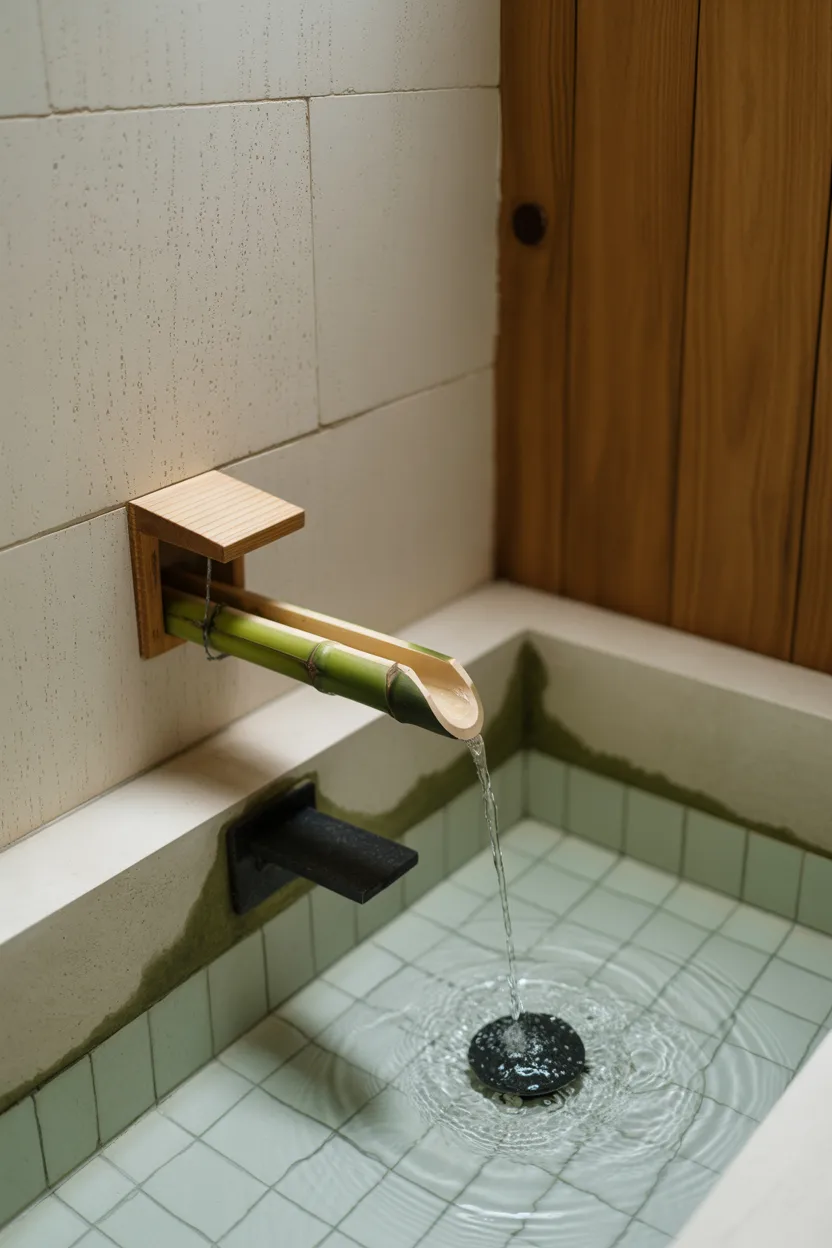
A shishi-odoshi bamboo water feature in a Japandi bathroom introduces the acoustic dimension of relaxation that pure visual design cannot provide, fundamentally expanding what relaxing actually looks like into what relaxing actually sounds like. The traditional deer-chaser mechanism — a length of bamboo that fills with water, tips, strikes a stone with a hollow knock, and resets — creates an irregular, unpredictable rhythm of gentle water sounds that the mind cannot habituate to and tune out, the way it quickly tunes out white noise or music.
The irregularity of the shishi-odoshi’s rhythm is precisely its meditative value — because the next tipping cannot be predicted exactly, the mind remains softly engaged with listening rather than drifting into anxiety or planning. This is the quality of attention that a Zen garden or a natural stream creates — focused without effort, calm without boredom. In a Japandi bathroom designed entirely from natural materials, the addition of this living water sound creates a sensory environment of complete organic warmth. This is what relaxing actually looks like when a bathroom remembers that the most restorative sounds in the world are made by water and wood.
20. Japandi Bathroom With Terrazzo Floor in Natural Tones
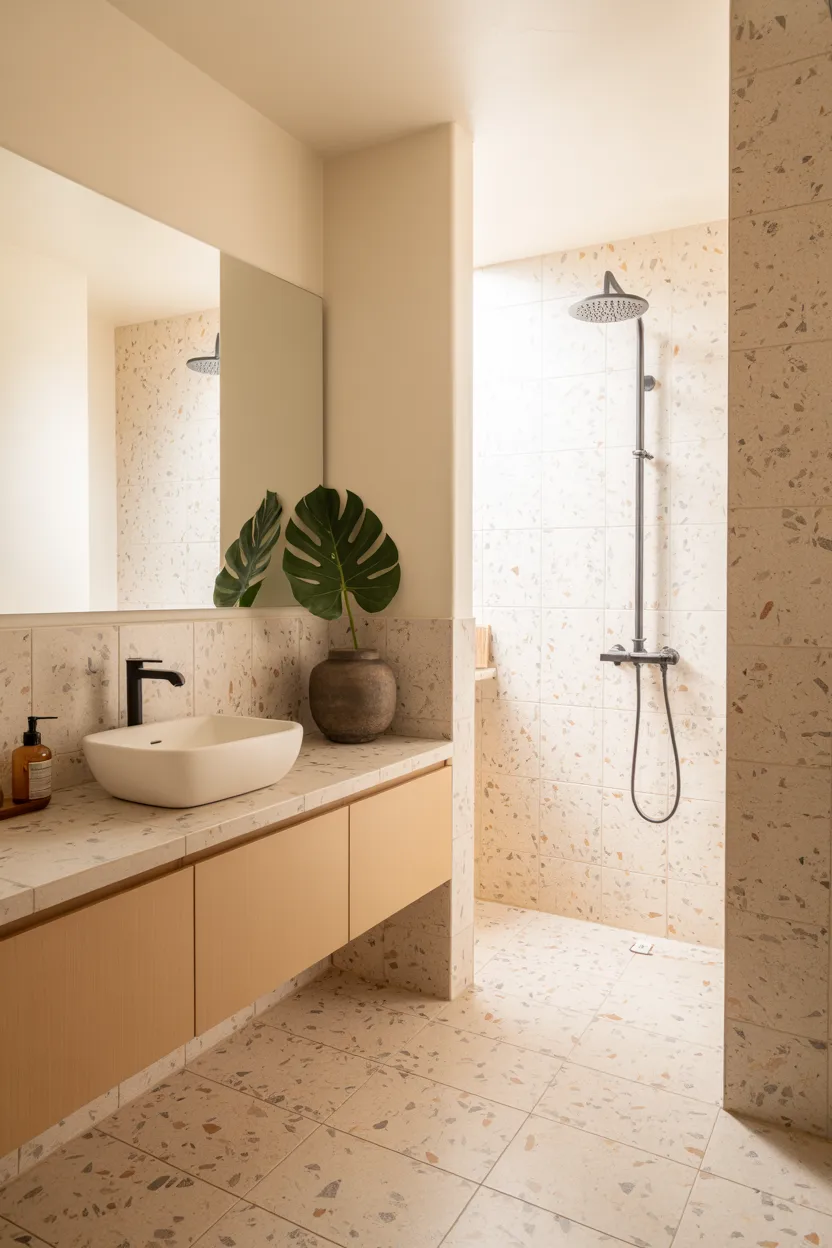
Natural-tone terrazzo flooring in a Japandi bathroom creates the most beautiful floor surface available for this aesthetic — a hand-poured composite of natural stone chips in warm cream, sand, terracotta, and ivory tones set in a pale matrix creates a floor that is unique, slightly irregular in its chip distribution, and increasingly beautiful with age and polishing. This is what relaxing actually looks like underfoot: a surface that tells the story of natural stone without the uniformity of tile, providing organic variety without visual chaos.
The seamless extension of the terrazzo floor from the main bathroom area directly into the walk-in shower without a threshold or change of material creates a spatial continuity that makes the bathroom feel like one unified room rather than a main area with a shower attachment. This continuity is a Japandi spatial principle — the elimination of unnecessary visual boundaries — applied to the floor plane. A single large monstera leaf in a dark ceramic pot provides the room’s only gesture toward bold organic form, its deep green and dramatic shape amplified by the terrazzo’s warm neutral ground. This floor knows what relaxing actually looks like beneath bare feet.
21. Japandi Bathroom Where Time Stops — The Complete Sensory Sanctuary
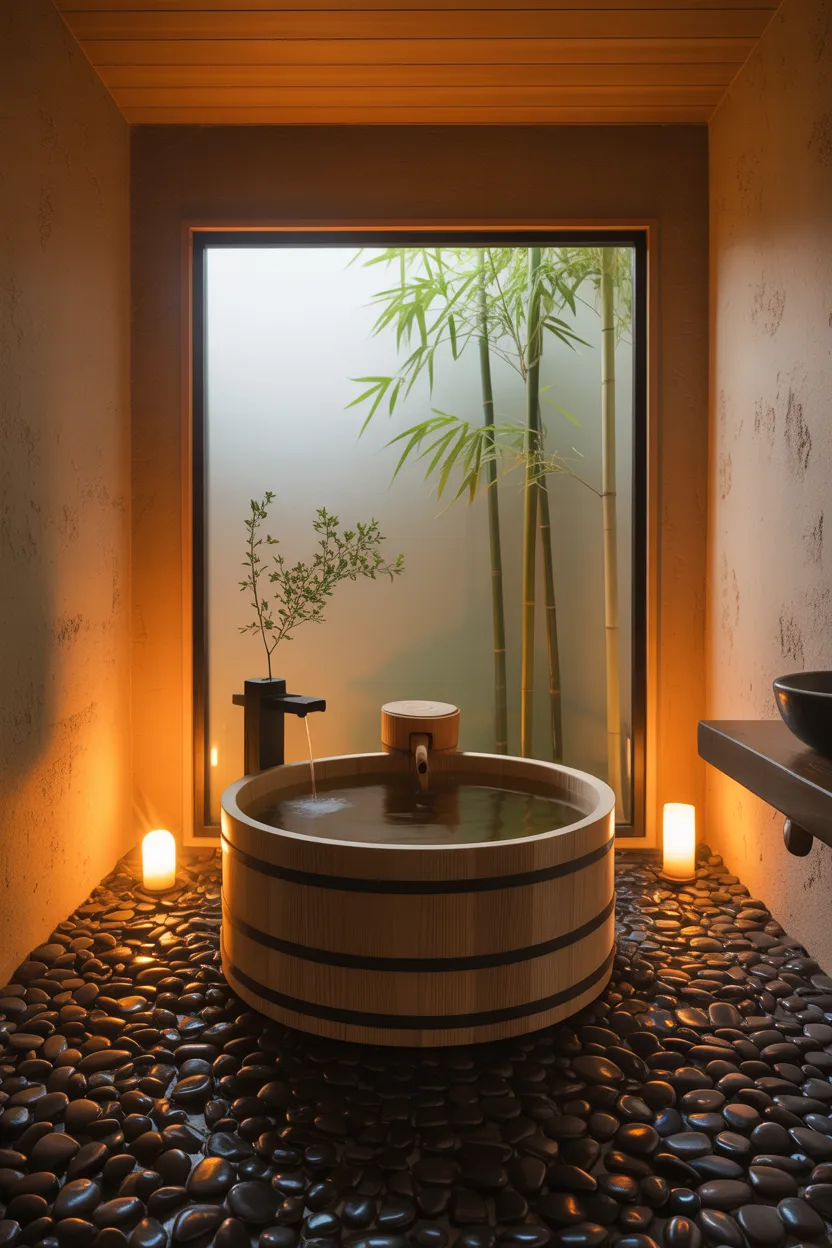
The complete Japandi sensory sanctuary bathroom is the fullest possible answer to what relaxing actually looks like — a room designed with equal attention to every sense simultaneously. The visual calm of wabi-sabi plaster walls and warm amber candlelight. The tactile richness of a hinoki wood tub and river pebble floor. The fragrance of eucalyptus and mineral water steam. The sound of a bamboo water feature filling and tipping in its ancient, irregular rhythm. The sight of bamboo silhouettes moving behind frosted glass. Together these five sensory experiences create a bathroom that is a complete retreat from every demand of the external world.
This is the Japandi bathroom philosophy at its most complete and most ambitious — not a room where one beautiful thing compensates for everything else, but a room where every single design decision contributes to the same unified experience of sensory calm. The hinoki wood, the eucalyptus, the candlelight, the pebble floor, the bamboo sound, the frosted window — each element was chosen for what it contributes to the body and the nervous system, not for how it photographs or how it signals taste. When a bathroom is designed from the inside out — from the body’s experience rather than the eye’s impression — the result is precisely what relaxing actually looks like in its most honest, most human, and most beautiful form.
Conclusion
These 21 bathrooms are not selling a style — they are offering a philosophy. Every design decision in a Japandi bathroom begins with a single question: does this make the experience of bathing more restorative, more honest, more connected to natural material beauty? When that question guides every choice from the floor surface to the single ceramic vessel on the vanity edge, the result is a bathroom that genuinely changes what relaxing actually looks like — not just visually, but physically, sensorially, and completely. Start with one honest material, and let everything else follow.

Join The Discussion