
Introduction
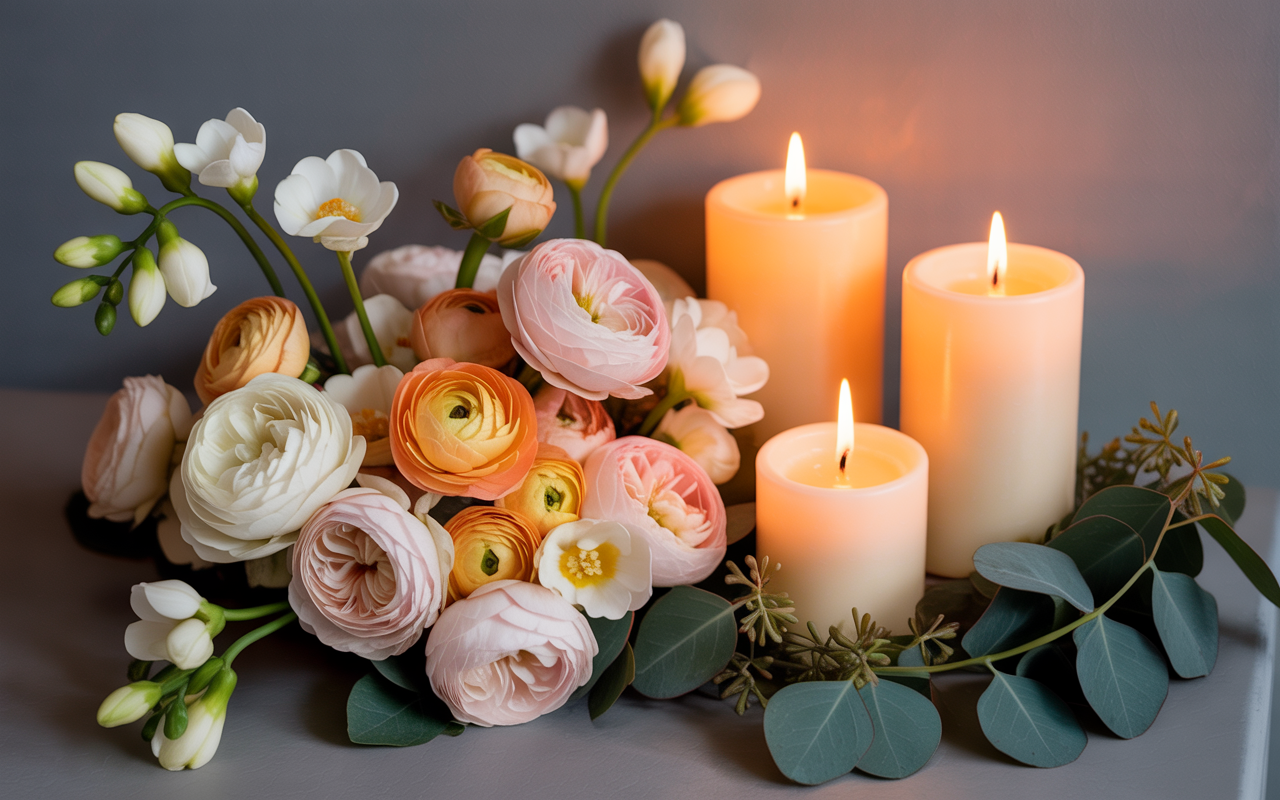
Winter florals deserve a completely different conversation than the arrangements filling every other season. The best winter floral arrangement ideas lean into drama, depth, and a moody richness that spring and summer flowers simply cannot achieve. Deep burgundy ranunculus, frosted eucalyptus, black calla lilies, and smoke-dried botanicals create atmospheres that feel genuinely cinematic — like walking into a beautifully lit scene. These 22 ideas prove that winter is actually the most extraordinary season for truly unforgettable floral design.
1. The Moody Burgundy and Black Winter Arrangement With Gothic Drama
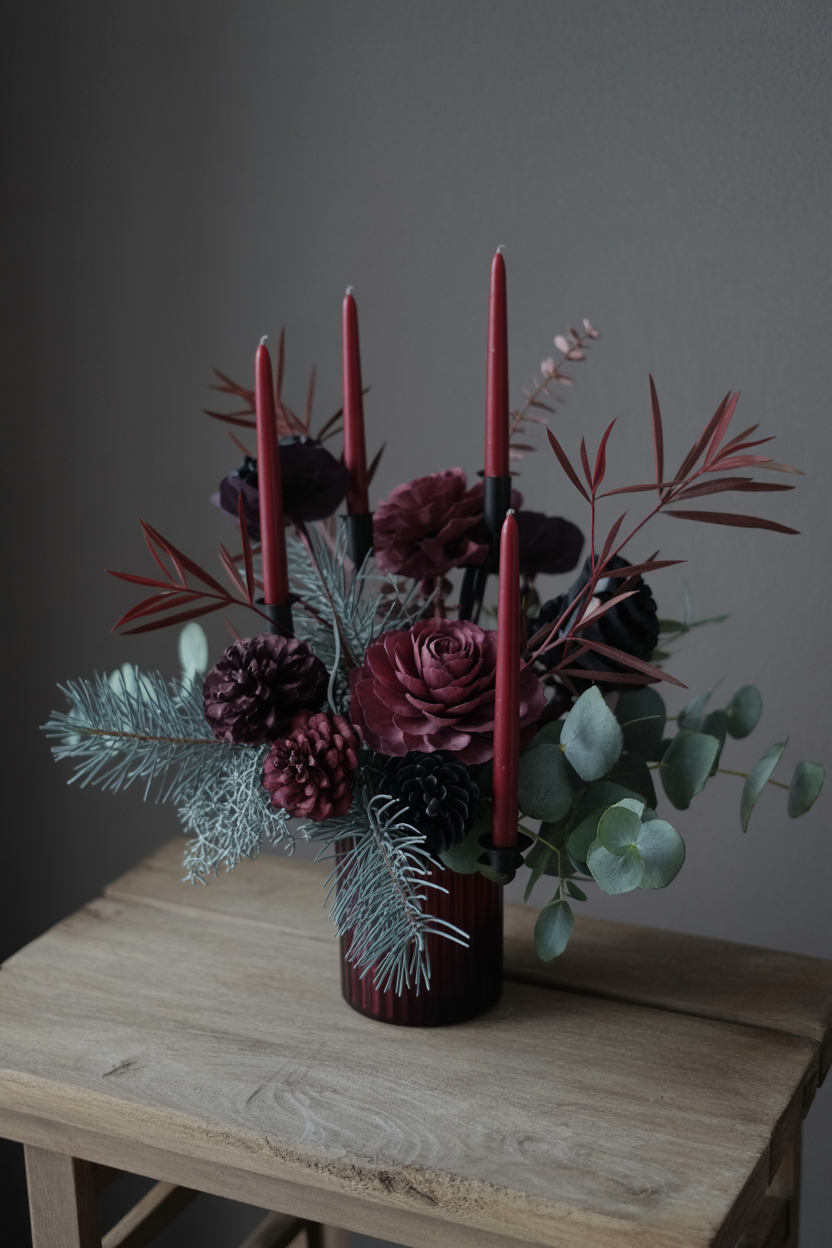
Moody burgundy and black winter floral arrangements occupy a design register that no other season makes possible — the darkness feels appropriate rather than oppressive because winter itself is a season of depth and shadow. Deep burgundy ranunculus layered alongside near-black chocolate cosmos creates a color story that operates entirely within the dark spectrum while maintaining genuine floral complexity. The chromatic range between deep plum and near-black is surprisingly vast when botanical materials fill it with varied textures and forms.
Black-sprayed bare branches rising above the primary bloom layer are the architectural decision that makes this arrangement feel genuinely cinematic rather than simply dramatic. They push the composition vertically beyond conventional bouquet territory and into something that reads as installation art. Cascading burgundy amaranthus softens the arrangement’s lower edge with flowing movement that prevents the dark palette from feeling static or heavy. This winter floral arrangement idea photographs magnificently against dark walls where the moody palette achieves its full atmospheric power.
2. The All-White Bridal Winter Arrangement With Ethereal Softness
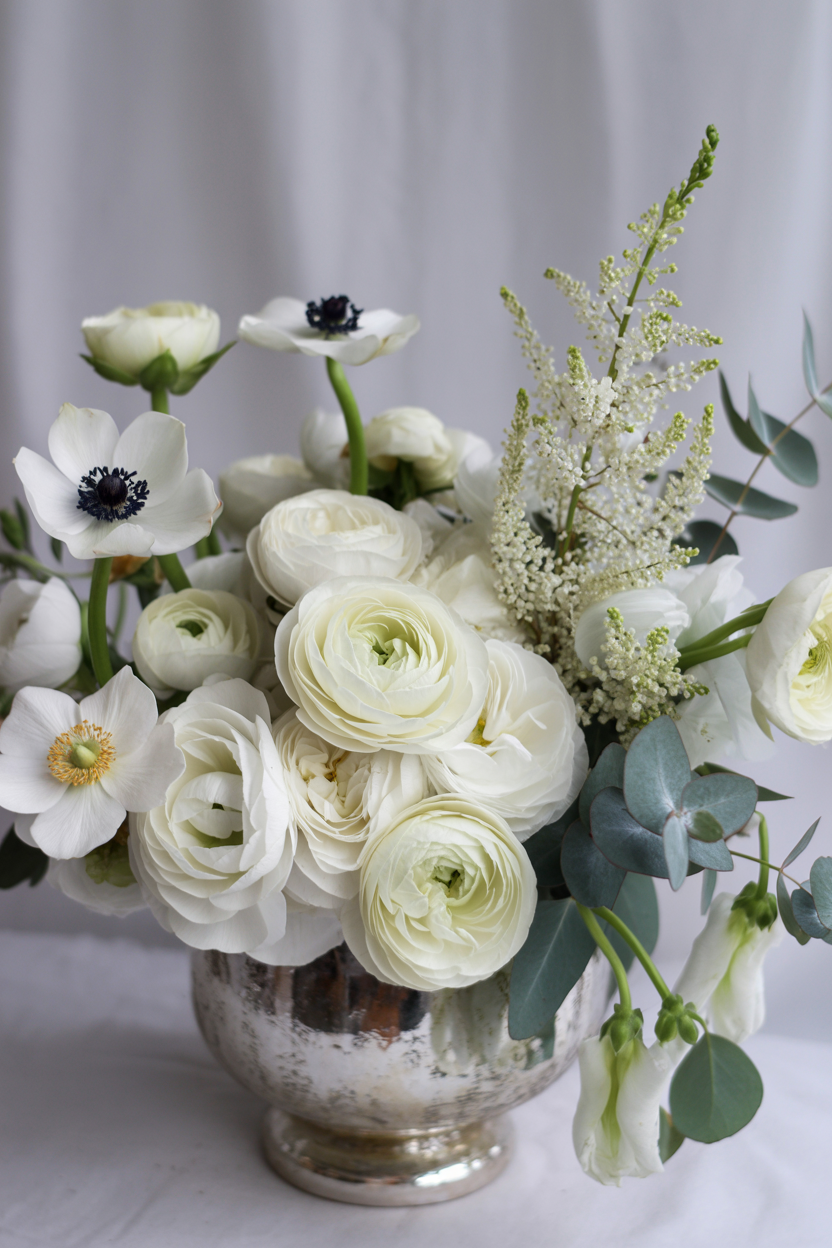
All-white winter floral arrangements achieve something that summer white arrangements never quite manage — a luminous, almost otherworldly quality that winter’s particular quality of diffused light amplifies rather than flattens. White garden roses at peak bloom layered with white ranunculus create stacked layers of papery petal complexity within the same color family, producing depth through form variation rather than color contrast. The visual richness of an all-white arrangement depends entirely on the variety of flower forms chosen rather than color relationships between them.
White anemones with their dramatic black centers introduce the arrangement’s single most sophisticated detail — that precise black punctuation within the white composition creates visual tension that prevents ethereal from sliding into bland. White hellebores nodding gently throughout maintain the winter-botanical authenticity that distinguishes genuinely seasonal arrangements from simply white ones. Silver-green eucalyptus provides the foliage backbone that holds the looser elements in coherent relationship. This winter floral arrangement idea suits wedding ceremonies, intimate dinner tables, and any context where beauty is intended to feel genuinely moving.
3. The Dried Pampas and Protea Winter Arrangement With Desert Cinema
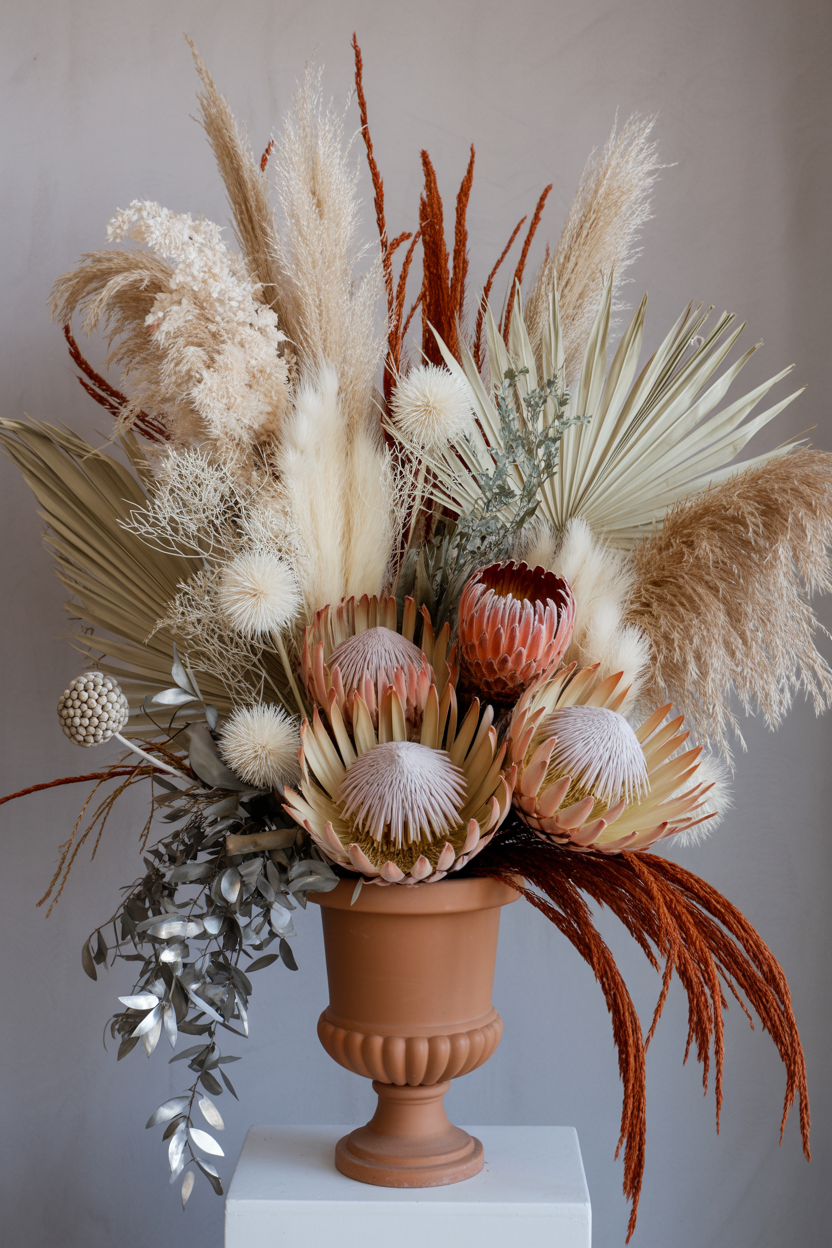
Dried pampas and protea winter arrangements bring an entirely different cinematic reference than the lush European floristry tradition — they evoke arid landscape cinematography, the visual language of vast open spaces and botanical forms shaped by extreme conditions. Oversized pampas plumes in cream and blush tones create the arrangement’s most dramatically scaled element, their feathered textures catching light with a luminous quality that no fresh flower replicates. Placed at the arrangement’s outer reaches, they establish an airiness that contradicts the composition’s apparent solidity.
King protea heads in warm terracotta tones are among the most architecturally extraordinary flowers available to winter floral designers — their scale, their structural geometry, and their genuine botanical strangeness make them impossible to overlook within any arrangement they inhabit. Dried banksia pods and bleached lunaria seed pods introduce the detailed textural interest at intermediate scales between the bold protea and the feathery pampas. This winter floral arrangement idea suits large-scale interior spaces where the arrangement’s generous proportions can be fully appreciated rather than compressed into a corner.
4. The Romantic Candlelit Winter Arrangement With Soft Amber Glow
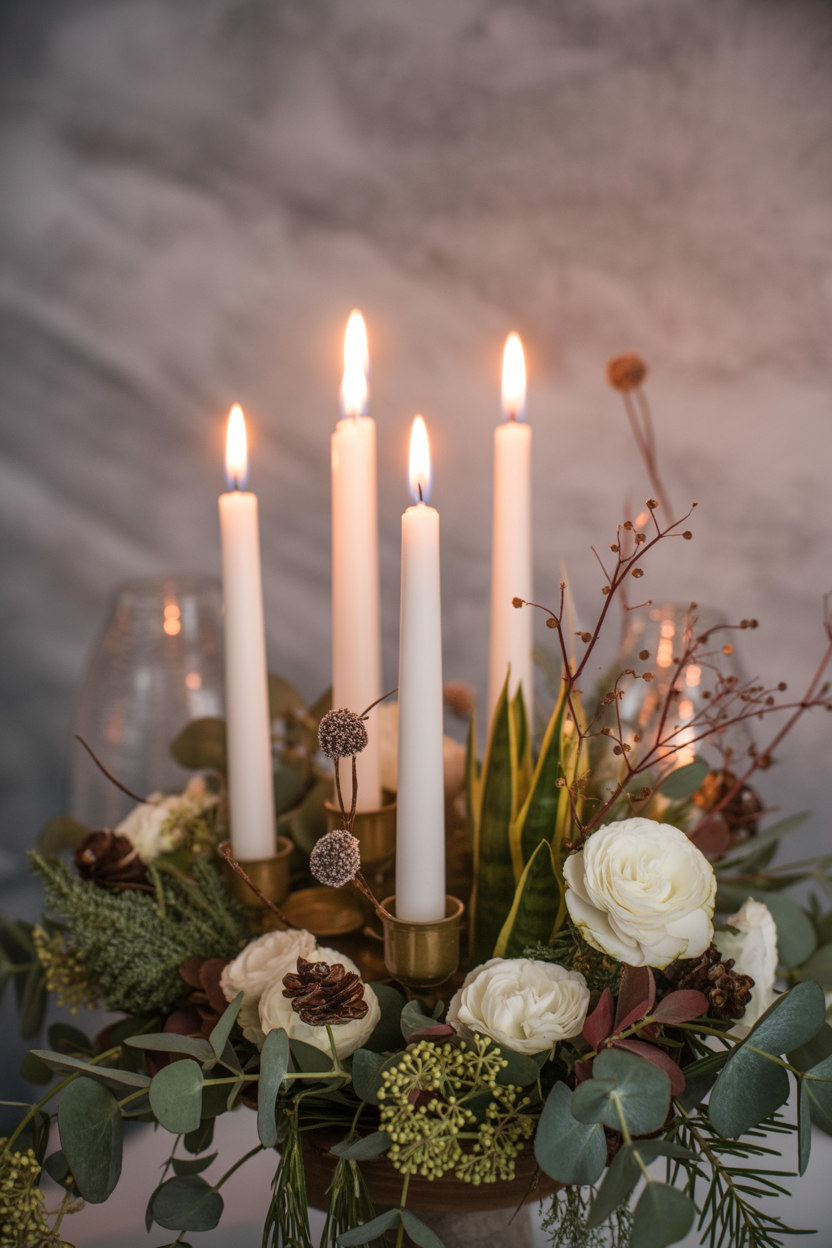
Candlelit winter floral arrangements operate on a design principle fundamentally different from arrangements created for daylight — every material and color choice must be made in consideration of how warm amber light will transform it after dark rather than how it appears in the honest clarity of afternoon. Blush and warm peach tones are specifically chosen here because candlelight intensifies warm undertones, making blush roses appear to radiate their own warmth rather than simply reflecting external illumination. That internal glow quality is the effect that makes these arrangements feel genuinely cinematic.
Pillar candles of varying heights integrated directly within the floral composition rather than positioned separately on the table create complete atmospheric unity between the lighting and the flowers — they become a single object rather than two decorative elements placed near each other. Trailing jasmine vine introduces a delicate scent dimension that candlelight warmth releases more generously than any other light source. This winter floral arrangement idea creates the most extraordinary dinner table atmosphere of any on this list — it genuinely transforms the experience of sitting near it.
5. The Dramatic Red and Black Winter Arrangement With Operatic Intensity
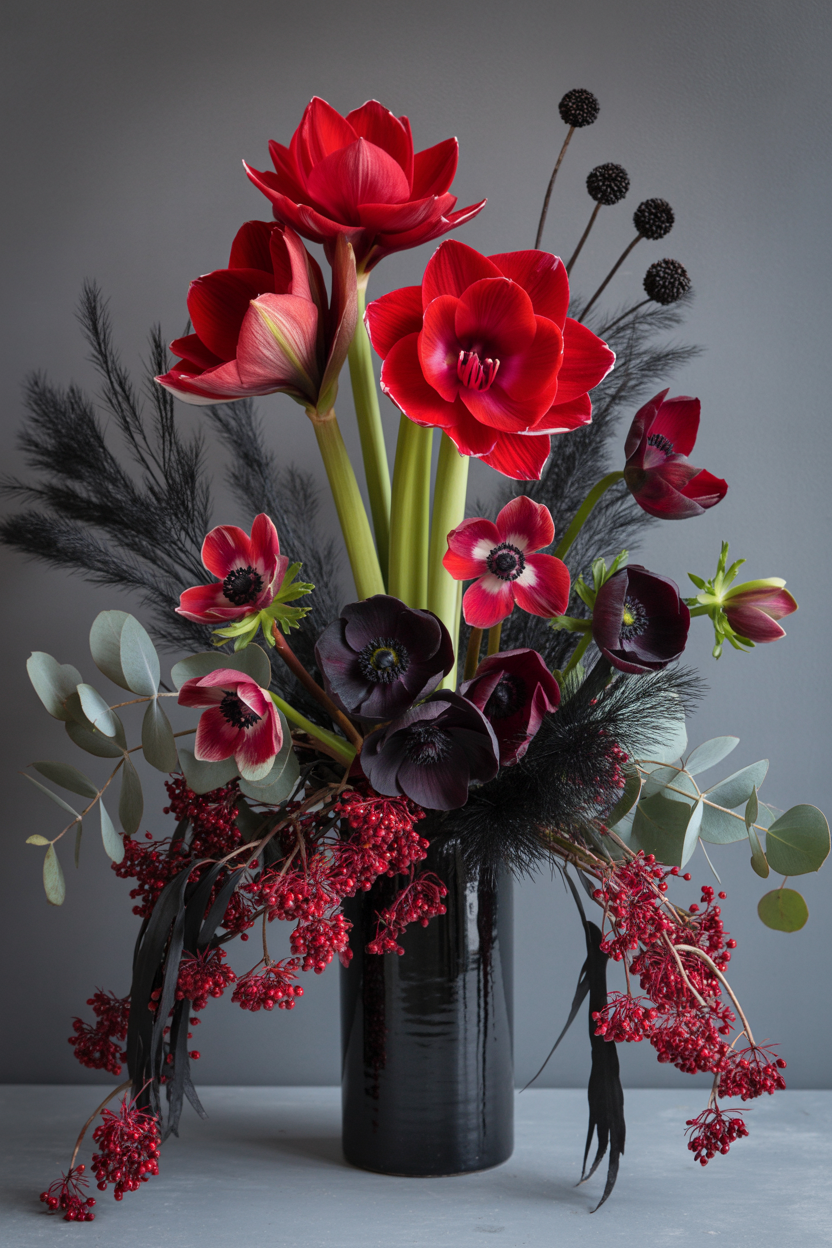
Red and black winter floral arrangements reference one of the most powerful color relationships in all of visual art — the pairing that simultaneously communicates passion, danger, and extraordinary beauty in equal measure. Deep scarlet amaryllis standing tall above the arrangement’s primary mass establish vertical authority that no other winter flower quite achieves — their trumpet-shaped blooms at that height create both a dramatic silhouette and an irresistible focal point. Against black-sprayed eucalyptus foliage, the red reads with an intensity that green foliage would never amplify to the same degree.
Near-black hellebores clustered at the arrangement’s lower center create the darkest tonal anchor that allows the scarlet amaryllis above to achieve maximum luminosity through contrast. Red anemones with their characteristic black centers bridge the two dominant tones with botanical logic that feels genuinely inevitable rather than designed. Deep red hypericum berries cascading outward soften the arrangement’s perimeter with organic movement while maintaining strict palette discipline. This winter floral arrangement idea suits grand architectural spaces, dramatic dining rooms, and any interior context where the arrangement is intended to function as the room’s primary statement.
6. The Frosted Eucalyptus and Blue Thistle Winter Arrangement With Cool Mystique
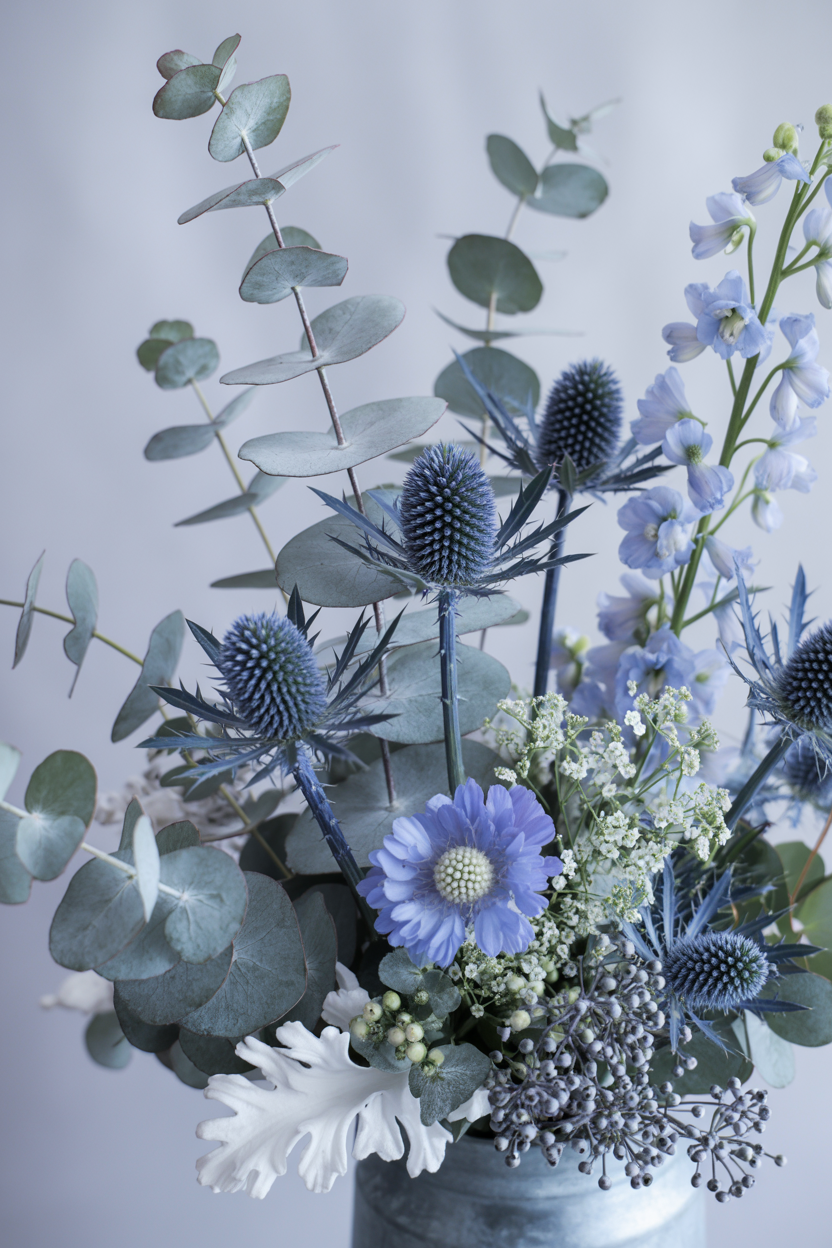
Cool-toned winter floral arrangements occupy the more mysterious and atmospheric end of the seasonal design spectrum — they feel less like brought-inside garden abundance and more like distillations of winter itself into botanical form. Silver-frosted eucalyptus in multiple varieties creates the arrangement’s foliage backbone with genuine botanical variety — the different leaf shapes and frosting intensities across species produce visual complexity within a strictly maintained cool silver-green palette. The overall impression is of something that grew in genuinely cold conditions rather than in a heated greenhouse.
Deep steel-blue thistle heads creating spiky textural contrast within the soft eucalyptus foliage are the design decision that elevates this arrangement from beautiful to genuinely compelling. That textural opposition — soft and spiky, rounded and pointed — creates visual tension that keeps the eye moving continuously through the composition rather than settling on any single element. Pale blue delphinium spires rising vertically complete the cool palette while establishing vertical momentum. This winter floral arrangement idea feels intrinsically cinematic because it looks like it was art-directed for a film set in an ice palace rather than simply assembled from available winter florals.
7. The Oversized Statement Winter Arrangement With Architectural Grandeur
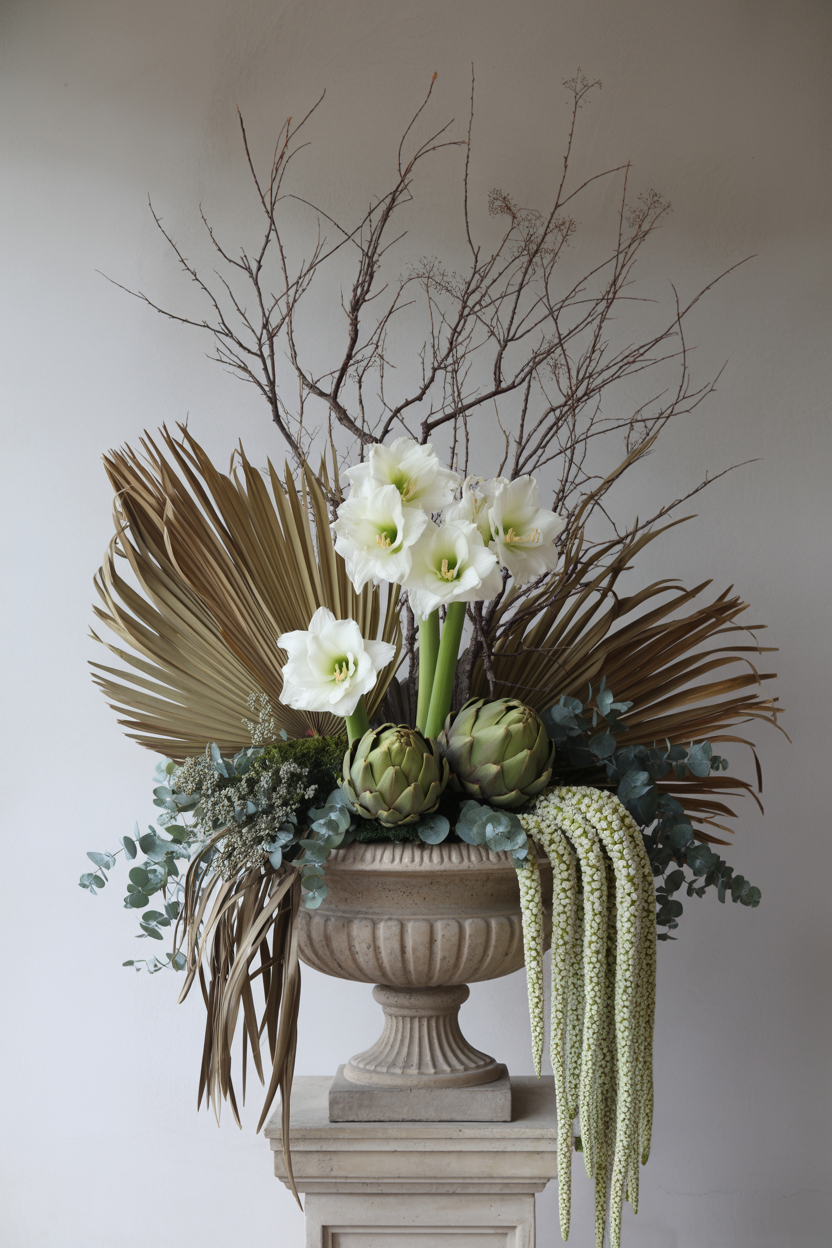
Oversized architectural winter floral arrangements abandon the domestic scale that most flower arranging operates within and enter the territory of installation art — they’re designed to hold their own against high ceilings, grand fireplaces, and significant interior architecture rather than simply decorating a surface. The bare branching structure rising four feet above the urn establishes the arrangement’s overall scale ambition immediately upon entering the room. Every subsequent element must justify its inclusion by contributing to a composition working at that expanded scale rather than the intimate scale of conventional floristry.
Oversized white amaryllis blooms positioned among the branches create moments of floral drama that read clearly from across a large room — their scale is appropriate to the arrangement’s architectural ambition rather than overpowering it. Artichoke heads introduce a genuinely extraordinary botanical form that blurs the boundary between flower and vegetable in the most sophisticated possible way. This winter floral arrangement idea suits entrance halls, double-height living rooms, hotel lobbies, and any interior space where the arrangement’s size feels proportionally correct rather than extravagant — because genuine extravagance is always contextually appropriate.
8. The Japanese Ikebana-Inspired Winter Arrangement With Meditative Precision
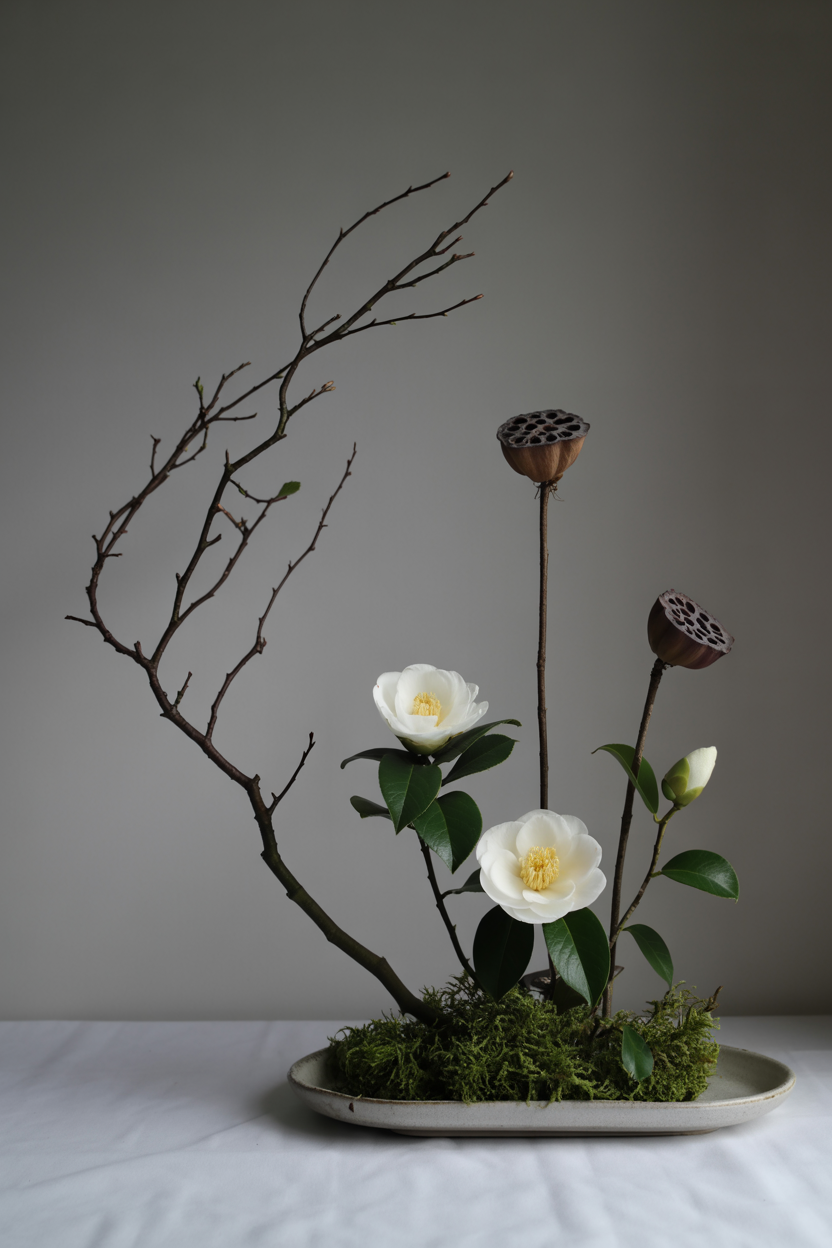
Ikebana-inspired winter floral arrangements challenge every assumption Western floristry makes about abundance, symmetry, and the relationship between flowers and the space surrounding them. A single dramatic quince branch reaching asymmetrically leftward contains more intentional design thinking than arrangements ten times its botanical volume — because the branch’s precise angle, its relationship to the vessel’s edge, and the negative space it frames are all deliberate compositional decisions rather than aesthetic accidents. The tradition demands that every element earn its position through considered placement rather than visual abundance.
Three white camellia blooms placed at different heights within the overall composition create a vertical rhythm that guides the eye through the arrangement in a specific sequence rather than allowing it to scan randomly. That directed visual movement is one of ikebana’s most sophisticated contributions to floral design thinking. Dried lotus seed pods at intermediate heights introduce structural botanical forms that hold their visual weight without competing with the camellia blooms for primary attention. This winter floral arrangement idea creates the most meditative and thoughtful spatial atmosphere of any approach on this list.
9. The Maximalist Winter Arrangement With Abundant Botanical Generosity
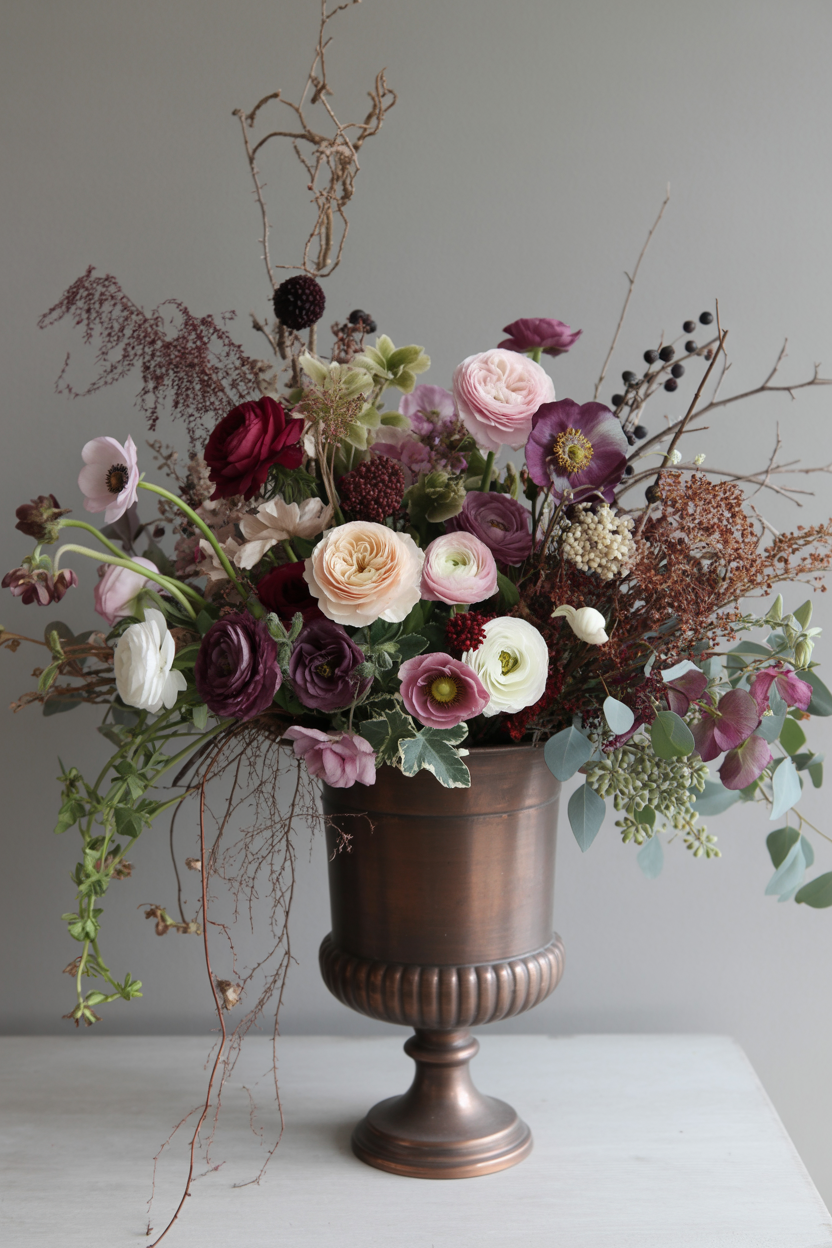
Maximalist winter floral arrangements reject restraint as a design virtue and instead celebrate botanical abundance as its own form of visual generosity — the kind of arrangement that makes people lean forward rather than stand back, discovering new elements with each closer look. The antique copper urn establishes the correct historical register for this level of floral extravagance — it references the grand Victorian flower arrangements that inspired the maximalist floristry revival and provides a vessel whose own patina and warmth contribute actively to the overall composition rather than simply containing it.
The discipline within apparent abundance is what separates genuinely beautiful maximalist arrangements from simply overwhelming ones — and that discipline operates through color temperature consistency rather than restraint in botanical variety. Every flower in this composition, despite their dramatic variety in form and scale, shares the same warm jewel-tone color temperature that creates visual cohesion among extraordinary diversity. Trailing ivy and hanging amaranthus soften the arrangement’s outer edges with organic movement that prevents the abundant center mass from feeling contained or artificially bounded. This winter floral arrangement idea is for people who believe more is always more — and who are correct.
10. The Dark Garden Winter Arrangement With Moonlit Mystery
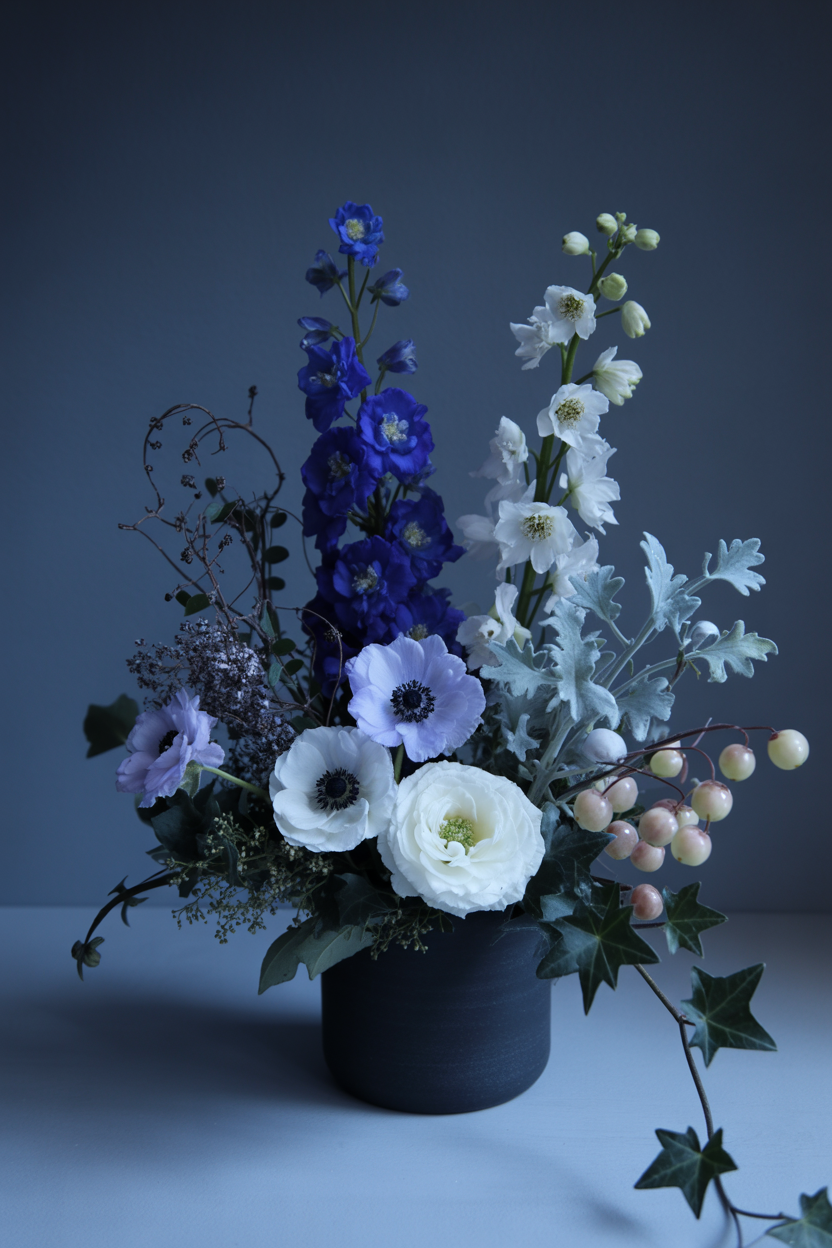
Moonlit garden winter floral arrangements create an atmospheric quality that operates more like set design than conventional floristry — they’re built around a specific light condition and time of day rather than simply selecting beautiful flowers and arranging them attractively. Midnight blue delphinium provides the deepest cool tone in the floral designer’s palette, creating the nocturnal color anchor from which every lighter element radiates with apparent luminosity. Against that deep blue backdrop, white moonflower blooms appear to generate their own cool light rather than simply reflecting what falls upon them.
Iridescent brunia berries scattered throughout the arrangement catch directional light with a dewdrop quality that reinforces the nocturnal garden atmosphere — they look specifically like moisture-touched botanical forms caught in moonlight rather than a decorative addition. The dramatic side lighting in the arrangement’s presentation context is as important as the botanical content itself — this is a winter floral arrangement idea that deserves a dedicated spot, a single directional light source, and the visual space to let shadows become part of the overall composition rather than simply the absence of light.
11. The Warm Terracotta and Rust Winter Arrangement With Mediterranean Soul
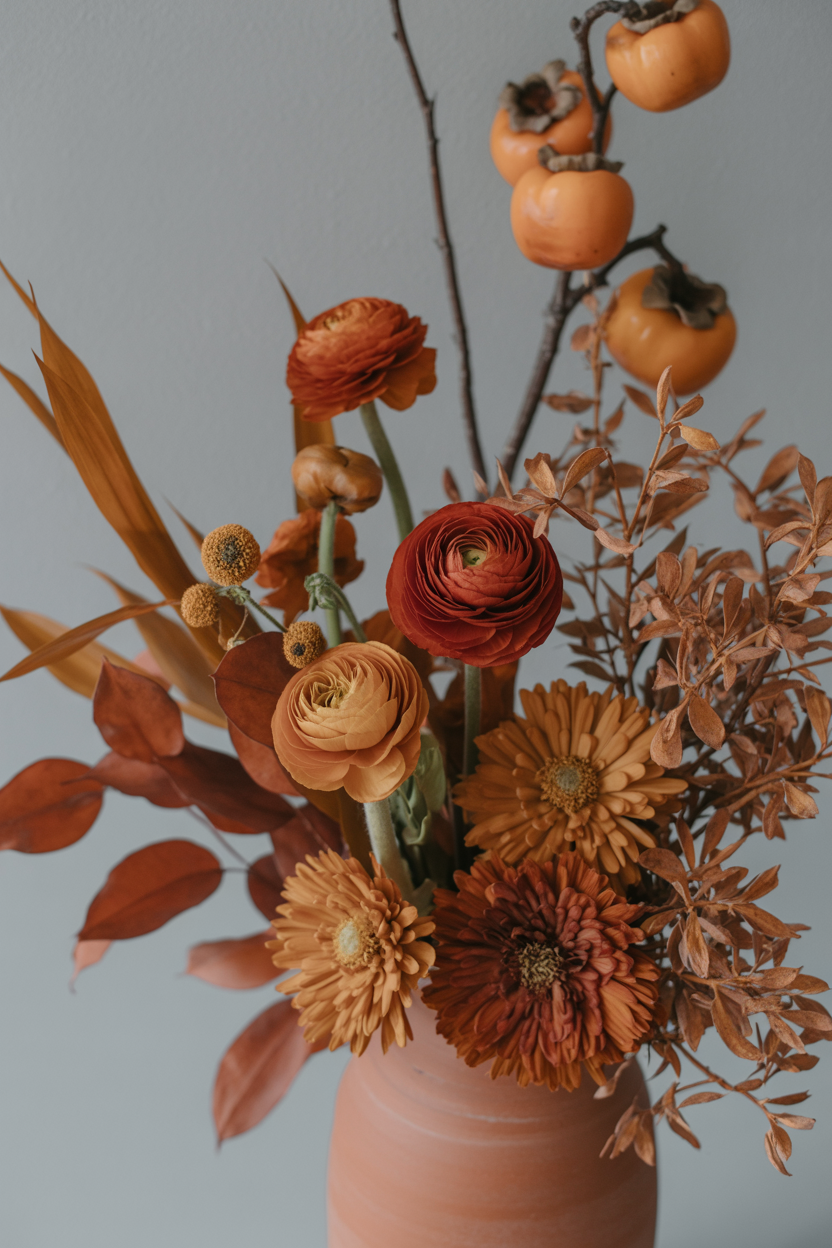
Terracotta and rust winter floral arrangements bring Mediterranean warmth to the coldest season — they feel like the color memory of summer landscapes preserved in botanical form through winter months. Terracotta-toned ranunculus in deep rust and burnt orange create the arrangement’s primary warm tonal anchor while their layered papery petals introduce the floral complexity that distinguishes sophisticated arrangements from simply colored ones. The chromatic range between deep rust and warm amber within a single color family produces more visual depth than most multi-color arrangements achieve through broader palette choices.
Dried orange persimmons on branches introduce one of winter’s most distinctive and regionally specific botanical offerings — their deep orange fruit against bare branches is a composition that exists in nature for only a brief seasonal window, making its inclusion in the arrangement feel genuinely time-specific and botanically honest. Handthrown terracotta vessels with their characteristic organic imperfection communicate the same authentic earthen warmth as the botanical materials they contain — the vessel and arrangement share a material philosophy rather than simply occupying the same space. This winter floral arrangement idea warms every interior it inhabits regardless of the temperature outside.
Visit more https://www.pinterest.com/Dreamgardenshome/
12. The Minimalist Single-Stem Winter Arrangement With Quiet Power
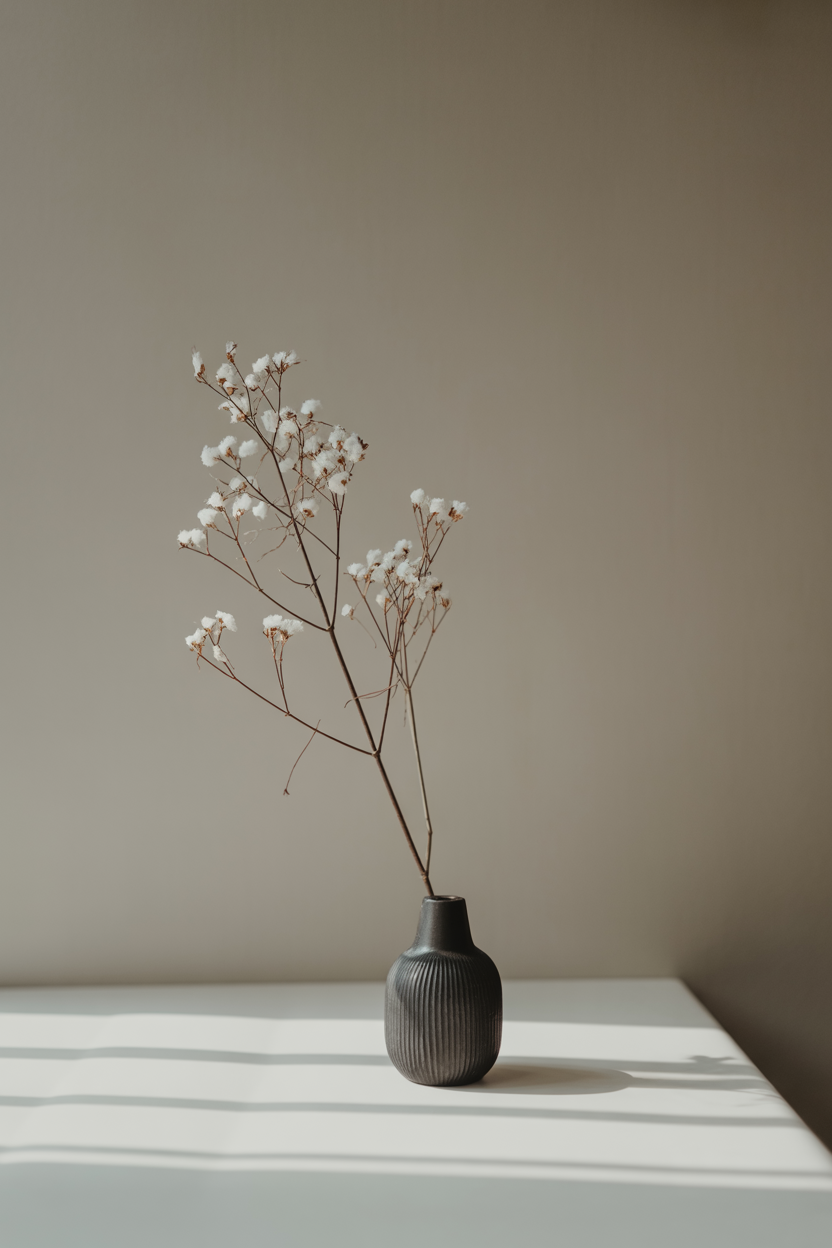
Single-stem winter floral arrangements are the design choice that requires the most confidence because they offer no place to hide compositional uncertainty behind botanical volume. A single oversized white amaryllis in a tall clear glass cylinder succeeds as a complete arrangement because the amaryllis bloom’s scale, its architectural trumpet form, and its pure white luminosity contain sufficient visual interest within themselves to justify that singular presentation. Adding a second bloom would immediately shift the arrangement’s fundamental character from confident minimalism to simple smallness.
Three stems of silver brunia berry alongside the amaryllis introduce the secondary element with extreme editorial restraint — three stems rather than a cluster, positioned as companions rather than competing focal points. Their small spherical forms provide textural contrast to the amaryllis’s broad trumpet without challenging its compositional authority. The dried lunaria branch casting a delicate shadow on the wall behind is the arrangement’s most sophisticated detail — it incorporates the wall surface into the composition, expanding the arrangement beyond its physical boundaries into the surrounding space. This winter floral arrangement idea is for people who understand that restraint is itself a form of abundance.
13. The Cascading Winter Arrangement With Baroque Grandeur
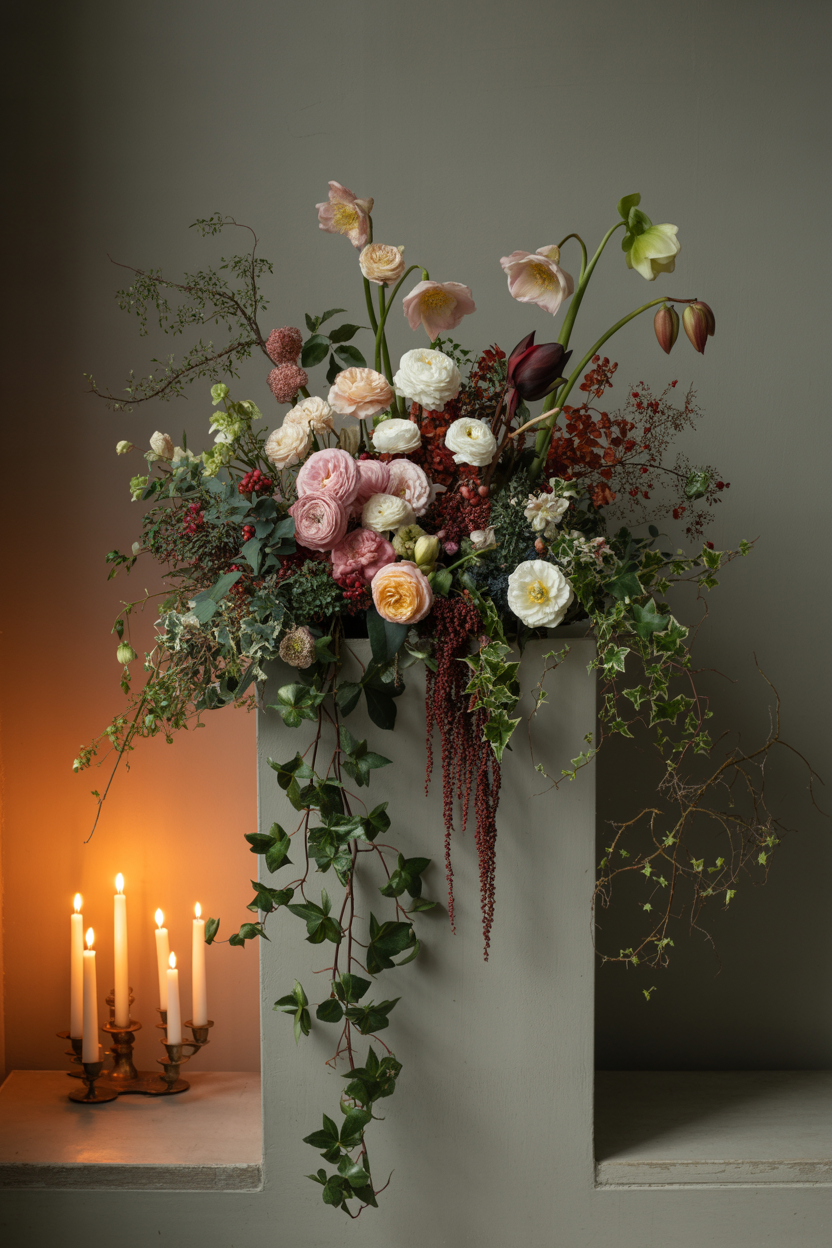
Cascading winter floral arrangements reference the most dramatically beautiful tradition in Western floral art — the Dutch Golden Age still life paintings where flowers tumbled over vessel edges and beyond the composition’s apparent boundaries with theatrical abandon. That cascading movement transforms a flower arrangement from a static object into a dynamic visual event — the eye follows the downward flow of trailing elements and experiences the composition as motion rather than arrangement. Dramatic cascades require generous trailing materials — amaranthus, ivy, jasmine, and berry branches — that have sufficient length and weight to hang convincingly rather than simply drooping.
Warm amber candlelight photographed deliberately into the composition is the decision that most directly references the Old Master painterly tradition — that quality of warm directional light against deep shadow creates the chiaroscuro contrast that makes flowers appear three-dimensional rather than flat, luminous rather than simply colorful. Garden roses and ranunculus in deep jewel tones glow with extraordinary intensity in candlelight because their layered petals create internal shadow depths that direct light cannot fully penetrate, creating that characteristic sense of floral richness. This winter floral arrangement idea belongs in the most beautiful room in the home, lit as it deserves.
14. The Woodland Floor Winter Arrangement With Forest Intimacy
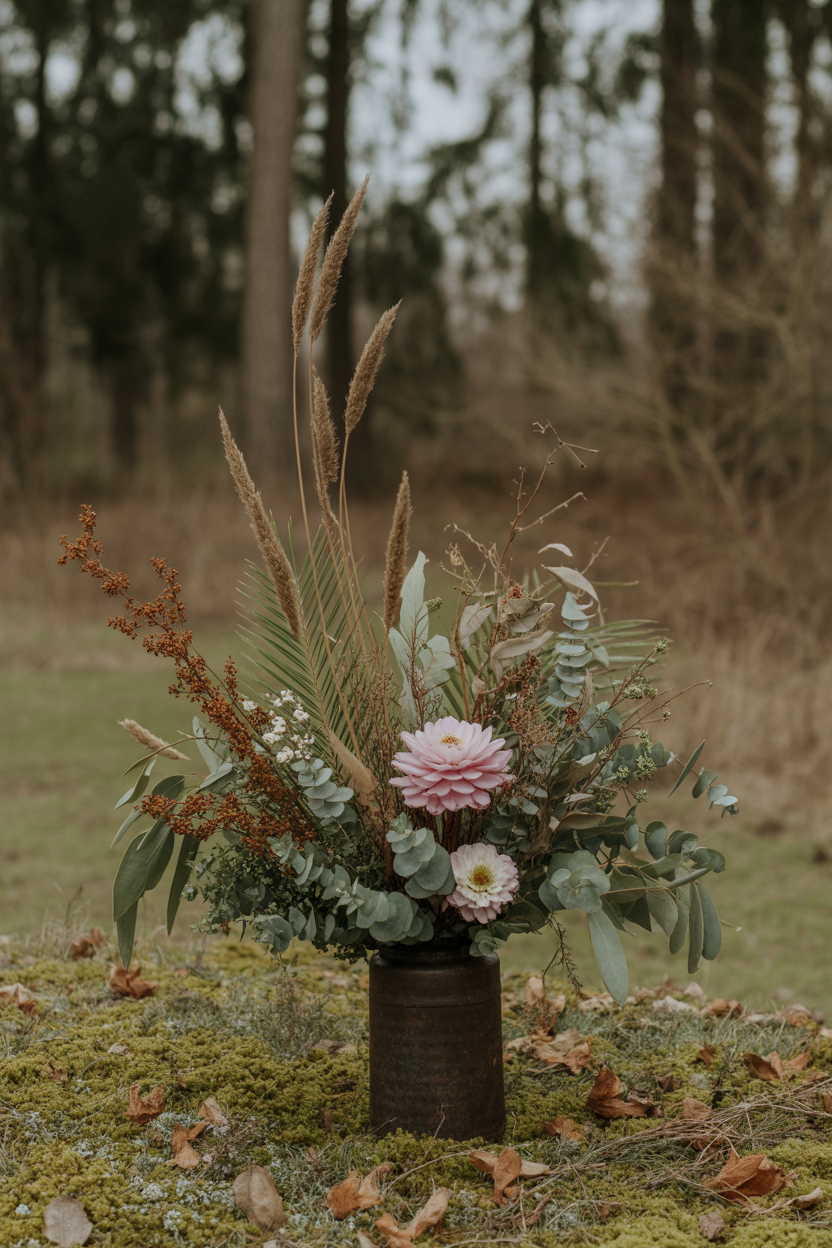
Floor-level woodland winter floral arrangements challenge the conventional assumption that flower arrangements belong on elevated surfaces where they can be admired from standing height — and by abandoning that assumption, they create an entirely different experiential relationship with the botanical composition. A wide shallow wooden trough filled with preserved forest moss creates an immediate environmental quality that no elevated vessel can replicate — it reads as a section of forest floor transported intact rather than as a conventional floral arrangement constructed in a container. That environmental quality is what makes the composition feel genuinely cinematic.
White hellebore blooms nestled at ground level among the moss are seen from above rather than eye-level — a completely different perspective that reveals their downward-facing flower forms with unusual clarity while maintaining the intimate scale of ground-level botanical discovery. Dried mushrooms integrated into the moss create the most convincingly woodland element in the composition because nothing signals forest floor as immediately and authentically as fungal forms. This winter floral arrangement idea suits large floor areas beside fireplaces, at the base of staircases, or within any architectural context where the floor itself is understood as a surface worthy of decorative attention.
15. The Jewel-Tone Winter Arrangement With Stained Glass Luminosity
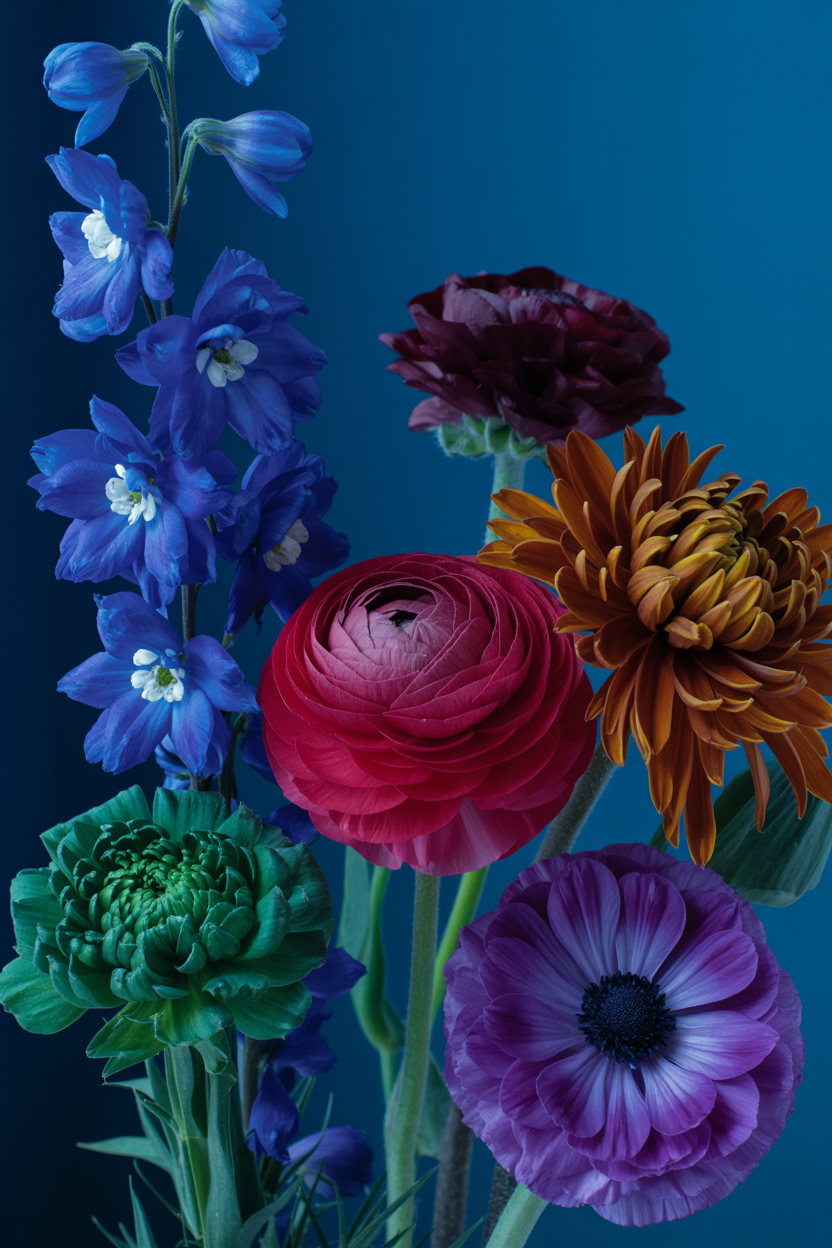
Jewel-tone winter floral arrangements achieve their maximum visual impact through the specific relationship between deeply saturated flower colors and directional backlighting — without the light relationship, they’re simply colorful arrangements; with it, they become something genuinely extraordinary. Backlighting translucent petals from behind creates the stained-glass luminosity effect that transforms each flower into an independent light source within the overall composition. Sapphire delphinium, amethyst lisianthus, and ruby ranunculus each reveal their internal petal structure when backlit in ways that frontal lighting entirely obscures.
The arrangement’s color selection follows the gemstone vocabulary deliberately rather than conventional floral color theory — each flower is chosen for its specific jewel-tone chromatic identity rather than its relationship to adjacent colors. That approach produces a palette of extraordinary richness where the colors coexist through shared saturational intensity rather than traditional complementary or analogous color relationships. This winter floral arrangement idea requires thoughtful placement near a natural light source — a south-facing window in winter light, or a carefully positioned directional lamp — because the backlighting condition is as essential to the arrangement’s success as the botanical content itself.
16. The Smoky Dried Winter Arrangement With Apothecary Mystery
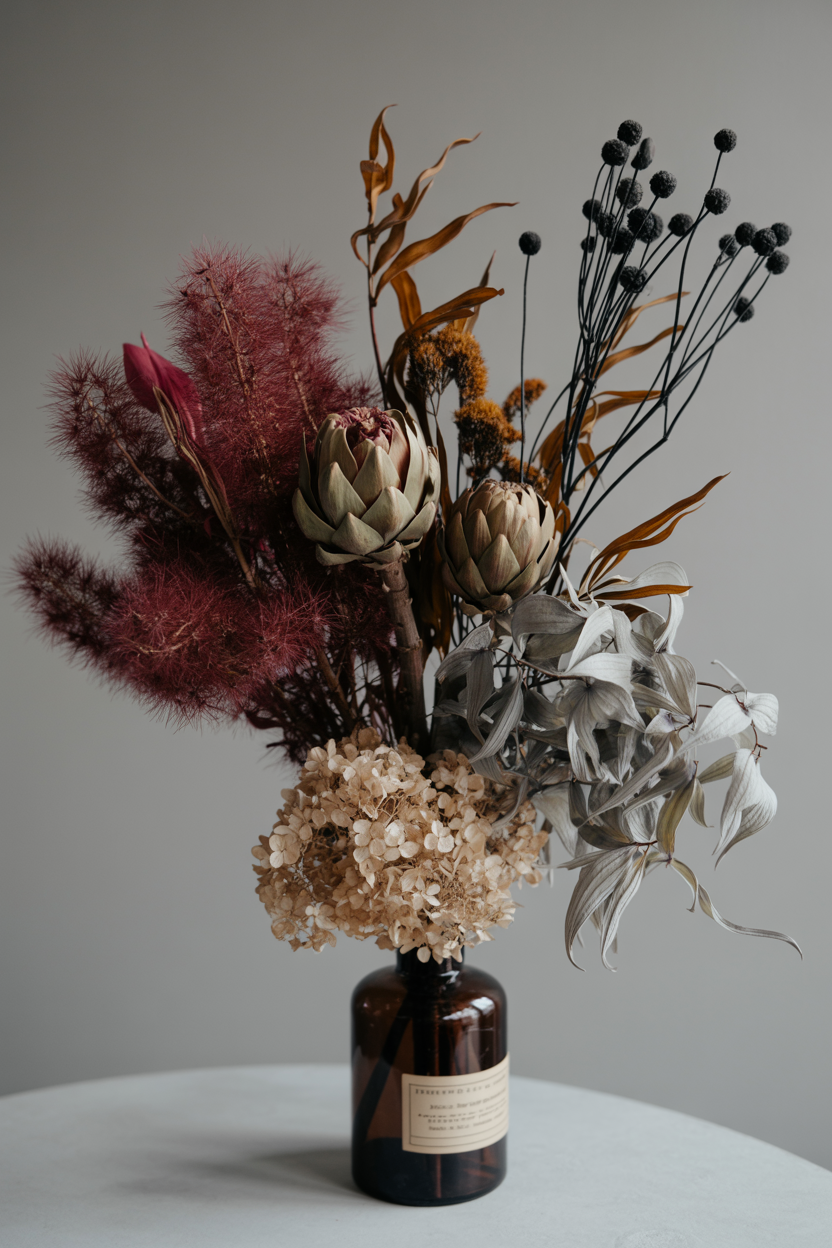
Smoky dried winter arrangements inhabit the most mysterious and atmospheric corner of the winter floral design world — they feel less like arranged flowers and more like gathered evidence of something beautiful and slightly secret. Smoke bush dried plumes in deep burgundy create the arrangement’s signature element — that characteristic feathery texture at the tips of each branch creates a literal visual smokiness that makes the material appear perpetually in motion even when completely still. Against light backgrounds, the effect is genuinely extraordinary.
Dark vintage apothecary bottles as vessels complete the mysterious narrative with perfect material logic — their historical association with gathered botanical remedies, their dark glass that hints at contents rather than revealing them, and their occasional visible labeling all contribute to an arrangement that feels genuinely discovered rather than constructed. Dried artichoke heads in muted grey-green and ghost-pale dried hydrangea heads introduce organic forms whose beauty is in their decay rather than their fresh vitality — they’re beautiful precisely because they’ve passed through their flowering peak and arrived at something more complex. This winter floral arrangement idea rewards people drawn to beauty that contains a little darkness.
17. The Festive Winter Arrangement With Celebratory Holiday Spirit
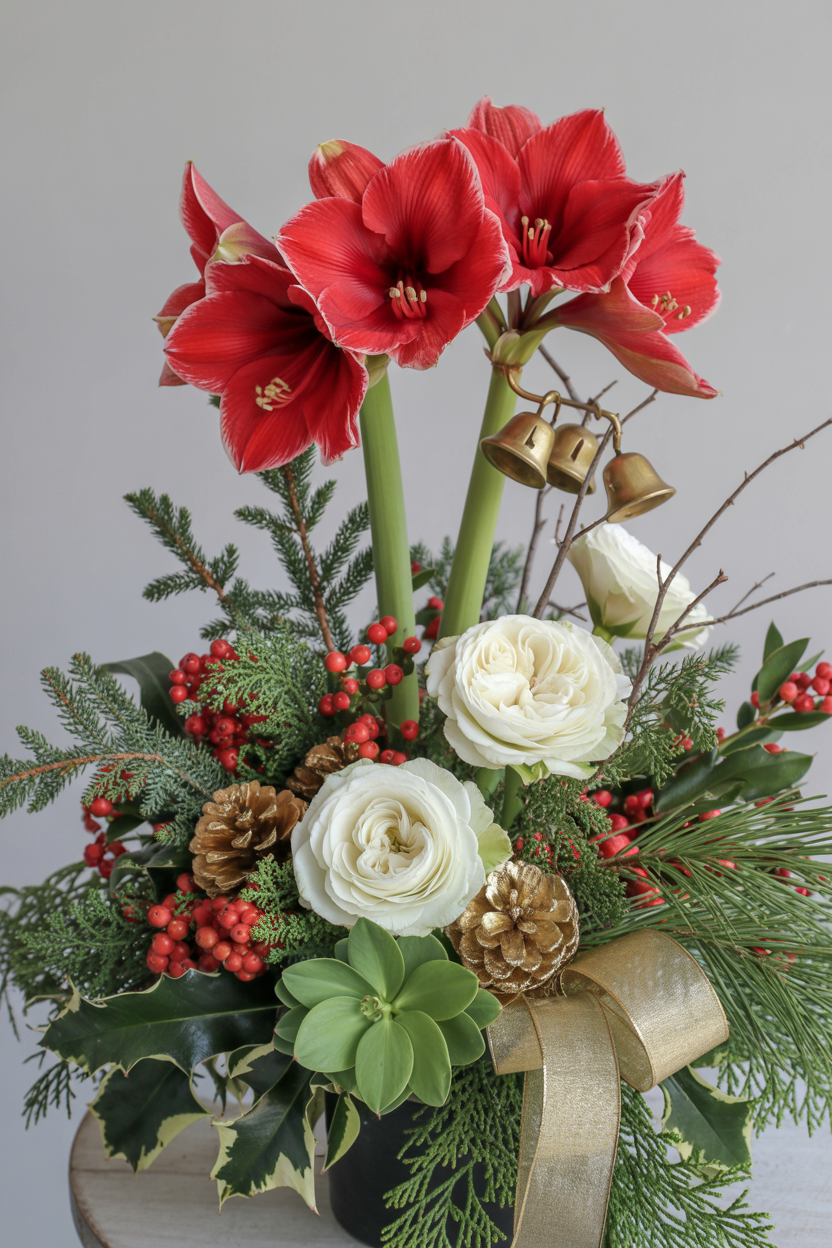
Festive holiday winter floral arrangements succeed when they treat the Christmas color palette as a genuine design directive rather than a decorating obligation — when the red, gold, and green relationship is handled with the same care and intentionality that any sophisticated color palette receives. Red amaryllis in full dramatic bloom provides the arrangement’s primary floral statement in the seasonal color’s most architecturally impressive botanical form. The trumpet blooms’ scale and their genuinely crimson color — not the slightly orange red of many holiday decorations — creates a floral focal point of real quality.
Pine and cedar branches woven through the floral arrangement rather than simply placed around it create genuine botanical integration between the floral and the foliage elements — the greenery becomes part of the arrangement’s internal structure rather than its backdrop. Gold-sprayed pinecones nestled among the blooms introduce the metallic dimension at the scale of the individual botanical form rather than through ribbon or added decoration. This winter floral arrangement idea bridges the gap between the botanical tradition of floral design and the decorative tradition of holiday styling with genuine grace — it feels like both simultaneously rather than compromising between them.
18. The Neutral Organic Winter Arrangement With Linen and Sand Warmth
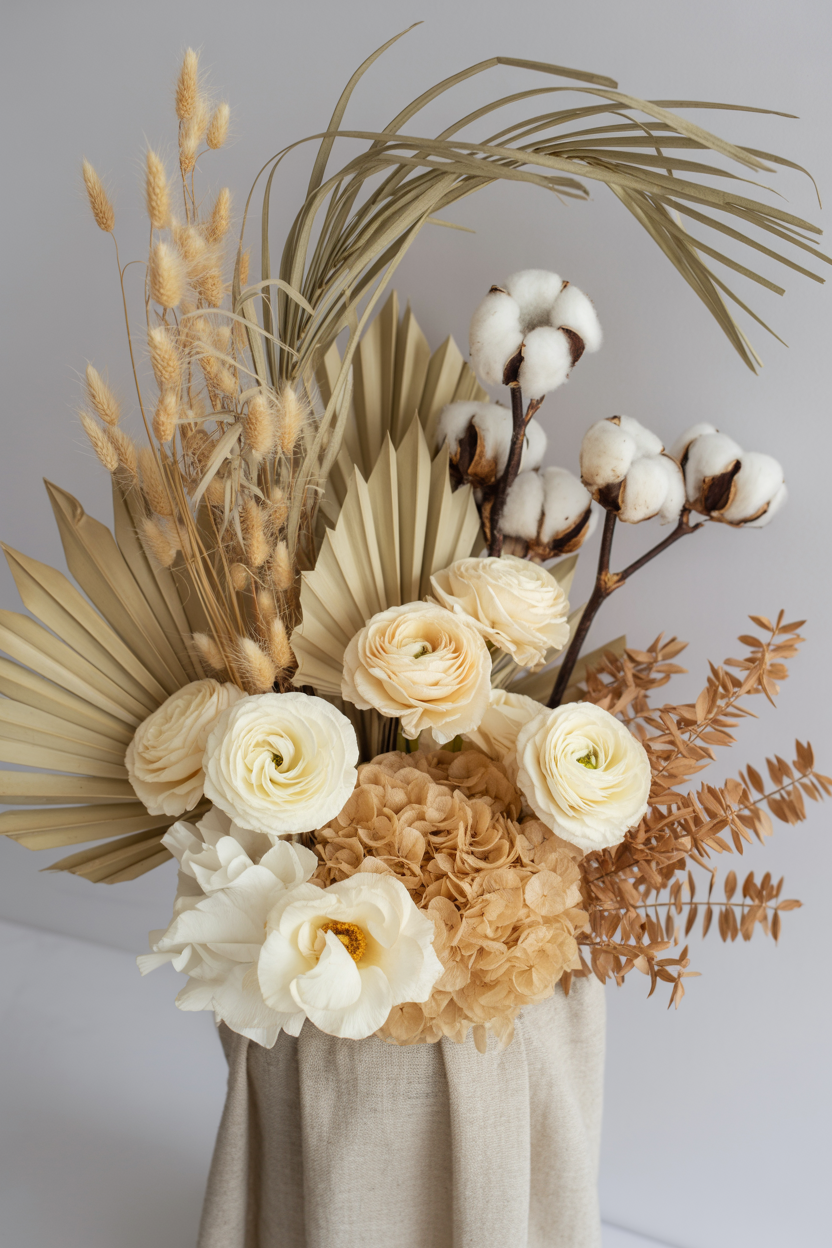
Neutral organic winter floral arrangements achieve warmth through texture abundance rather than color variety — every element exists within the narrow linen-to-sand-to-cream color range while contributing dramatically different surface qualities that create visual richness through material contrast alone. Cream ranunculus layered with ivory garden roses produce floral depth within the same near-white color family through their fundamentally different petal structures — the ranunculus’s tight concentric layers versus the rose’s looser unfurling spiral. That structural distinction generates visual interest without any color differentiation whatsoever.
Bleached palm fronds in architectural curves introduce the arrangement’s most dramatically scaled botanical element — their broad, deeply ribbed forms create strong graphic silhouettes at the composition’s outer reaches that smaller-scaled materials cannot achieve. Dried cotton bolls on branches contribute one of winter’s most texturally honest botanical materials — their raw agricultural origins and simple organic forms feel genuinely honest in a way that more conventionally beautiful flowers sometimes don’t. Raw linen-wrapped vessels complete the material philosophy at the container level. This winter floral arrangement idea suits interiors committed to natural materials and honest beauty throughout every design decision.
19. The Underwater Winter Arrangement With Submerged Ethereal Beauty
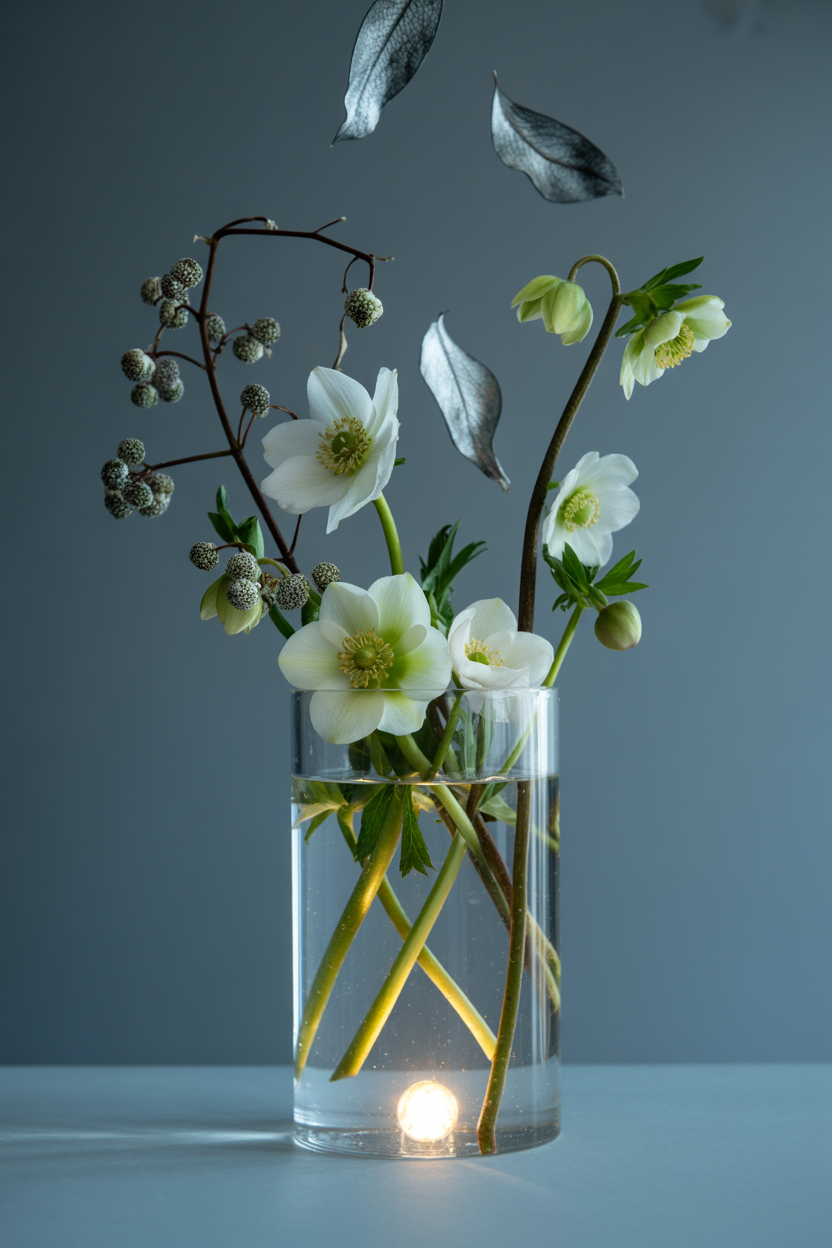
Submerged winter floral arrangements inhabit genuinely unusual creative territory because they transform the expected relationship between flowers and their environment — rather than flowers displayed in water, these are flowers displayed through water, with the medium becoming as visually significant as the botanical content it contains. White anemone blooms submerged in a clear glass cylinder appear weightless in a way that no above-water arrangement ever achieves — the water suspends their petals in positions that gravity alone would never maintain, creating postures of absolute delicate stillness.
LED illumination from beneath the vessel is the technical decision that transforms this from a botanical curiosity into a genuinely cinematic winter floral arrangement idea — the upward light through water and suspended flowers creates the quality of underwater cinematography, a light source that seems physically impossible by conventional decorating logic. Silver leaf fragments drifting above the submerged blooms connect the underwater environment to the surface with visual continuity. This arrangement belongs in spaces where unconventional beauty is understood and appreciated — it rewards people who look at it with genuine attention rather than passing glances.
20. The Grand Entrance Winter Arrangement With Floor Urn Drama
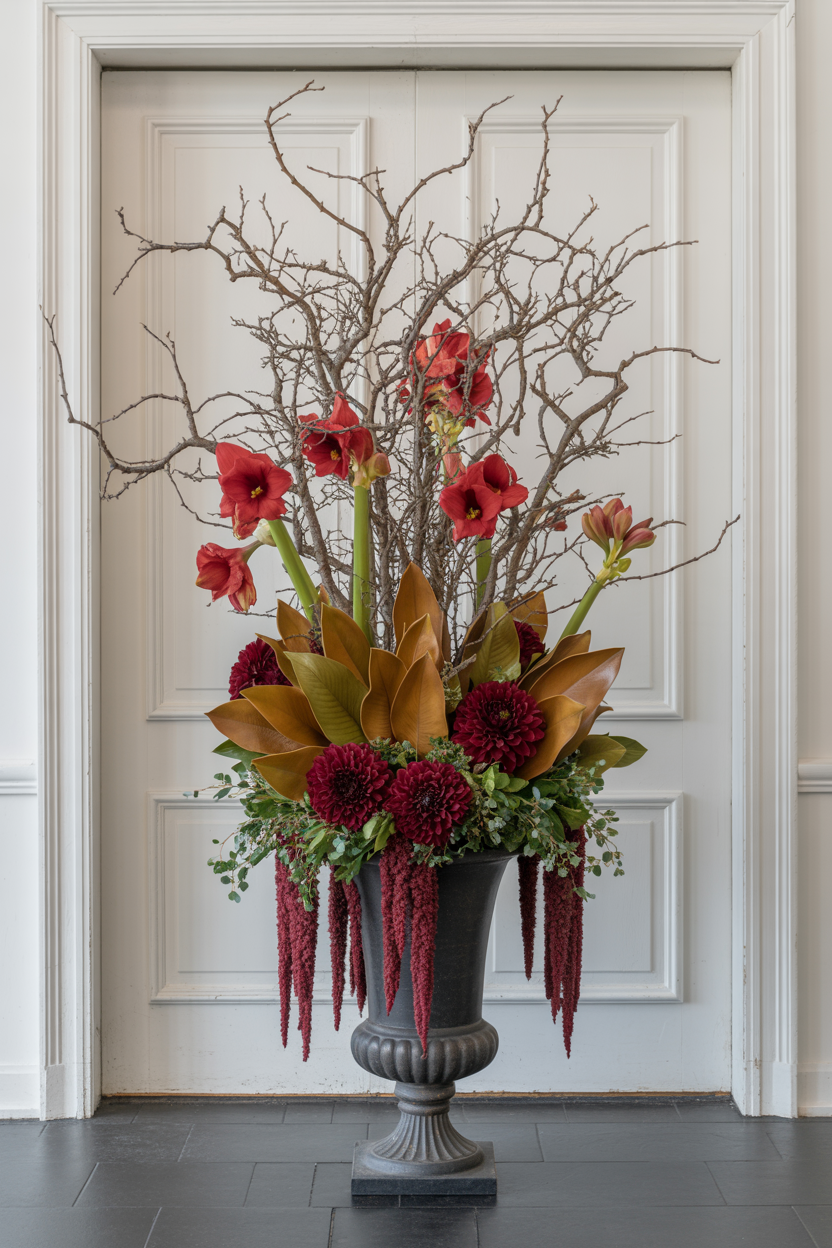
Grand entrance winter floral arrangements operate at a scale where conventional floristry principles give way to spatial design thinking — these compositions don’t simply occupy a surface but actively shape the experience of moving through the space they inhabit. A tall floor-standing urn immediately establishes architectural ambition that tabletop vessels cannot match — the arrangement’s base sits at floor level, its primary bloom mass at chest height, and its reaching branches at ceiling territory, engaging the full vertical dimension of the entrance space simultaneously.
Contorted filbert branches reaching dramatically outward at four feet are the element that makes the arrangement’s footprint extend far beyond its vessel — they claim airspace on multiple sides and create the impression of a presence rather than simply an object. Deep red amaryllis blooms positioned at varying heights throughout the branch structure create floral focal points that the eye discovers sequentially as it moves upward through the composition rather than finding simultaneously. This winter floral arrangement idea requires physical space proportional to its ambition — but in the right architectural context, it creates an arrival experience that guests genuinely remember.
21. The Terracotta Pot Winter Arrangement With Italian Garden Nostalgia
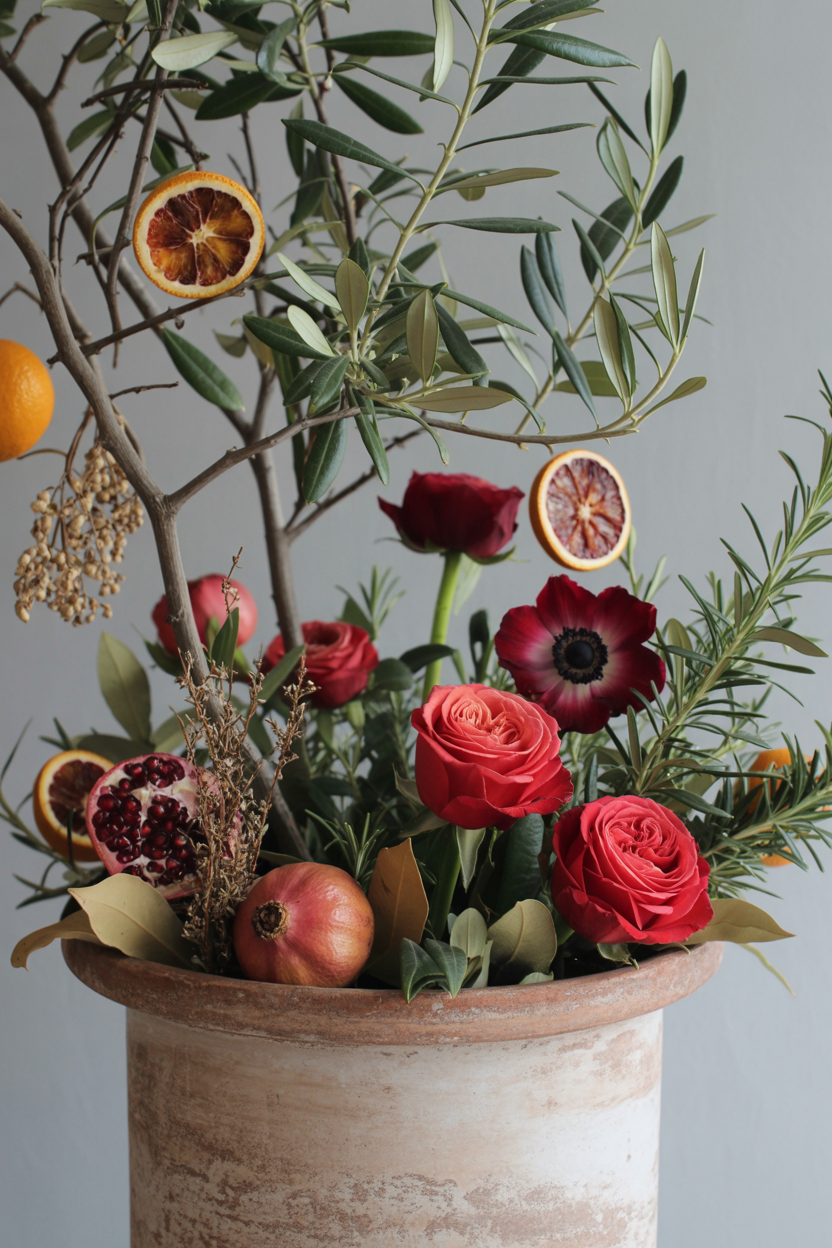
Italian garden-inspired winter floral arrangements draw from one of the most enduringly beautiful botanical and culinary traditions available to floral designers — the Mediterranean kitchen garden where culinary herbs, fruit trees, and ornamental plants exist in companionable proximity and create arrangements that engage all five senses simultaneously. Olive branches with their characteristic silver-green leaves establish the arrangement’s distinctly Mediterranean botanical identity immediately — there is no other plant that communicates southern European garden culture as efficiently and authentically as the olive.
Blood orange slices drying on twisted branches introduce the citrus dimension of Italian winter culture — the deep ruby-red interior of blood oranges revealed in cross-section is one of the most visually extraordinary botanical forms available in the seasonal palette, and their drying process deepens both their color and their translucency simultaneously. Pomegranate halves as color accents continue the Italian fruiting garden vocabulary while contributing their own remarkable color — the deep jewel-red of pomegranate seeds against aged terracotta creates a color relationship of genuine beauty. This winter floral arrangement idea rewards anyone who has ever experienced the particular magic of an Italian garden in January.
22. The Timeless White and Green Winter Arrangement That Works Everywhere
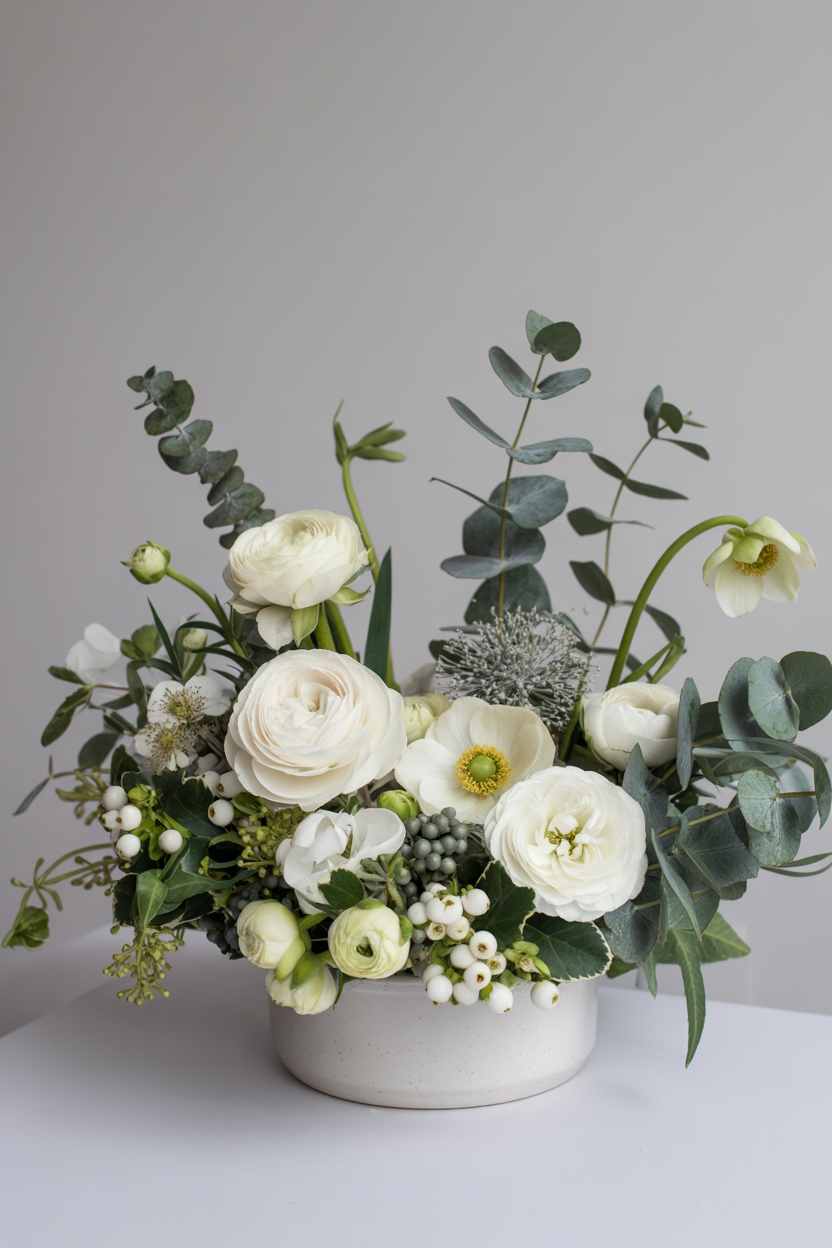
Timeless white and green winter floral arrangements work in every interior context because they’re built on the most enduring color relationship in all of floral design — the relationship between white flowers and green foliage that has never required any other justification than its own intrinsic rightness. White garden roses, ranunculus, hellebores, and anemones together create extraordinary variety in floral form within the single color directive — each flower contributes its distinctive petal structure and scale to a composition that rewards close inspection rather than simply reading as uniformly white from a distance.
Multiple eucalyptus varieties create the foliage backbone with genuine botanical variety — the coin-shaped leaves of silver dollar eucalyptus, the narrow pointed leaves of seeded eucalyptus, and the rounded forms of baby blue eucalyptus together produce visual complexity within the green element that matches the floral variety above it. Trailing ivy softens the arrangement’s perimeter with organic movement that the more structured eucalyptus branches cannot provide. This winter floral arrangement idea is the one to return to whenever the brief calls for beauty that communicates universally rather than specifically — for a dinner table, a wedding, a gift, or simply a Tuesday in January that deserves something genuinely lovely.
Conclusion
Winter floral arrangements reward one quality above everything else — the willingness to take the season seriously as a design opportunity rather than a botanical consolation prize. The flowers, dried botanicals, and architectural branches available in winter create atmospheres that warmer seasons genuinely cannot replicate. Dark, dramatic, ethereal, abundant, or deliberately restrained — the range is extraordinary. Choose the direction that moves you most and let the arrangement do what great florals always do. Make the room feel completely alive.

Join The Discussion