
Intro (87 words): If your little ones love digging in the dirt, a mud kitchen might be the best outdoor addition you make this year. Mud kitchens turn messy outdoor play into rich sensory experiences that build creativity, motor skills, and imaginative thinking. Whether you have a big backyard or a tiny patio, there’s a mud kitchen idea for every space and budget. From rustic wooden setups to upcycled furniture makeovers, these 25 mud kitchen ideas will inspire you to create the ultimate outdoor play space your kids will adore.
1. Classic Wooden Mud Kitchen with a Sink
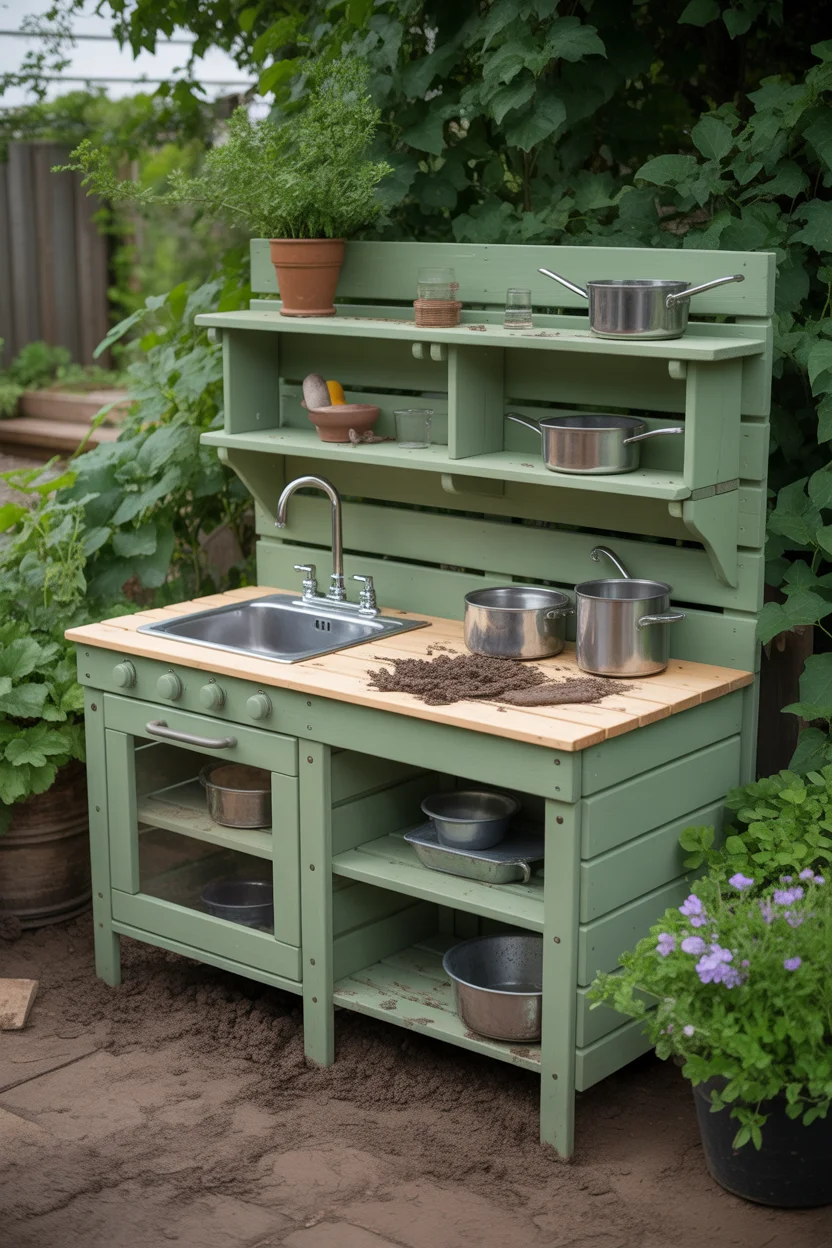
A classic wooden mud kitchen with a built-in sink is the gold standard for outdoor sensory play. The sink doesn’t need running water — simply fill it with water from a garden hose or a pitcher to create the perfect muddy mixing station. Using weather-resistant wood like cedar or pine ensures the kitchen stands up to rain and sunshine season after season. The natural material blends beautifully into any garden setting and gives kids a sense of playing in a real, purposeful kitchen of their very own.
Adding open shelving beneath and beside the sink gives little chefs plenty of space to store their mud kitchen accessories — think old pots, spoons, measuring cups, and even silicone molds for creative mud baking. Paint the frame in a muted, earthy tone like sage green or terracotta to tie the kitchen into the garden’s color palette. A small hooks rail along the side is perfect for hanging utensils, making cleanup easier and keeping everything organized. This timeless design grows with your child and never goes out of style.
2. Upcycled Pallet Mud Kitchen
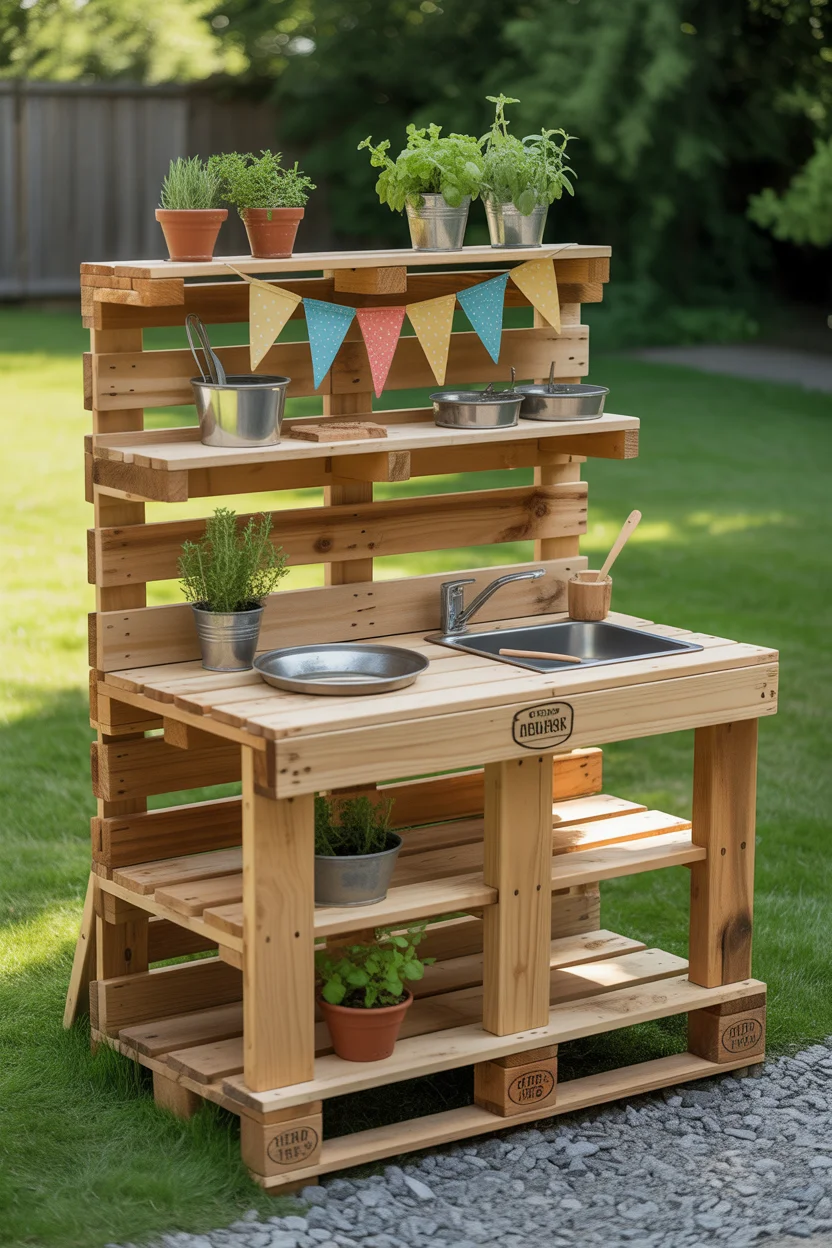
Building a mud kitchen from wooden pallets is one of the most budget-friendly and eco-conscious projects you can tackle for your backyard. Pallets are often available for free from garden centers, hardware stores, or online marketplaces, making this idea accessible to nearly every family. A few pallets stacked and secured together create a surprisingly sturdy, tiered workspace that gives kids room to spread out their ingredients, utensils, and muddy creations without everything tumbling off a cramped surface.
Sanding the pallets smooth and sealing them with an outdoor wood stain protects against splinters and weather damage, giving your creation a polished, intentional look rather than a thrown-together feel. Add a few decorative touches — colorful bunting, a chalk-painted sign, or small potted herbs along the edges — to make the space feel special and truly theirs. Because pallets come in a standard size, you can easily expand the kitchen as your child grows or as their mud-cooking ambitions demand more counter space and storage.
3. Mud Kitchen with Chalkboard Backsplash
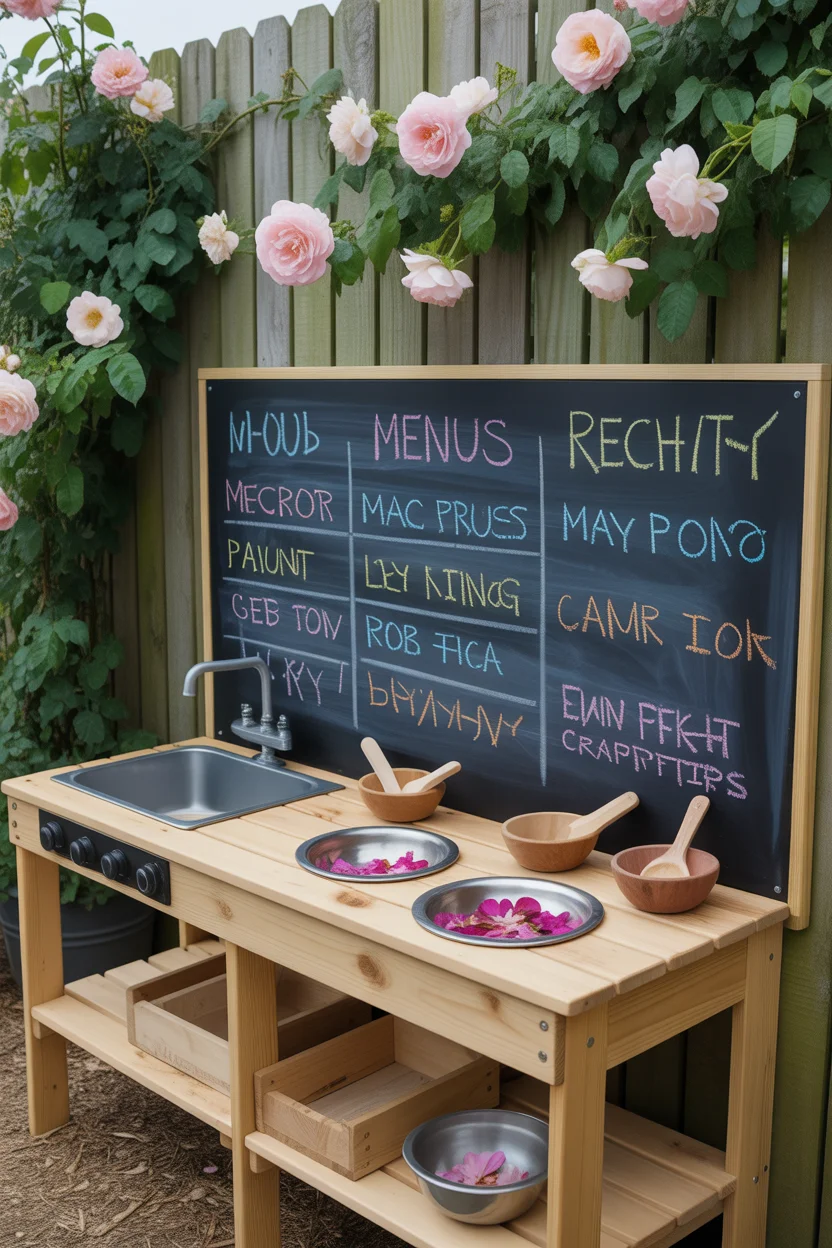
A chalkboard backsplash transforms a simple mud kitchen into an endlessly interactive play station. Children can draw their menus, write out their recipes, or sketch the meals they’re pretending to prepare — blending sensory play with early literacy and artistic expression. The chalkboard surface is easy to add using outdoor chalkboard paint applied directly to a flat plywood panel that slots neatly behind the countertop. It wipes clean with a damp cloth and becomes a fresh canvas again and again, offering new creative possibilities every single time kids venture outside.
Beyond menus, the chalkboard backsplash becomes a place where kids can track their “orders,” practice writing numbers, or leave messages for siblings and friends. Parents love this feature because it quietly encourages pre-writing skills and number recognition through completely unstructured, joyful play. Pair this kitchen with a small bucket of chunky chalk and a wet sponge hung nearby for easy erasing, and you’ve created an outdoor learning environment disguised as pure, gloriously messy fun that kids will choose over screen time every time.
4. Mud Kitchen from an Old Dresser
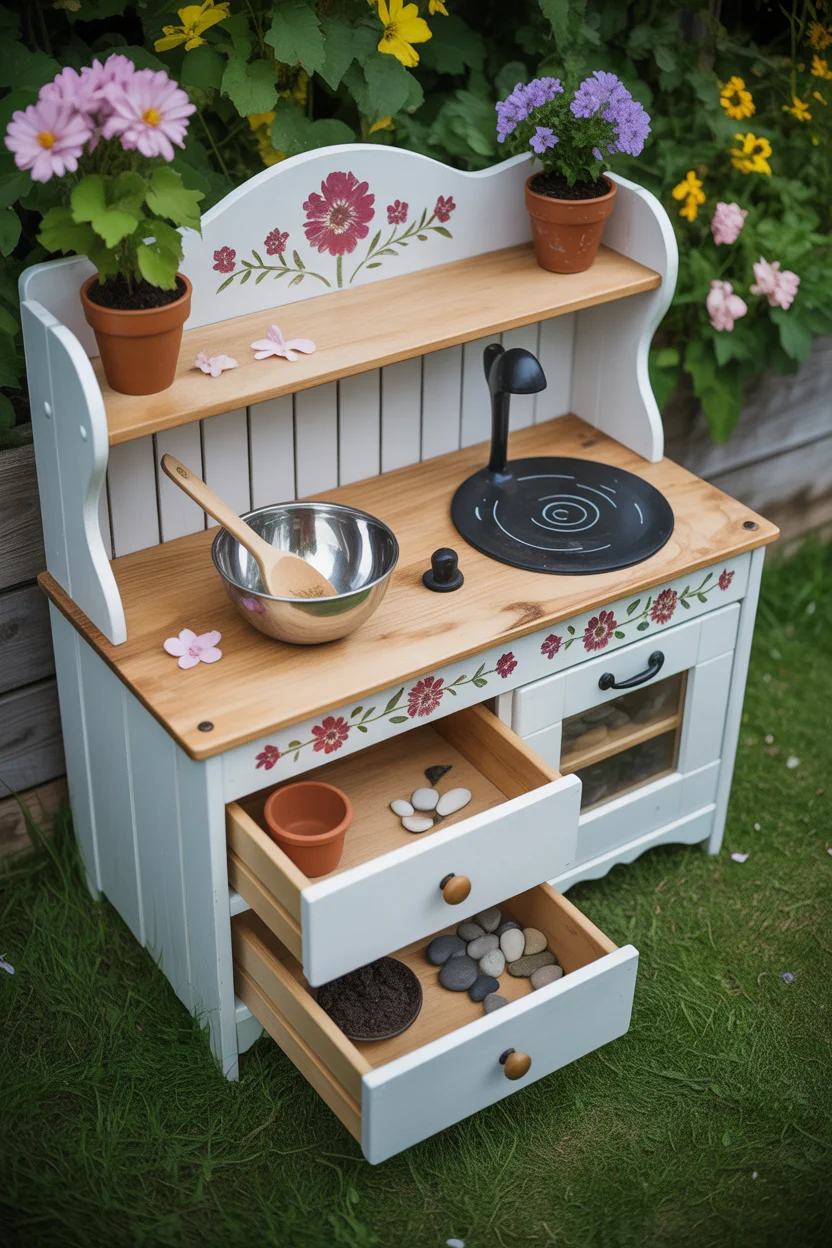
Giving an old dresser a second life as a mud kitchen is a wonderfully creative upcycling project that results in a one-of-a-kind outdoor play station. Thrift stores, garage sales, and online marketplaces are treasure troves of solid wood dressers that are structurally sound but cosmetically worn — perfect candidates for an outdoor transformation. Remove the drawers partially or fully, paint the frame in a weather-resistant outdoor paint, and you instantly have a multi-level workstation with deep, useful storage nooks that would cost far more to replicate from scratch.
The drawer compartments become brilliant storage spaces for mud kitchen “ingredients” — pine cones, dried flowers, pebbles, sticks, and shells that double as spices and garnishes in imaginative play scenarios. Sand the surface smooth and seal it well to handle outdoor moisture, and consider adding small cup hooks to the sides for hanging utensils. With a little distressed paint and some whimsical stenciling, this repurposed dresser mud kitchen becomes a genuinely beautiful garden feature that parents enjoy looking at as much as kids love using it.
5. Mini Mud Kitchen for Toddlers
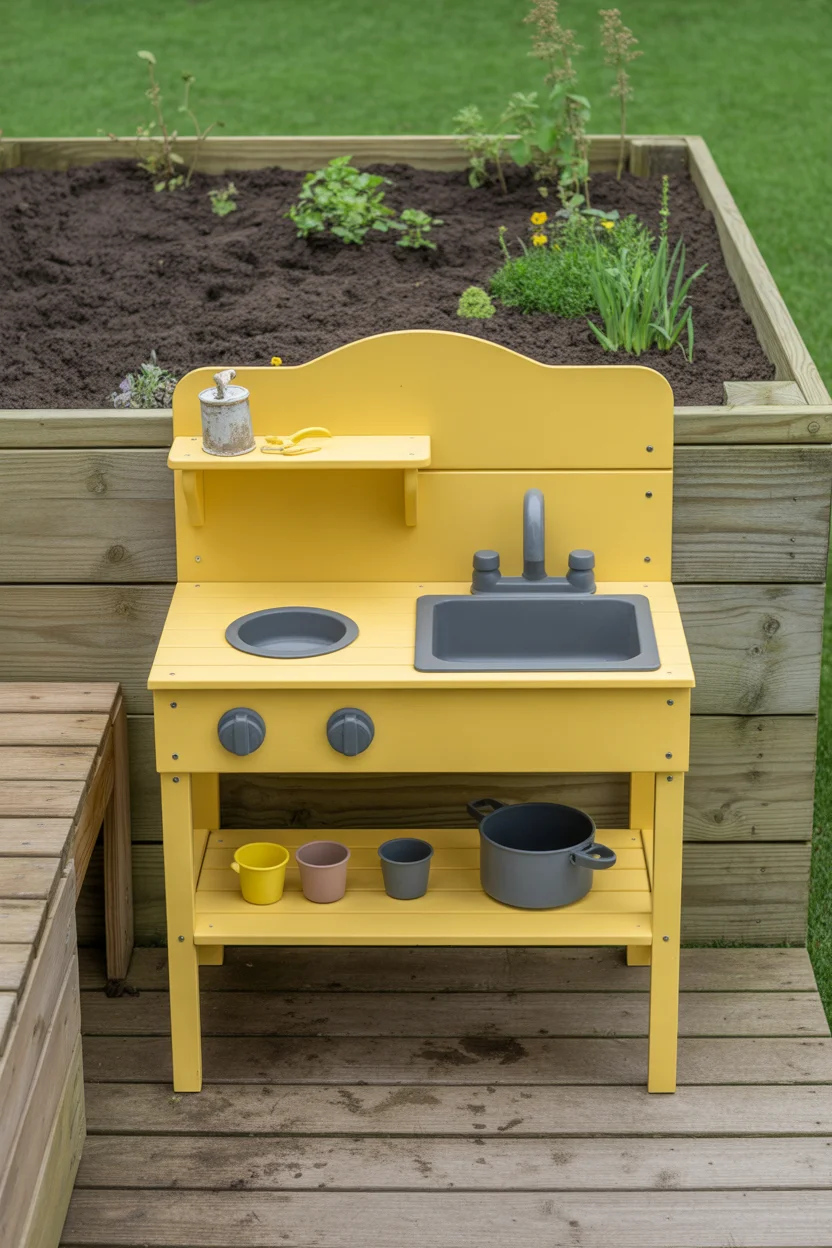
Designing a mud kitchen specifically scaled for toddlers makes all the difference in how independently and confidently young children engage with sensory play. When the counter height sits at hip level for a two-year-old, they can reach everything without climbing or stretching, which dramatically reduces frustration and increases the length of time they’ll play contentedly on their own. A mini mud kitchen can be as simple as a small plywood box with two knobs and a shallow basin, or a compact version of a full-sized kitchen build.
For toddler mud kitchens, safety and simplicity are key design principles. Rounded corners, smooth sanding, and non-toxic paint ensure the setup is completely hazard-free for curious little hands and mouths. Keep the utensil selection small and toddler-friendly — chunky wooden spoons, silicone cups, and large plastic scoops are ideal. A low, wide shelf beneath the counter at toddler height encourages them to independently access and put away their play tools, which also builds early tidying habits through natural, play-based routines they actually enjoy.
6. Mud Kitchen with Herb Garden Integration
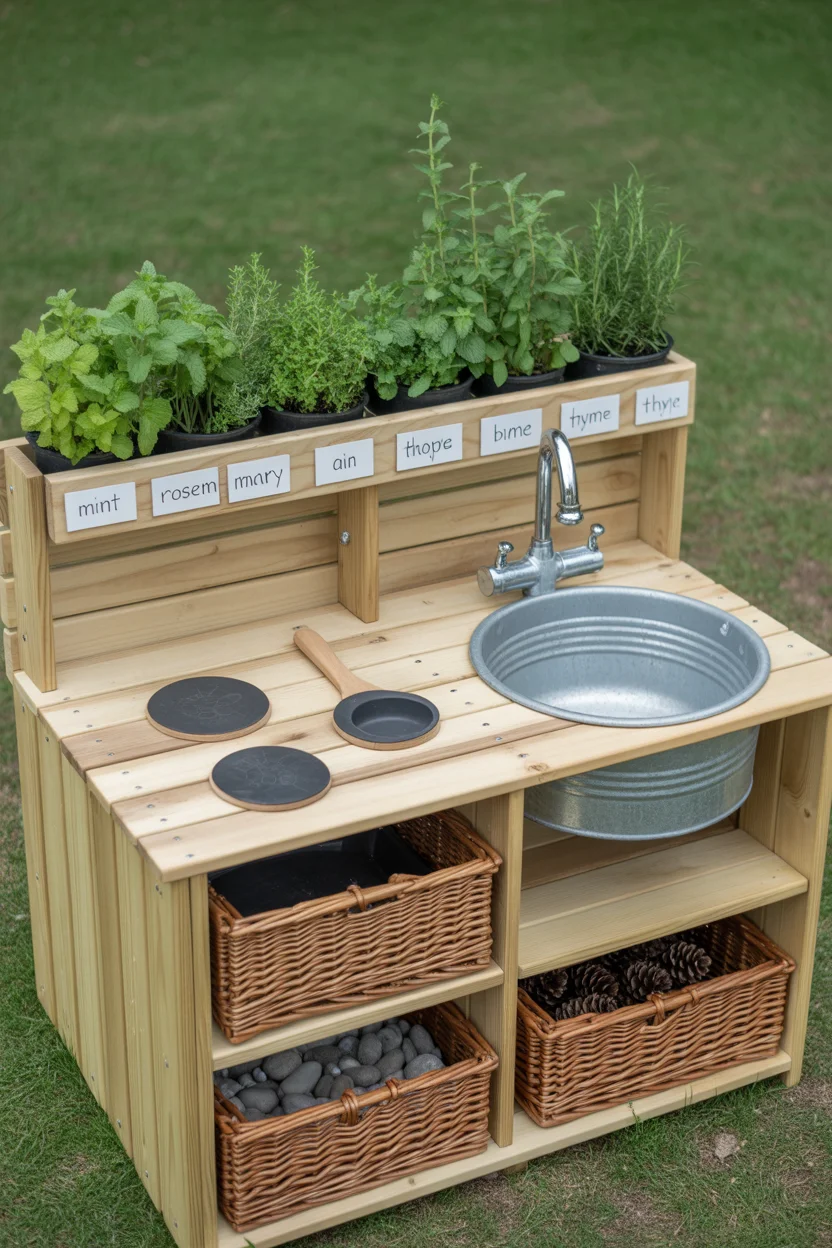
Integrating a small herb garden into the design of a mud kitchen adds a spectacular sensory dimension that goes far beyond mud and water. Children can snip a few mint leaves to add to their mud soup, crush rosemary between their fingers to discover its intense fragrance, or scatter thyme petals across their mud cakes as a garnish. This combination of gardening and imaginative play encourages children to connect with nature in a deeply meaningful, multisensory way while also building early knowledge about plants, cooking, and where food comes from.
From a practical standpoint, pairing an herb planter with the mud kitchen keeps both elements contained within a single outdoor play zone, making supervision easy for parents and setup intuitive for kids. Choose hardy, child-safe herbs like mint, basil, and chives that bounce back from enthusiastic little hands. Label each pot with illustrated signs showing the herb’s name and a simple drawing, which reinforces early reading and vocabulary in a completely effortless, joyful context. This combination genuinely makes the mud kitchen feel like a real, purposeful garden workspace for young chefs.
7. Outdoor Mud Kitchen with Running Water
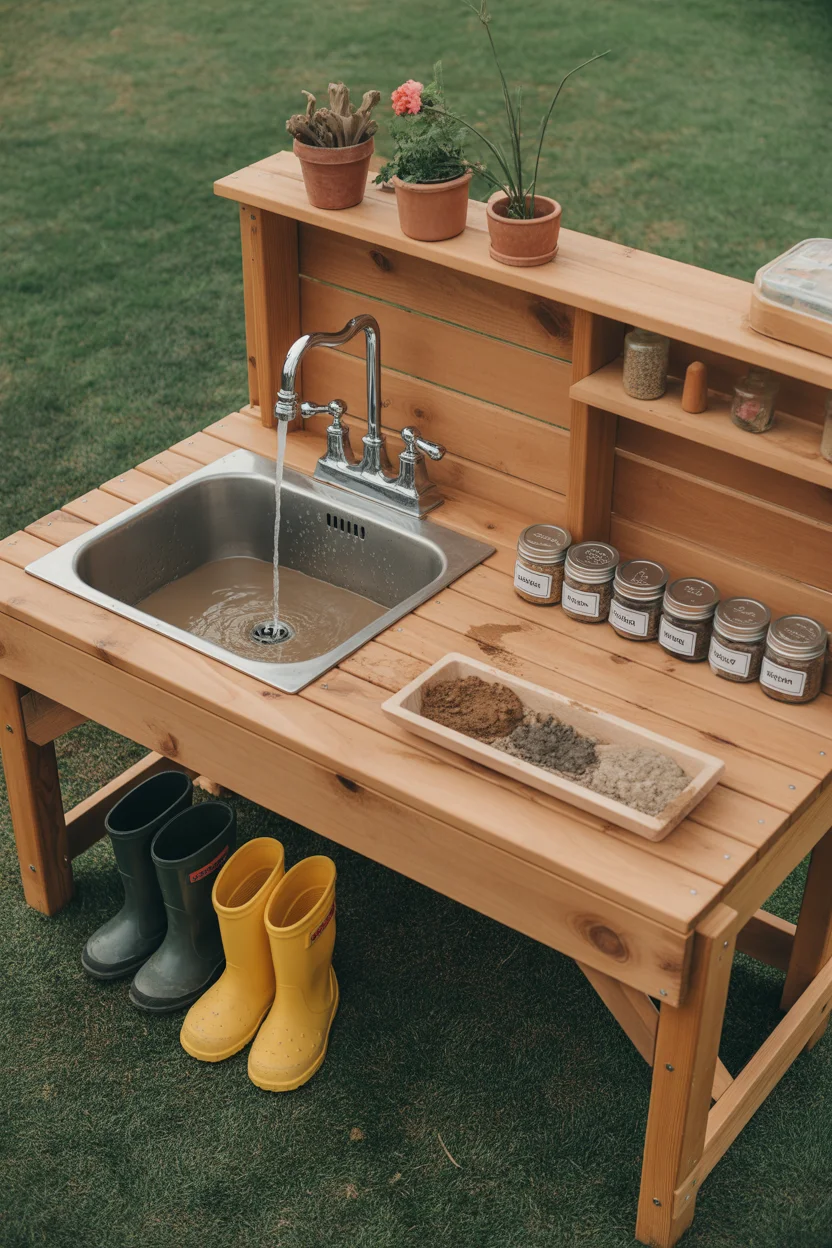
If you want to invest in a truly premium mud kitchen experience, connecting a real outdoor water tap to your build takes the play to an entirely different level. Running water allows children to control flow, experiment with filling and draining, and create truly dynamic mud and water mixtures that are impossible to replicate with pre-filled buckets alone. Many outdoor kitchens can be plumbed with a standard garden hose connection run through the back panel, making this upgrade more achievable than most parents initially assume.
The addition of running water introduces early science concepts in the most natural way imaginable. Kids discover water pressure, observe how mud changes consistency as more water is added, and experiment with drainage and overflow — all without any adult-directed instruction. To manage mess and keep the area from becoming waterlogged, install the kitchen on a gravel or paved base that allows water to drain freely. Add a small wooden step stool at the sink so children of all heights can reach the faucet independently with confidence.
8. Fairy-Tale Themed Mud Kitchen
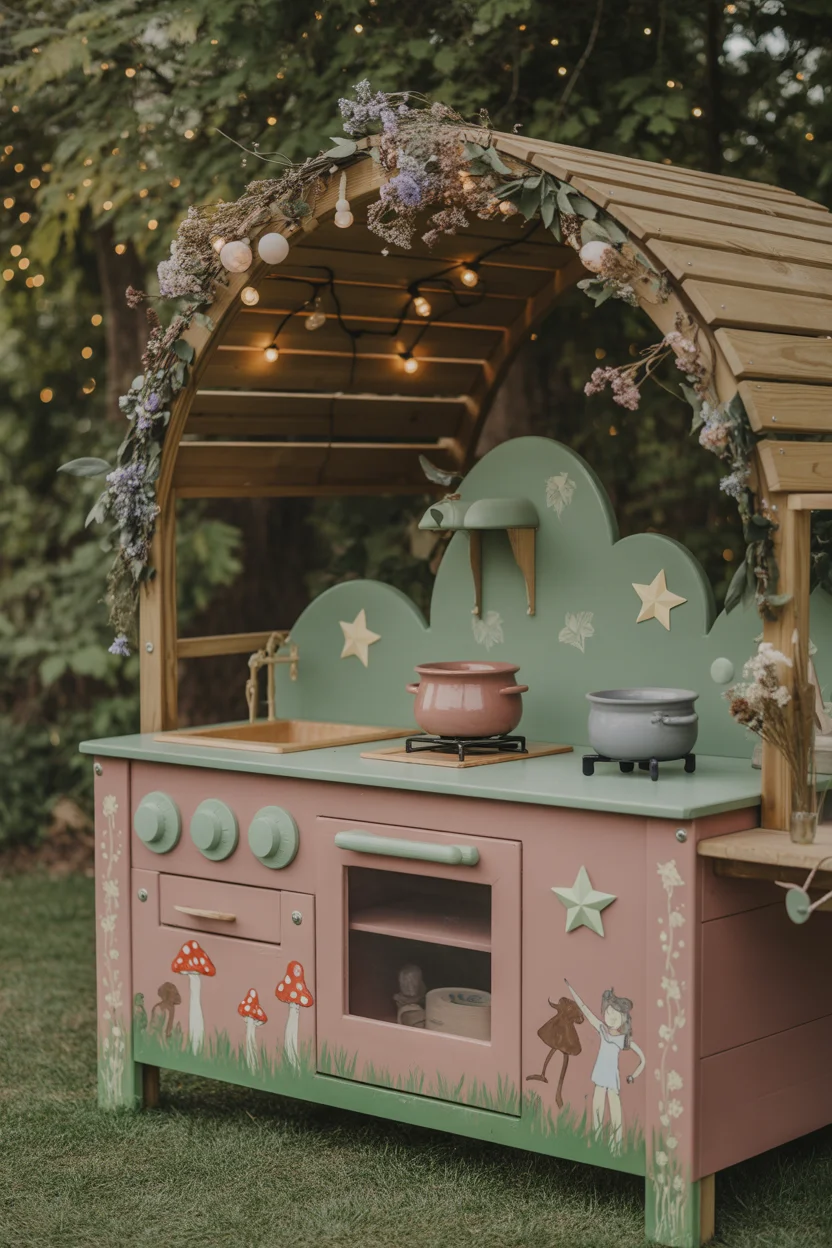
A fairy-tale themed mud kitchen transforms the backyard into an enchanted world where children aren’t just playing — they’re brewing magical potions, cooking feasts for woodland fairies, and gathering ingredients for spell books. This theme works beautifully because it taps into children’s natural love of fantasy and storytelling, making even simple activities like stirring mud or collecting pebbles feel genuinely meaningful and exciting. The theme is surprisingly easy to execute: whimsical paint colors, a few hand-painted motifs, and some decorative details are all it takes to create a truly magical atmosphere children step into with pure delight.
Fairy lights strung along a small canopy above the kitchen make the space feel special even on overcast days, and dried flower bundles hung from small hooks add a witchy, botanical charm. Providing children with small glass jars and labeled “ingredient” cards — “moon dust,” “dragon scales,” “enchanted petals” — fuels storytelling and narrative play that develops language, imagination, and social skills when played with friends. This themed mud kitchen becomes less of a toy and more of an entire imaginative universe your child inhabits with joy.
9. Mud Kitchen with Mud Pie Baking Station
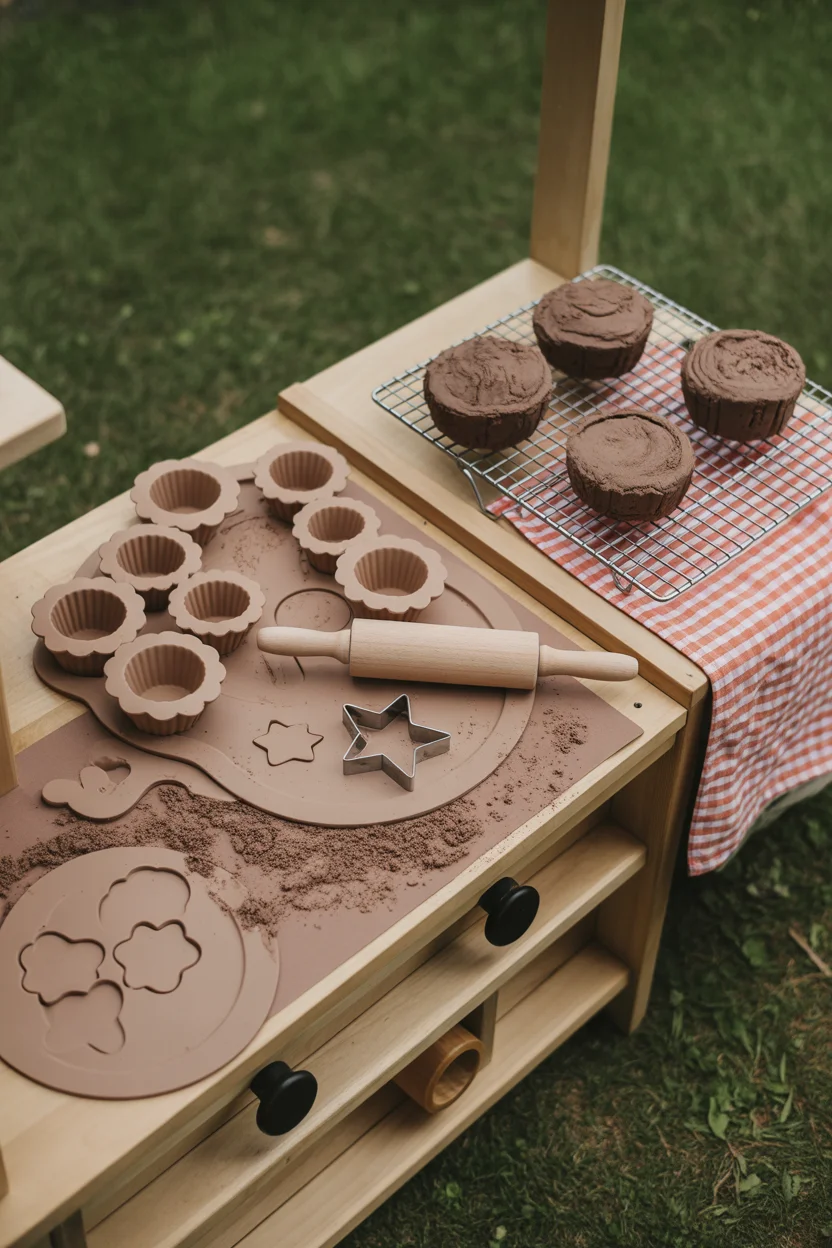
Adding a dedicated mud pie baking station to your mud kitchen setup elevates the creative possibilities from simple mixing to full-on baking roleplay. Equip the station with silicone baking molds in fun shapes — flowers, stars, animals — along with a small wooden rolling pin, cookie cutters, and a wire cooling rack where finished creations can rest proudly before being “served.” This extension of the kitchen mirrors what children see in real kitchen environments, making the play deeply satisfying and encouraging rich, sustained imaginative engagement that develops focus and creative problem-solving.
The baking station works best on a smooth, flat wooden surface where mud can be rolled and pressed without sticking excessively. Provide a small container of fine sand nearby, which children can dust onto the surface like flour to prevent sticking — a detail that adds yet another layer of sensory richness to the experience. Display the finished mud pies on a small wooden shelf or cake stand to give children a sense of pride and accomplishment in their creative work each session.
10. Industrial-Style Mud Kitchen with Metal Accents
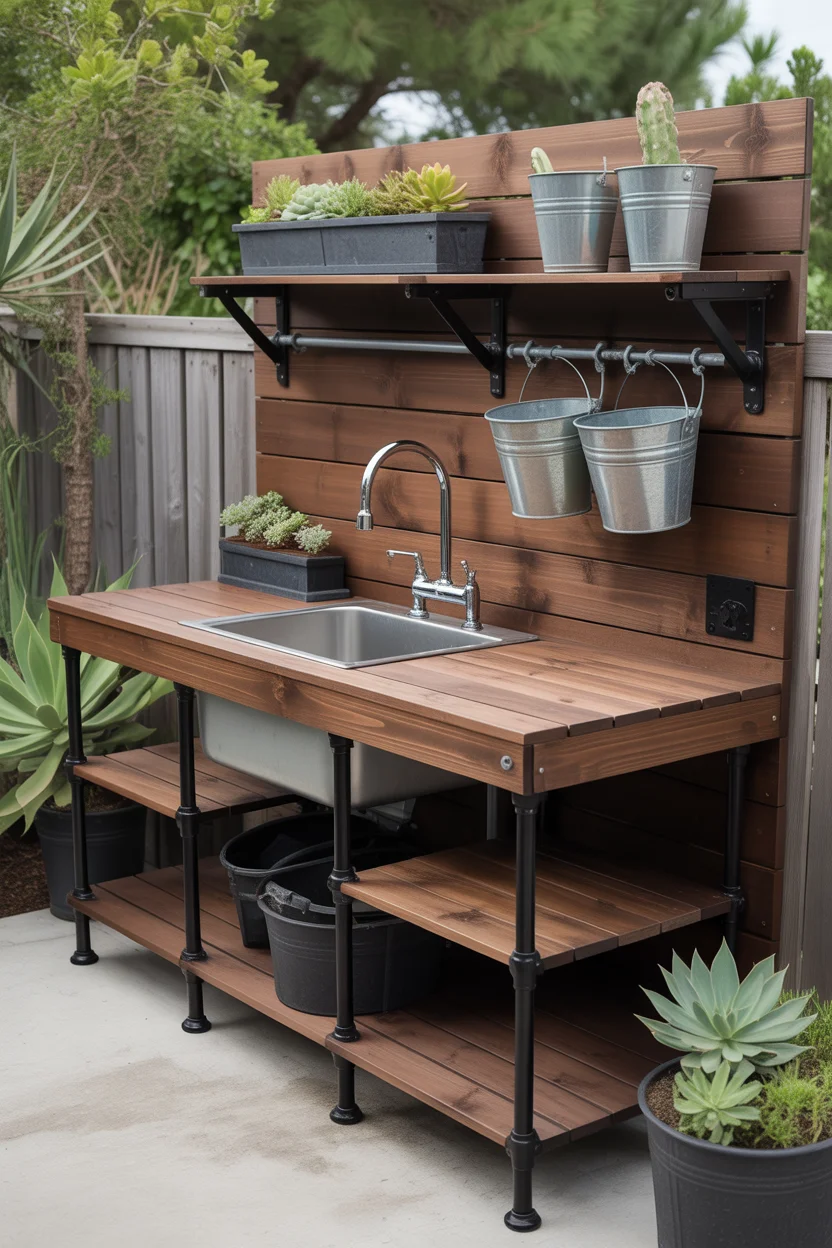
An industrial-style mud kitchen brings a sophisticated, design-conscious aesthetic to the backyard that parents genuinely love looking at as much as kids love using. Dark-stained timber combined with black metal pipe fittings, galvanized buckets, and a stainless steel utility sink creates a kitchen that looks purposeful and considered rather than purely childlike. This style is particularly popular in modern, minimalist outdoor spaces where a brightly colored plastic play kitchen would feel completely out of place. The visual result is a mud kitchen that fits seamlessly into the adult garden aesthetic while still being entirely kid-functional.
The pipe shelving characteristic of industrial design is surprisingly practical in a mud kitchen setting — open shelves are easier for children to access and don’t trap mud and moisture the way enclosed cabinet doors can. Galvanized metal buckets hung from sturdy S-hooks along the side serve as stylish storage for utensils, while a pegboard section painted in matte black holds tools within easy reach. This mud kitchen ages beautifully, developing a natural patina over time that only adds to its rugged, handsome character.
11. Mud Kitchen Corner Nook Under a Tree
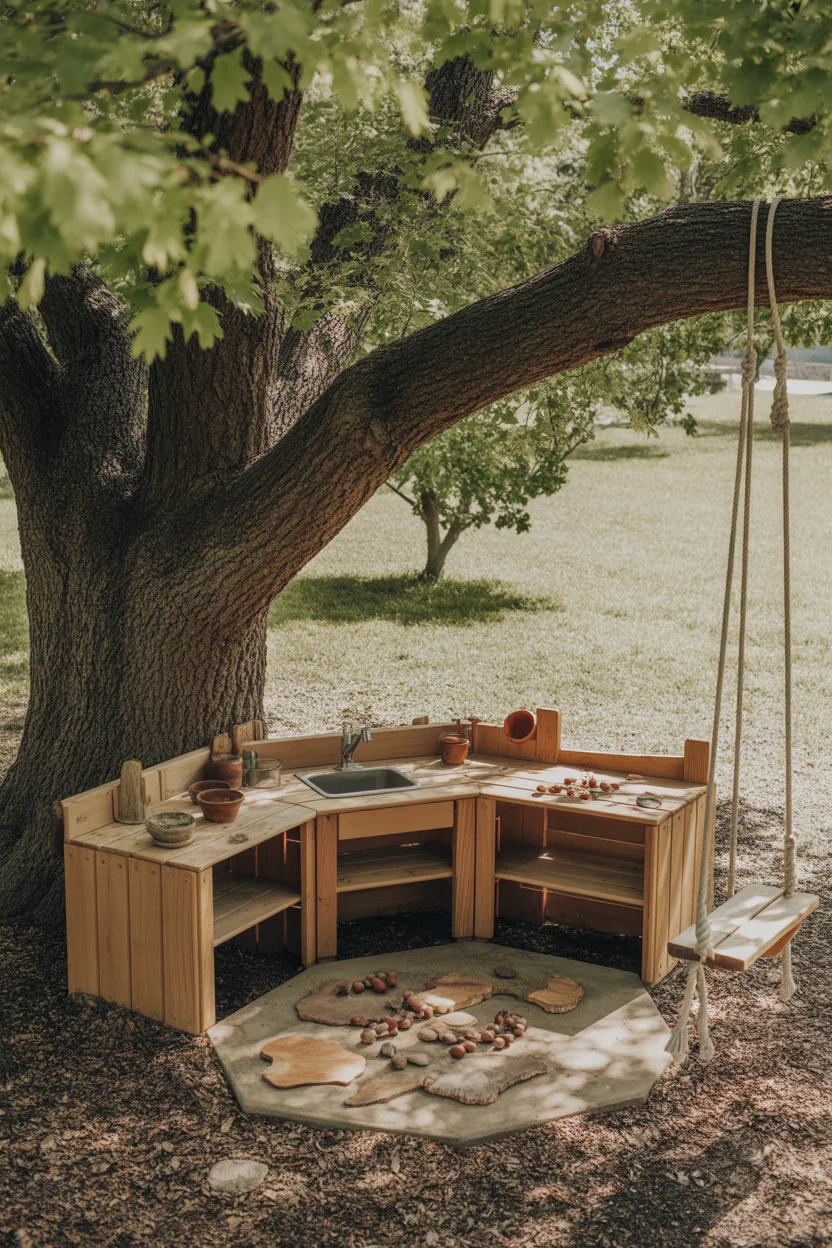
Using a natural tree as the backdrop and anchor for a mud kitchen creates one of the most magical and organically beautiful outdoor play spaces imaginable. The tree provides natural shade that makes the kitchen comfortable to use even on warm summer days, protecting both the children and the wooden structure from excessive sun exposure. Building the workstation to wrap partially around the tree trunk integrates the kitchen into the landscape rather than placing it on top of it, creating a play space that feels like it truly belongs in that garden.
From a practical perspective, the ground beneath a tree is often already enriched with leaves, twigs, acorns, bark, and other natural loose parts that become incredible mud kitchen ingredients without any extra effort from parents. This means the kitchen is always stocked with fresh, seasonal materials that change throughout the year — giving children a built-in reason to engage with the space differently in spring, summer, autumn, and winter. The result is a mud kitchen that teaches seasonal awareness and nature connection alongside all its other magnificent sensory play benefits.
12. Two-Story Mud Kitchen Tower
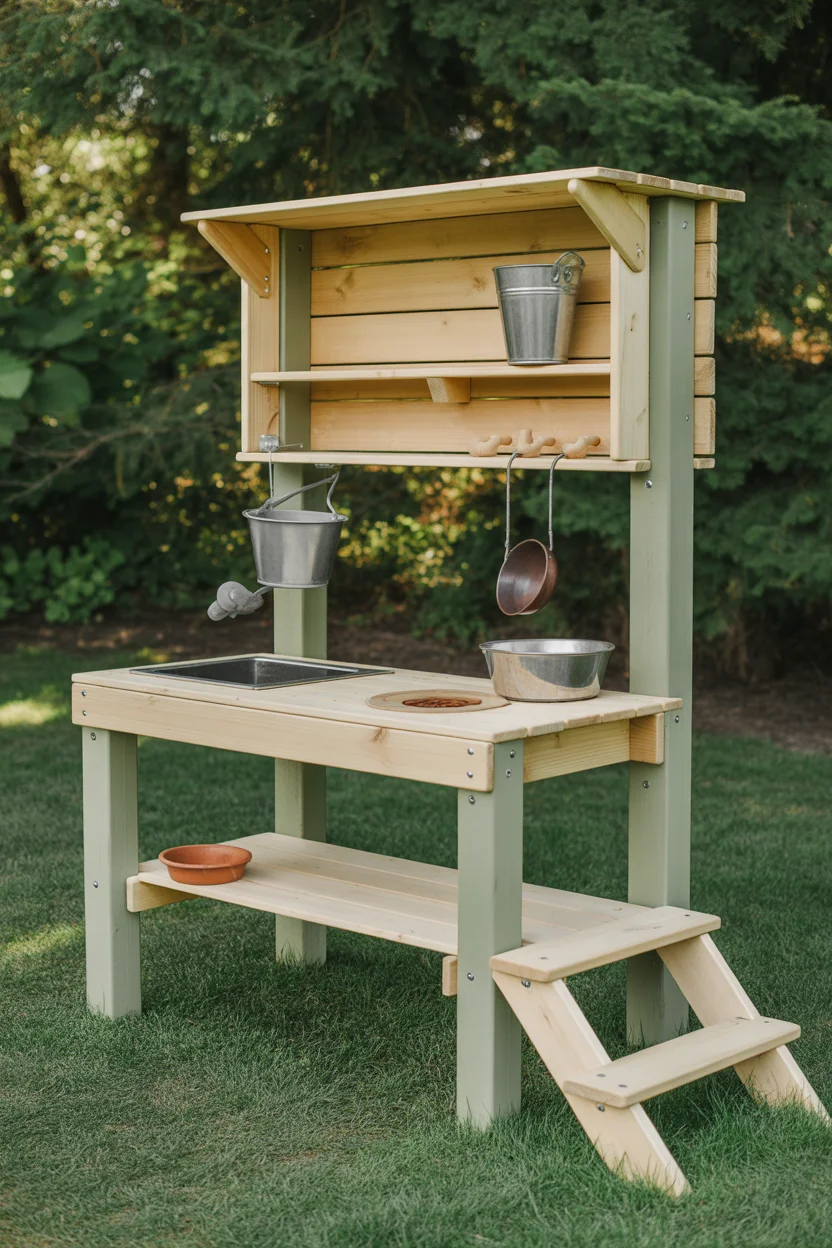
A two-story mud kitchen tower is the ultimate backyard statement piece for families who want to invest in an outdoor play structure that will engage children for years. The lower level functions as the primary cooking and mixing station, while the upper level creates an exciting “balcony kitchen” that can serve as a prep area, a cafe counter for serving pretend customers below, or a lookout point for imaginative play narratives. The vertical element adds dramatic visual interest to the garden and makes the mud kitchen feel genuinely adventurous rather than simply functional.
A simple pulley system — just a small bucket, a rope, and a hook — allows children to hoist “ingredients” from the lower level to the upper platform, introducing basic physics concepts through delightfully purposeful play. Building this structure requires more planning and materials than a standard single-level kitchen, but the investment pays off richly in the complexity and longevity of play it supports. Add a small roof over the upper level to protect children from sun and light rain, extending the usable season dramatically.
13. Mud Kitchen with Sensory Bins
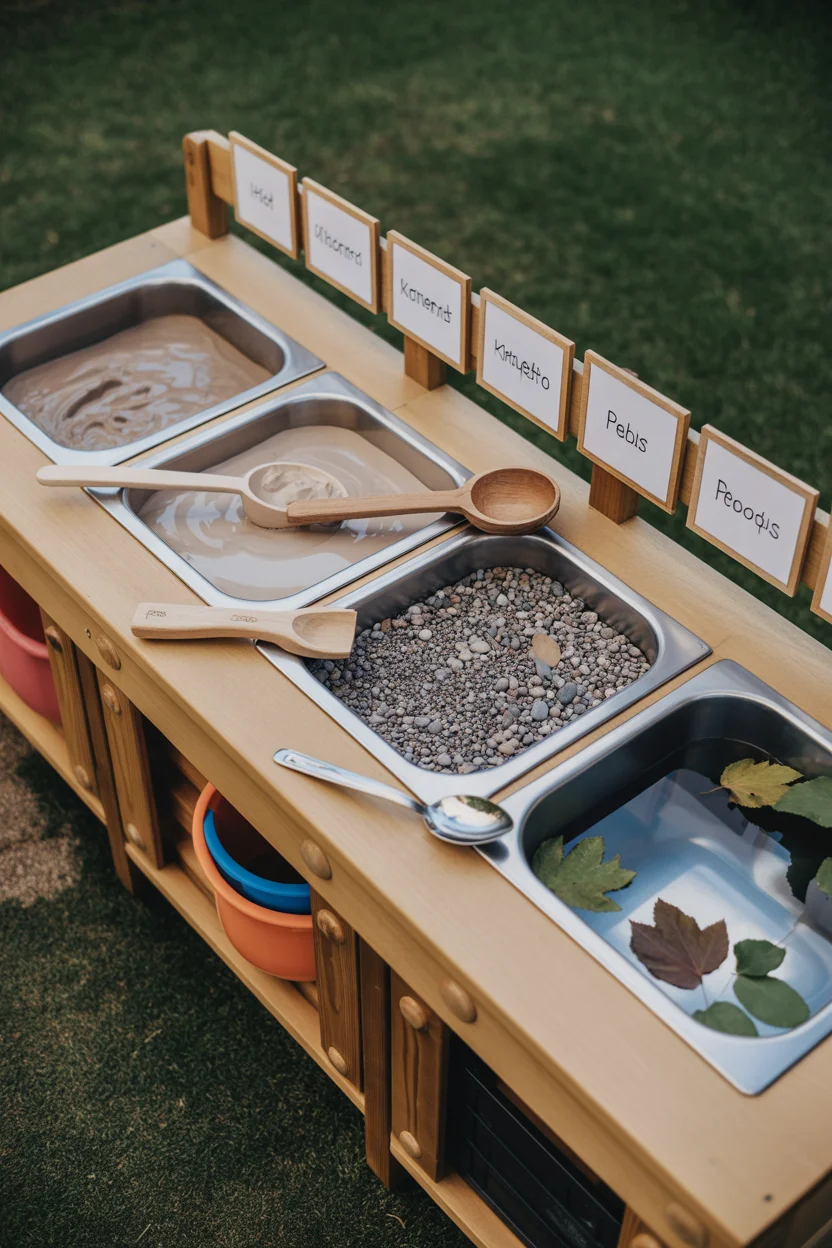
Incorporating dedicated sensory bins directly into the countertop design of a mud kitchen creates a beautifully organized sensory play station that offers children multiple textures and materials to explore simultaneously. Using inset bins — either purchased plastic storage tubs or custom-cut wooden frames — keeps materials contained and prevents mixing until children choose to combine them intentionally. Fill each bin with something different: wet mud, kinetic sand, water, bark chips, dried beans, or pebbles, giving children a rich palette of tactile experiences to draw from as they create and experiment freely.
Sensory bins are particularly valuable for children with sensory processing differences, as they allow gradual, self-directed exposure to different textures without overwhelming pressure. A child who finds wet mud uncomfortable might happily explore the pebble bin first before cautiously dipping a finger into the mud bin at their own pace. Label each bin with both a word and a simple image to support early literacy while keeping the environment welcoming and accessible to children at different developmental stages, including pre-readers who respond to visual cues.
14. Scandinavian-Style Simple Mud Kitchen
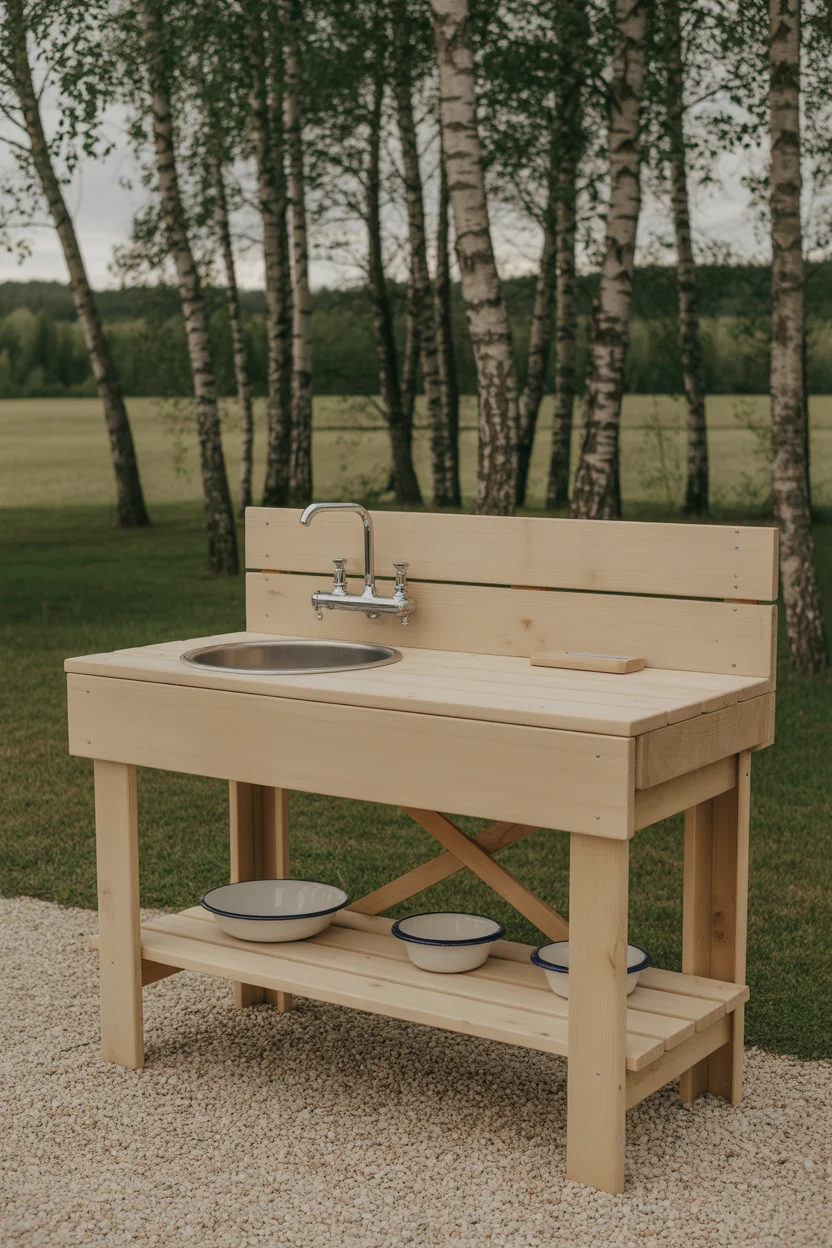
A Scandinavian-inspired mud kitchen strips the concept back to its most elegant, functional essence — clean lines, natural materials, and a complete absence of unnecessary decoration. Using unfinished or lightly oiled birch or pine wood gives the kitchen a warm, organic feel that sits beautifully in naturalistic garden settings. White enamel bowls, simple metal utensils, and a single round basin sink are all the accessories needed to create a play space that feels intentional, considered, and quietly beautiful rather than cluttered with toys competing for visual and tactile attention.
The philosophy behind Scandinavian design — that simplicity enhances rather than limits experience — translates remarkably well to children’s play spaces. Research consistently shows that open-ended, simple environments with fewer but higher-quality materials encourage deeper, more sustained play than busy, overstimulating setups. A minimal mud kitchen invites children to bring their own creativity and ideas to the space rather than having the design prescribe how they should play. Set on a clean pebble base with one or two potted birch trees nearby, this kitchen achieves genuine, effortless beauty.
15. Mud Kitchen with a Cob Oven
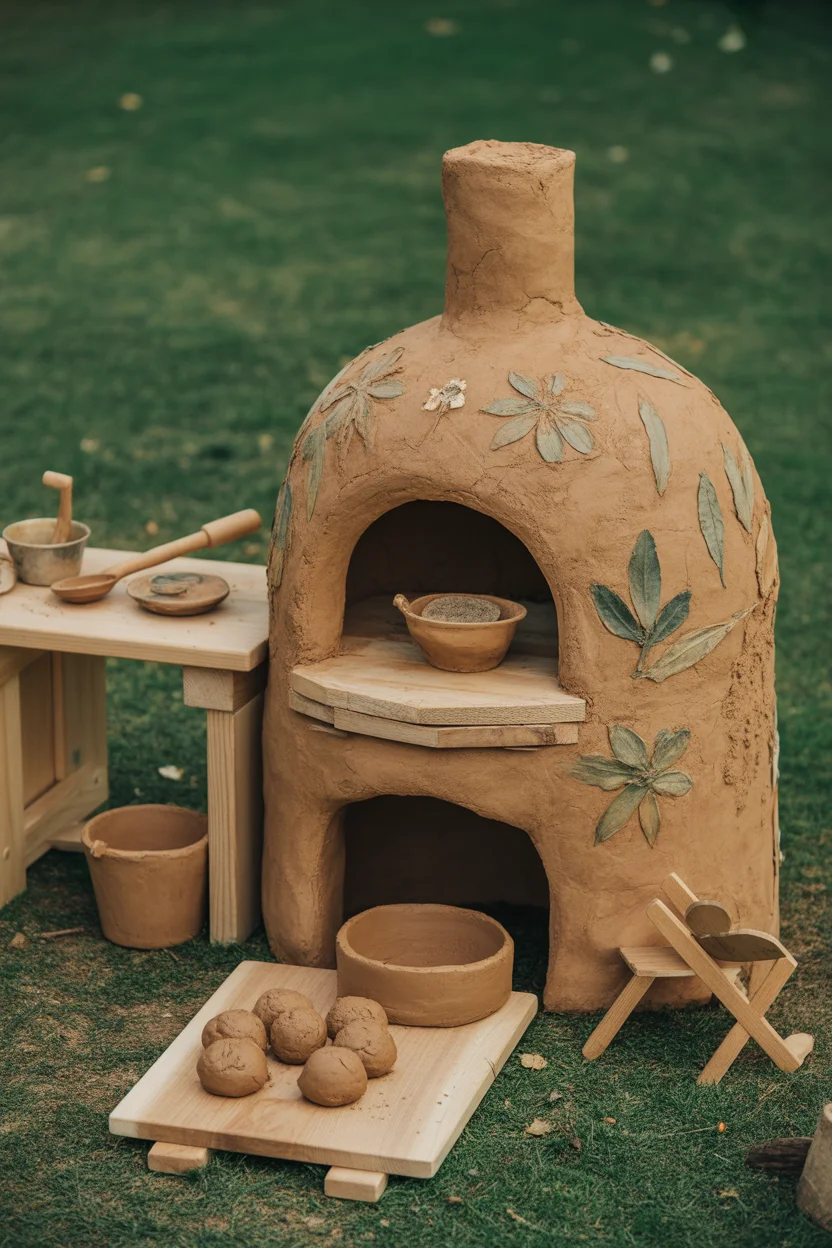
Adding a miniature cob oven to a mud kitchen setup is a spectacular project that children can actually help build, making it meaningful from the very first day of play. Cob — a mixture of clay, sand, and straw — is a completely natural, non-toxic building material that has been used for centuries, and scaling it down to child-sized makes it an achievable weekend project. Children who participate in building their own cob oven develop a deep ownership over the space and return to it repeatedly with pride and imaginative investment that store-bought structures simply cannot replicate.
During play, the miniature cob oven becomes the centerpiece of dramatic baking scenarios — mud loaves slide inside on a flat stick, pizza shapes pressed into rounds get “baked” to perfection, and children narrate elaborate cooking stories around the ritual of the oven. Decorating the exterior with pressed leaf imprints, pebble mosaics, or hand-sculpted animal figures before the clay dries makes the oven uniquely personal and artistically beautiful. This feature transforms an ordinary mud kitchen into a genuinely extraordinary outdoor installation that children and parents will treasure for many seasons.
16. Mud Kitchen with Natural Loose Parts Station
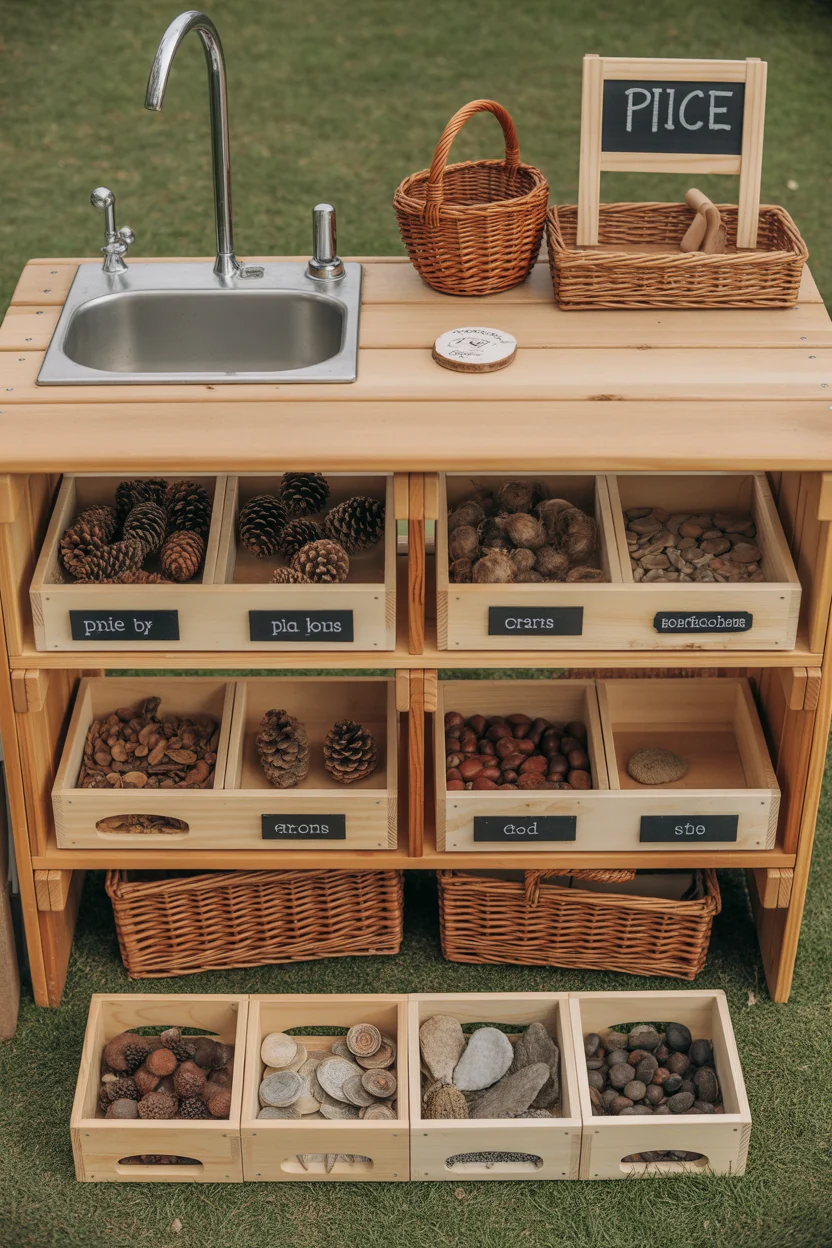
A loose parts station alongside a mud kitchen exponentially increases the richness and complexity of children’s play by providing an ever-changing collection of natural materials to incorporate into their creations. Loose parts theory — developed by architect Simon Nicholson — proposes that environments offering open-ended materials support more creative and intelligent play than those with fixed-function toys. Curate a collection of pine cones, acorns, shells, pebbles, seed pods, sticks, and dried flowers, rotating materials seasonally to keep the station fresh, surprising, and continuously engaging for children at all stages of development.
Organizing loose parts in a labeled wooden crate system or a set of small wicker baskets makes the collection visually beautiful and practically accessible, so children can independently select, combine, and return materials without adult help. Laminated picture labels on each compartment support early reading while ensuring even pre-literate children can navigate the system confidently. Invite children to add their own found natural treasures to the collection during walks, fostering a culture of noticing and gathering that deepens their relationship with the natural world throughout all seasons.
17. Mud Kitchen with a Chalkboard Menu Board
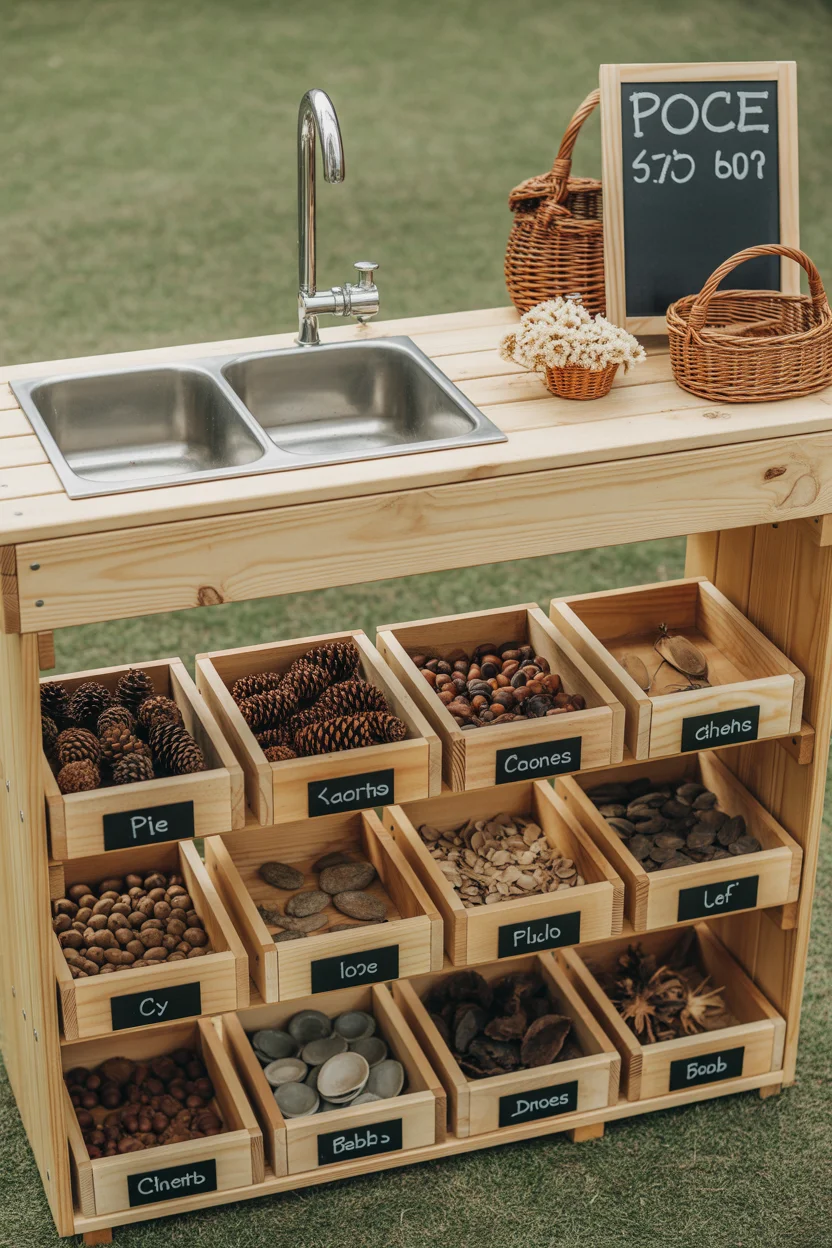
A chalkboard menu board beside the mud kitchen transforms the entire play scenario into a bustling garden cafe, restaurant, or bakery experience that draws children into rich, collaborative pretend play. The menu board becomes a shared narrative tool — children write or draw the day’s offerings, assign prices, take “orders” from siblings or parents, and manage a pretend business with surprising sophistication. This layer of roleplay on top of the sensory mud play builds language skills, mathematical thinking around numbers and pricing, and vital social skills around negotiation and cooperation.
Supply the café area with a small notepad and a stubby pencil for “order taking,” an old cash register or a simple coin tin for payments, and a set of mismatched plates and cups for serving. These additions cost very little but dramatically deepen the play narrative and extend sessions that might otherwise wind down after twenty minutes into hour-long, story-rich imaginative adventures. Update the menu board regularly with seasonal specials — “autumn leaf soup,” “spring blossom cake” — to give children fresh starting points for their ongoing culinary storytelling.
18. Repurposed Patio Table Mud Kitchen
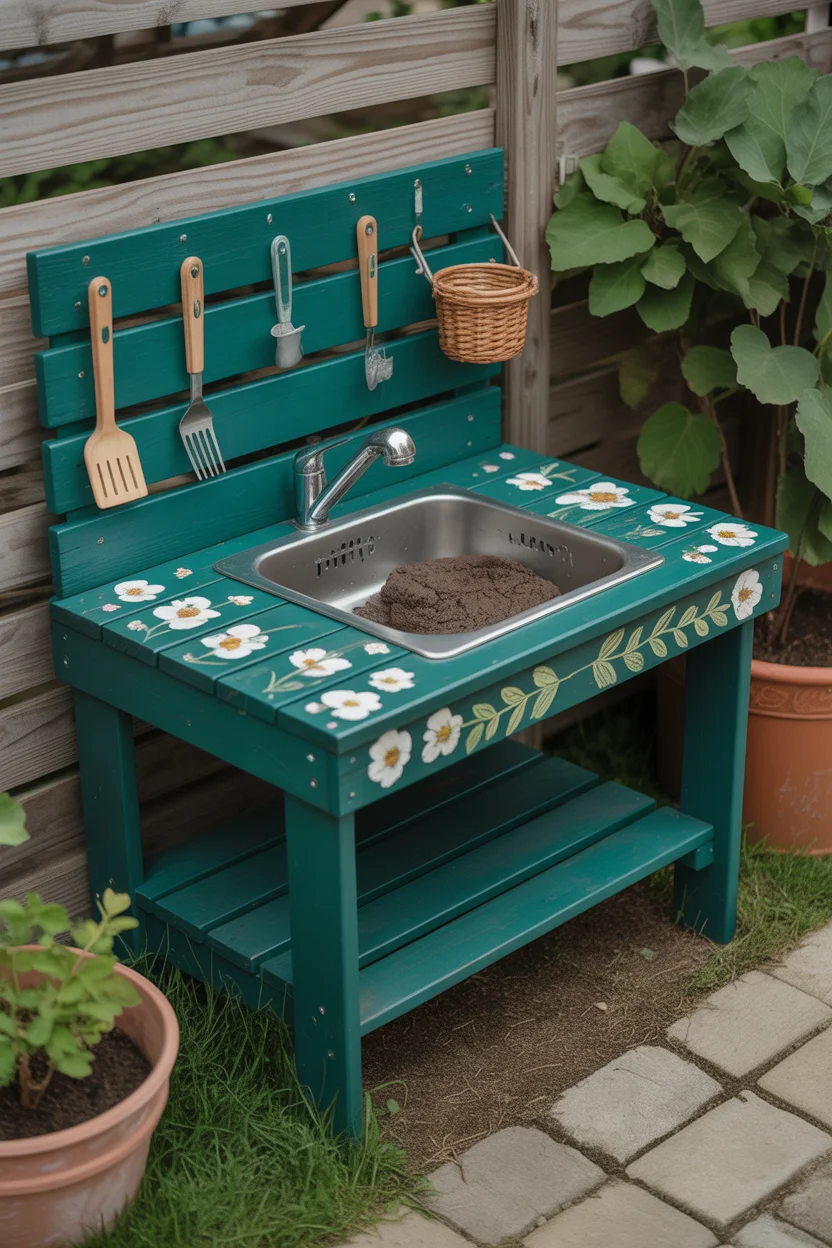
Turning an old patio table into a mud kitchen is one of the quickest and most satisfying upcycling projects a family can tackle together on a weekend afternoon. The table already provides the perfect counter height and structural stability, meaning the main work is purely cosmetic and functional customization. Cut a hole in the tabletop to accommodate an inset basin — a simple round plastic basin from a hardware store works perfectly — and you have a functional sink without any plumbing required. Fill from a jug and drain by lifting the basin to empty.
Add personality and practicality by attaching cup hooks around the table’s perimeter for hanging utensils, and attaching two or three wooden boards beneath the tabletop to create a useful lower shelf for storage. Sand, prime, and paint the entire surface with weather-resistant outdoor paint in a color that suits your garden aesthetic — deep forest green, terracotta orange, or chalky white all work beautifully. Seal with an outdoor varnish to protect against rain, and the repurposed patio table mud kitchen will serve your family faithfully for many seasons.
19. Mud Kitchen with a Rooftop Canopy
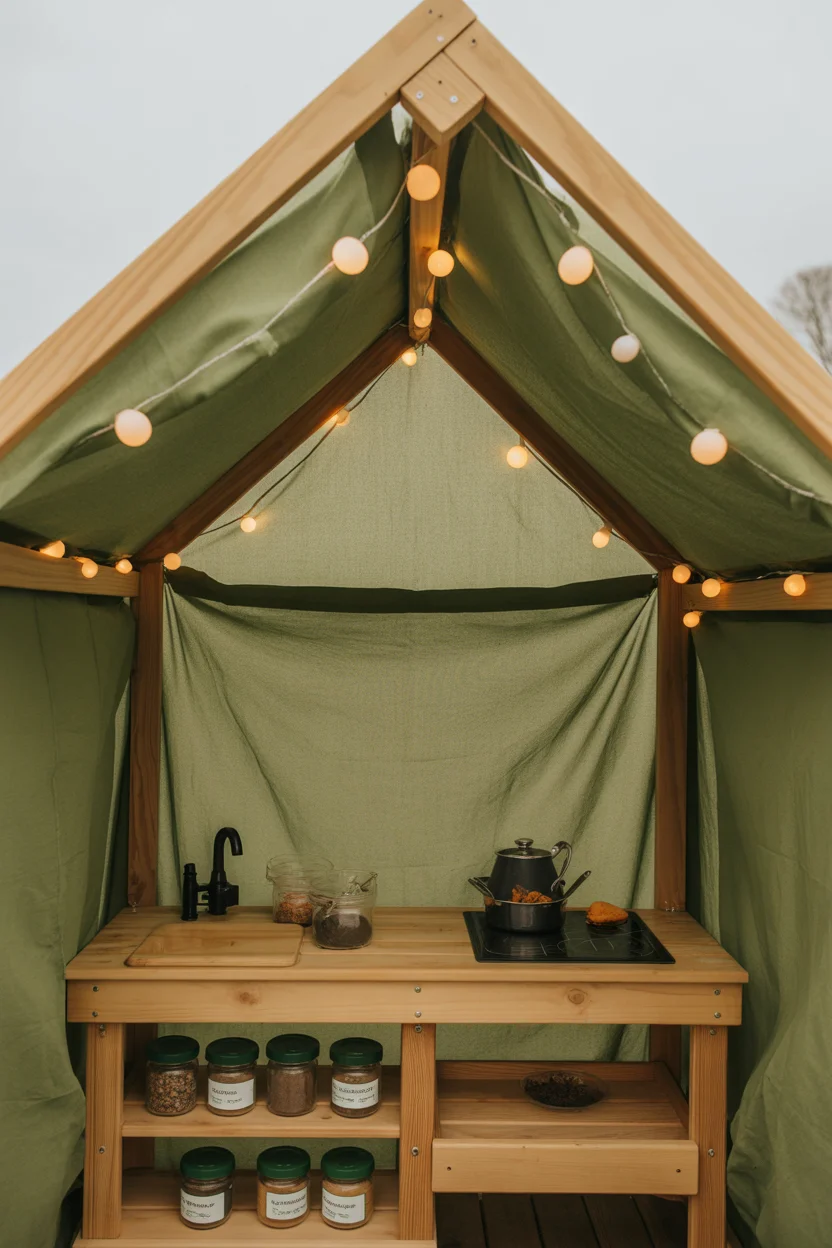
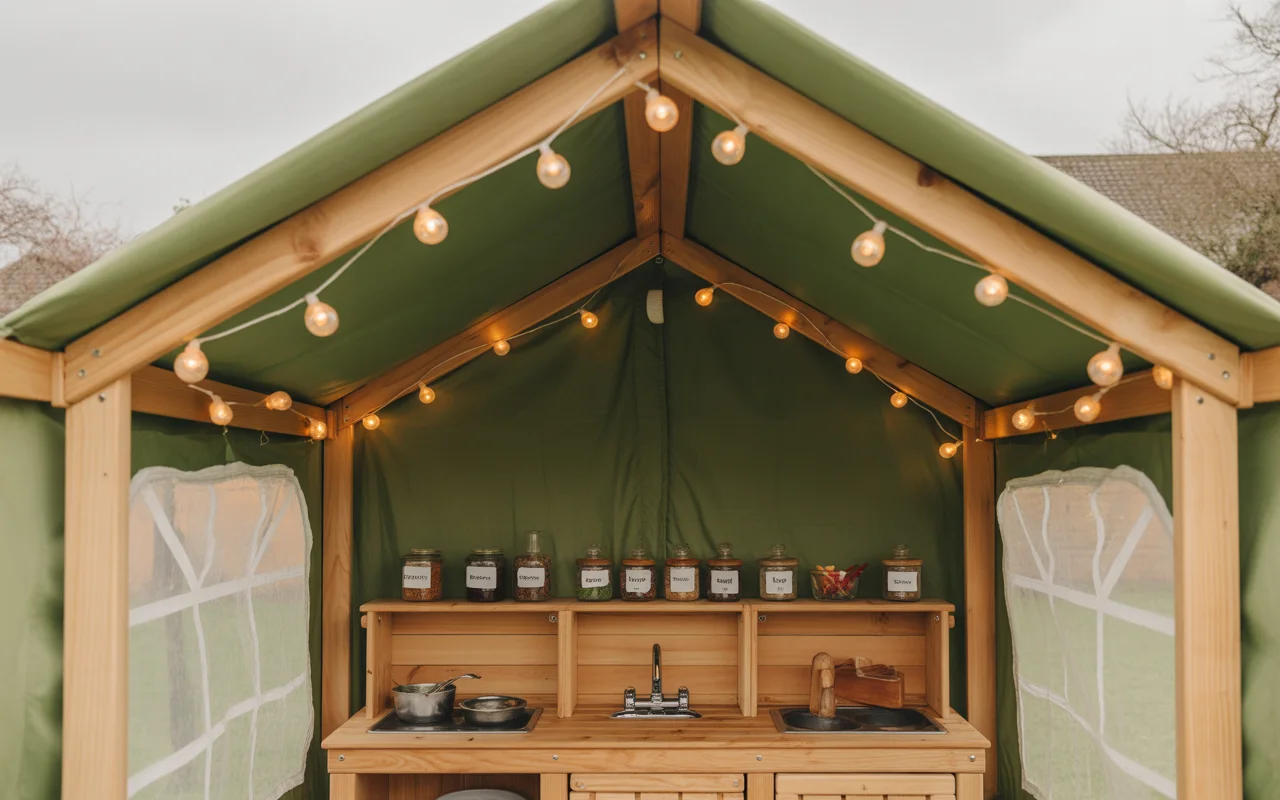
Adding a canopy or rooftop cover to a mud kitchen is the single most effective way to extend its use throughout the year, including during the drizzly, overcast days that are most perfect for making genuinely excellent mud. A simple peaked roof built from the same timber as the kitchen frame, covered with corrugated perspex, cedar shingles, or waterproof canvas, protects both the children and the kitchen’s surfaces from rain and harsh direct sunlight. Children with sensory sensitivities to rain on their heads particularly benefit from the sheltered, contained feeling a roofed kitchen provides.
String fairy lights along the interior of the canopy to create a magically atmospheric play space that feels like a secret outdoor room. Even on the greyest autumn afternoon, the warm glow of fairy lights makes the mud kitchen feel inviting and special — and dramatically extends evening play in summer when daylight lingers. Hang waterproof bunting or a few weatherproof plants from the canopy edges to add color and life overhead. A covered mud kitchen becomes a genuine outdoor room that children inhabit rather than simply visit occasionally.
20. Mud Kitchen with a Water Wheel
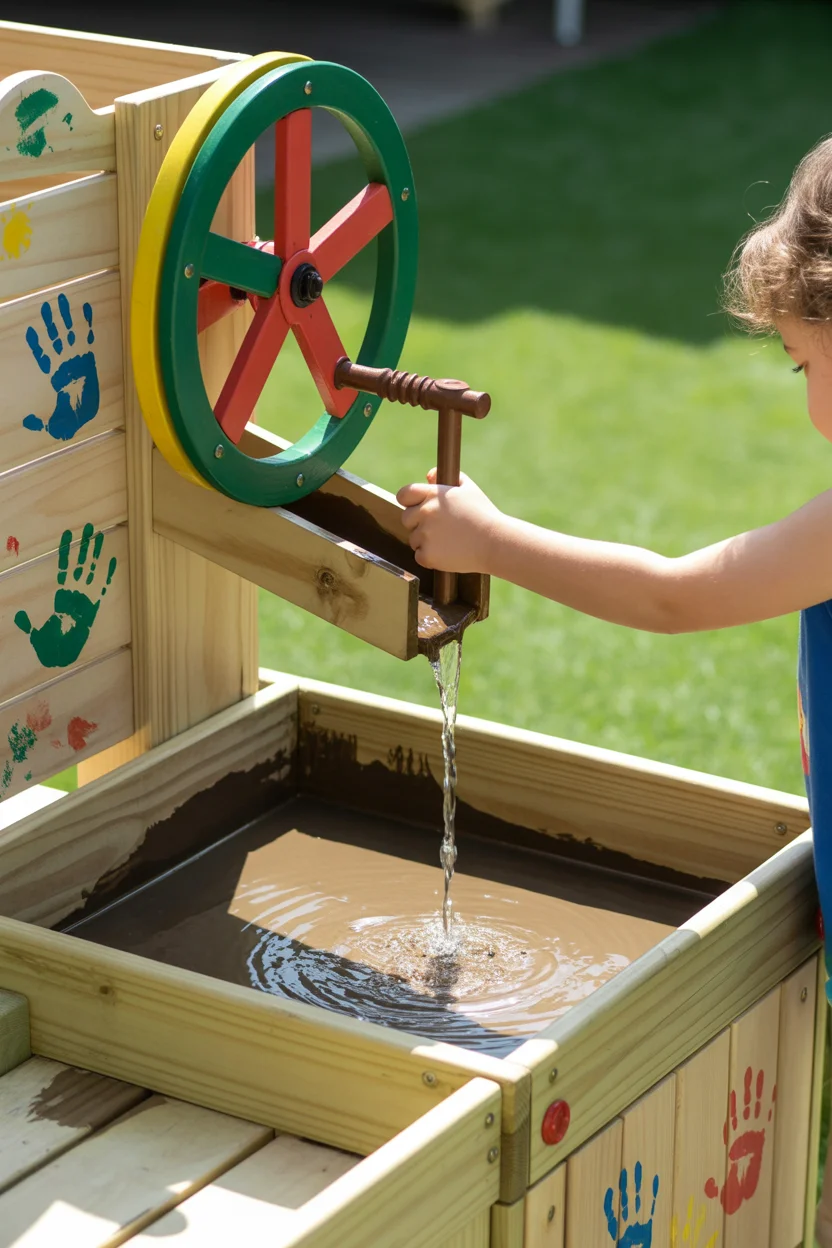
Mounting a hand-cranked water wheel on the side of a mud kitchen creates a thrillingly interactive water feature that introduces basic engineering and physics concepts through completely playful, self-directed exploration. Children discover cause and effect instantly — turn the handle, water flows. Turn faster, more water moves. Stop turning, the flow stops. This direct, immediate feedback loop is profoundly satisfying for young minds and encourages extended experimentation that goes far beyond what simple pouring from a jug would inspire. A bamboo chute is an easy, inexpensive, and beautiful way to direct the water flow into the main basin.
Water wheels are available as standalone educational toys or can be DIY-crafted from a plastic water wheel component purchased inexpensively online and mounted onto a simple wooden frame attached to the kitchen’s side panel. Painting the wheel in bold primary colors makes it visually exciting and easy for children to identify and operate independently. As a bonus, the water wheel keeps children engaged with the water element of the kitchen for much longer than static basins alone, extending play sessions and deepening the quality of sensory water exploration considerably.
21. Mud Kitchen with Hanging Herb Bundles
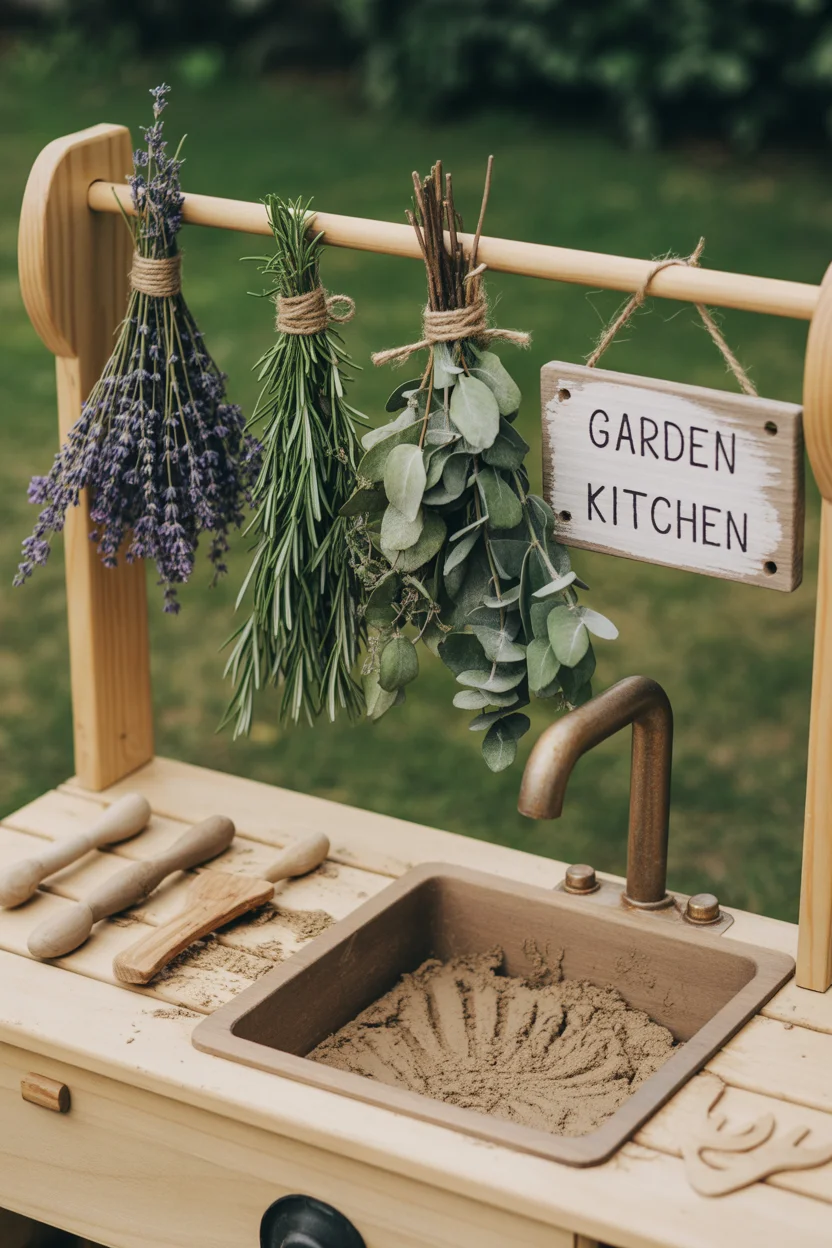
Hanging bundles of dried herbs above the mud kitchen counter adds the extraordinary dimension of scent to an already rich sensory environment, making the play experience genuinely multi-layered and memorable. Lavender, rosemary, mint, and eucalyptus all dry beautifully and retain their fragrance for many months, infusing the kitchen area with a calming, botanical aroma that grounds children in their natural surroundings. Children will inevitably reach up to touch, smell, and incorporate the herbs into their mud cooking, adding rich narrative texture to their imaginative play scenarios throughout every season.
From an educational standpoint, aromatic herb bundles introduce children to the concept of using herbs and botanicals in cooking and medicine — a gentle, age-appropriate introduction to herbalism and food culture. Naming each bundle with a small handwritten label (“lavender,” “rosemary,” “mint”) adds a literacy element to the visual experience. Replace bundles seasonally with whatever is growing abundantly in the garden, teaching children that kitchens — real and pretend — work in harmony with the seasons and the natural rhythms of the garden throughout the year.
22. Night-Time Mud Kitchen with Lanterns
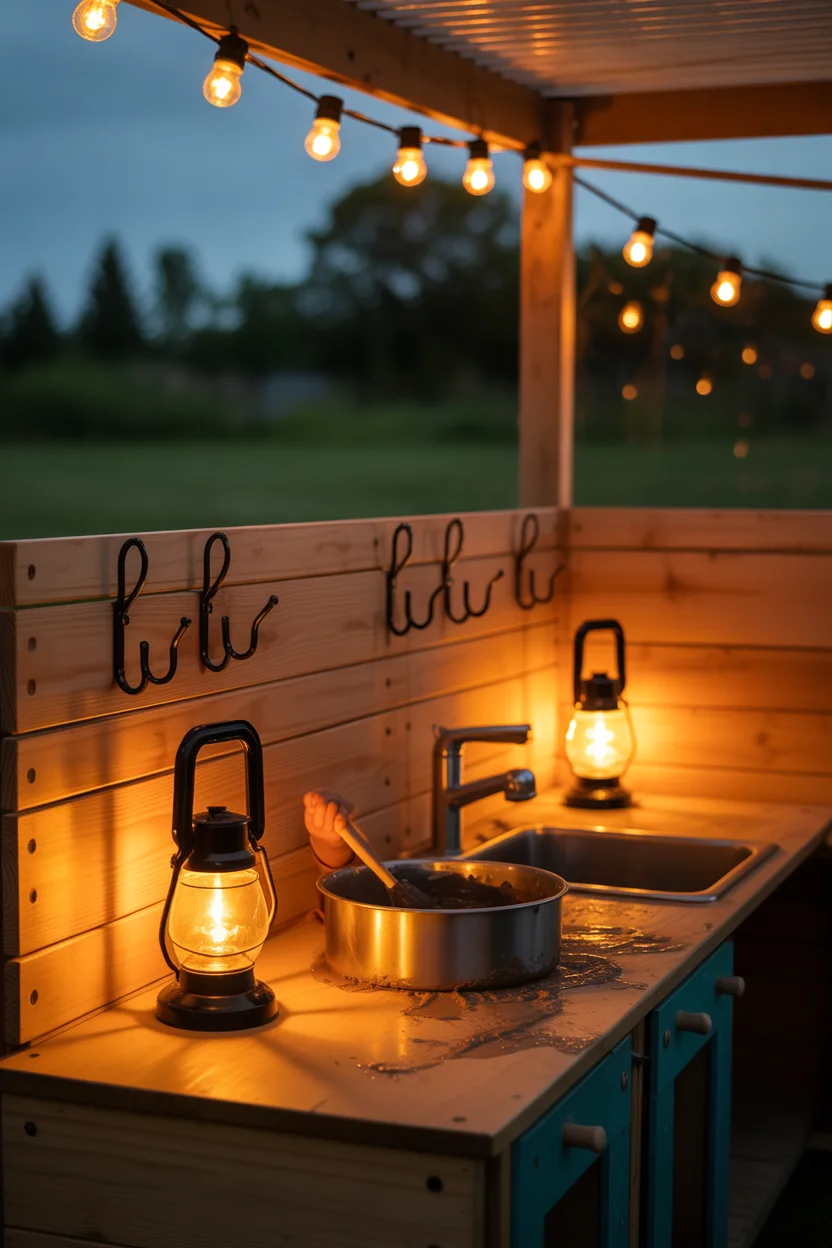
Setting up a mud kitchen for evening and nighttime use creates a uniquely magical play experience that children remember with enduring fondness. Solar-powered lanterns require no electrical work and charge effortlessly during daylight hours, providing warm, safe, ambient light that transforms the familiar daytime kitchen into a mysterious, atmospheric nighttime workspace. Evening mud play feels profoundly different from daytime sessions — sounds change, temperatures drop pleasantly, shadows lengthen, and children’s imaginations seem to expand in the quieter, dimmer atmosphere, producing richer and more narratively complex play scenarios than they generate in bright daylight.
For safety, ensure all lanterns are LED-based with no open flames, and position lights where they illuminate the work surface without shining directly into children’s eyes. String Edison-style outdoor bulbs beneath a canopy frame for a warm, festive glow that makes the kitchen feel like a real outdoor restaurant on a summer evening. Evening mud kitchen sessions work particularly well in warm summer months when bedtime is later and the long twilight creates a perfect transitional play window between dinner and the winding down of the evening.
23. Montessori-Inspired Mud Kitchen
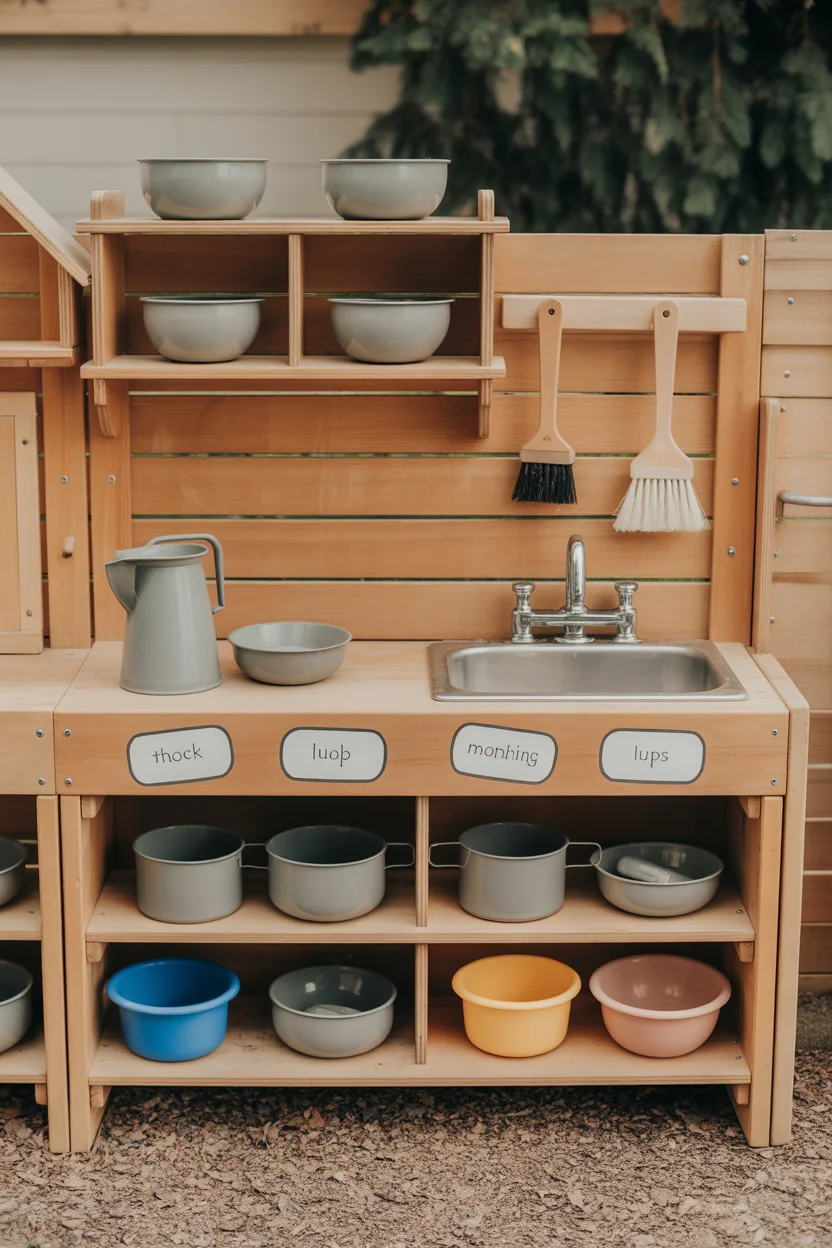
A Montessori-inspired mud kitchen applies the core principles of the Montessori educational philosophy — order, independence, beauty, and purposeful activity — to outdoor sensory play design. Every item has a designated place on the counter, marked with a gentle outline or label so children always know exactly where things belong and can maintain the space independently without adult direction. The environment itself teaches tidiness and responsibility through its inherent logic rather than through rules imposed from outside, which research consistently shows produces more genuinely organized and self-directed children over time.
Include a small cleaning station beside the kitchen — a dustpan and brush, a small broom, a bucket and cloth — scaled to child size so they can genuinely clean up after play without adult intervention. This closing routine of tidying becomes as meaningful and satisfying as the play itself in a Montessori framework. Choose materials thoughtfully: real ceramic bowls are preferred over plastic, real metal measuring cups over toy versions, and natural materials over synthetic alternatives wherever possible. The result is a mud kitchen that respects children’s intelligence and develops genuine competence.
24. Mud Kitchen with a Pulley and Bucket System
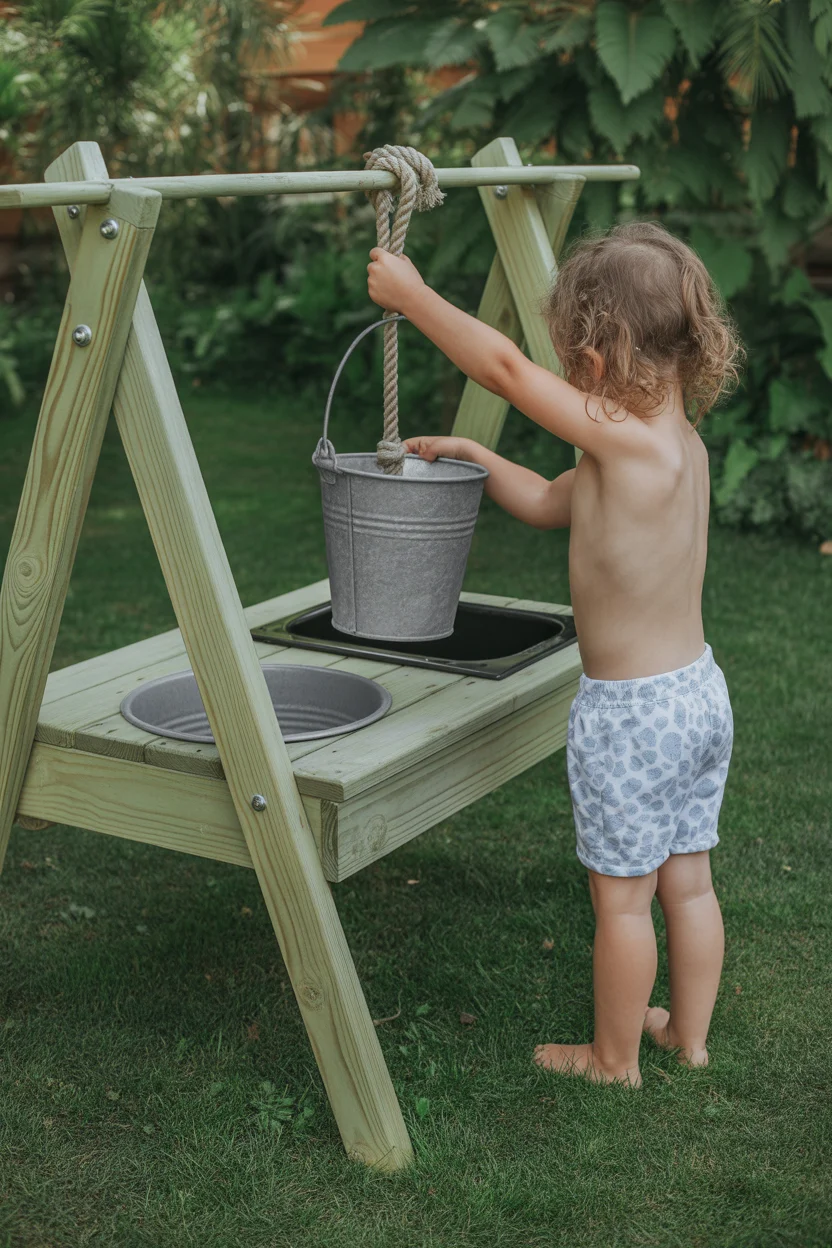
A pulley and bucket system is one of the most thrillingly interactive additions a mud kitchen can have, and it’s remarkably simple and inexpensive to install. A basic rope pulley mounted on a wooden A-frame or attached to an overhead beam allows children to hoist buckets of mud, water, or collected natural materials up to a higher level, introducing fundamental physics concepts — mechanical advantage, gravity, and load — through entirely self-motivated, joyful play. The system instantly creates collaborative play opportunities, since one child is needed below to load the bucket while another pulls the rope.
Children who might otherwise play independently tend to naturally seek partners when a pulley system is available, because its full potential is only realized through cooperation — making it a powerful social play catalyst. The engineering challenge of figuring out how much weight the pulley can lift, how to load the bucket without it tipping, and how to coordinate the raise and lower sequence engages problem-solving, communication, and teamwork skills simultaneously. This single addition transforms a solitary sensory play experience into a dynamic, collaborative outdoor physics experiment children will return to obsessively.
25. Mud Kitchen with a Seasonal Display Shelf
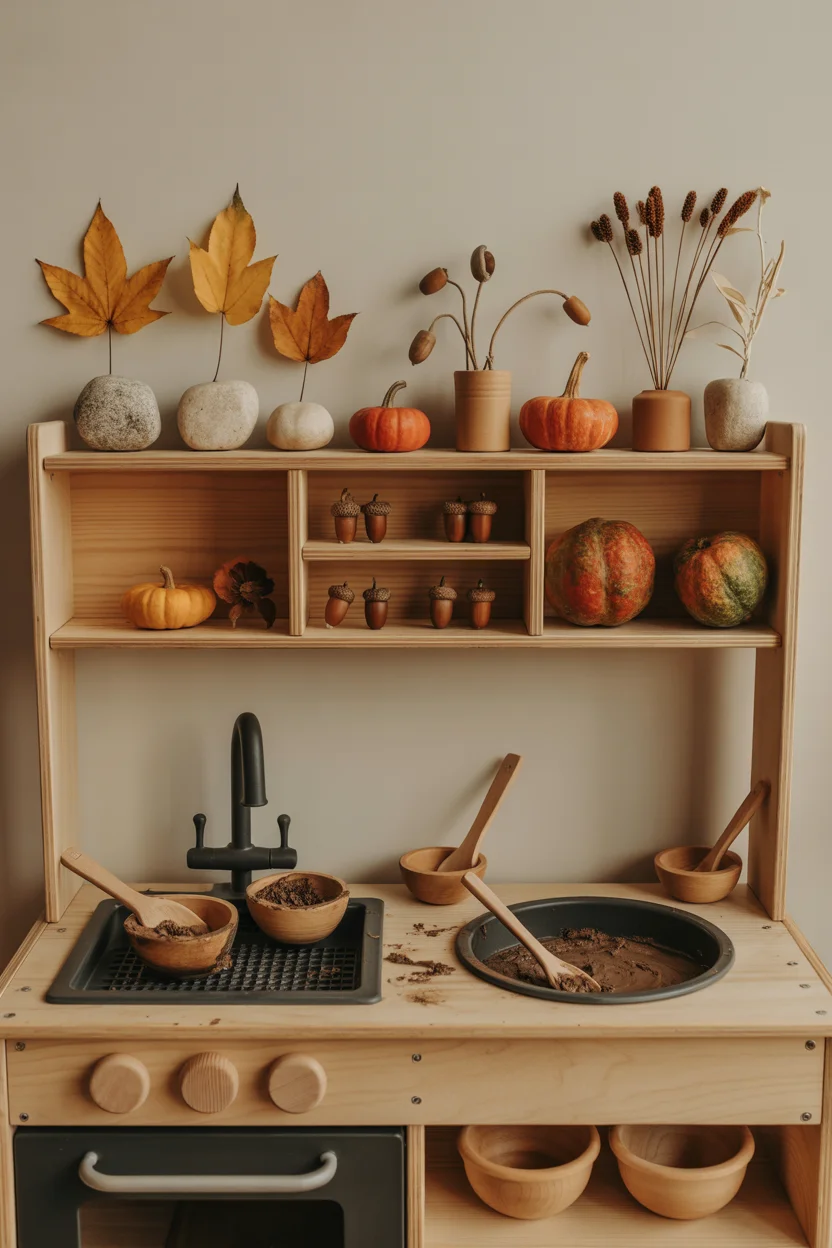
A seasonal display shelf above the mud kitchen counter transforms the space into a living nature table that evolves beautifully throughout the year, giving children a reason to visit the kitchen during every season and notice the changing natural world with genuine curiosity and excitement. In spring, fill the shelf with early blossoms, fresh green leaves, and bird feathers. In summer, display sun-bleached pebbles, vibrant wildflowers, and butterfly wing fragments. Autumn brings golden leaves, conkers, and berries, while winter offers frost-touched pinecones, bare seed heads, and perhaps a small bird’s nest discovered on a winter walk.
Curating the seasonal shelf together with your child makes it a shared ritual of observation, collection, and creative arrangement that deepens their relationship with the natural world far more meaningfully than any nature documentary could achieve. Discuss why certain things appear in each season, how living things change and adapt, and what will come next — conversations that build scientific thinking, vocabulary, and a profound sense of wonder. A mud kitchen with a seasonal shelf becomes not just a play space but a year-round nature education center in the heart of your garden.
Conclusion (76 words): From simple pallet builds to fairy-tale fantasy kitchens, there’s a mud kitchen idea here for every family, budget, and backyard size. The beauty of mud kitchen play lies in its simplicity — children need nothing more than mud, water, and a few tools to access hours of creativity, sensory exploration, and imaginative joy. Pick the idea that speaks to your space and style, gather your supplies, and get building. Your kids’ best outdoor memories are waiting to be made.

Join The Discussion